Division of Infectious Diseases and Hospital Epidemiology, University Children's Hospital Zurich, Zurich, Switzerland.
Microbiology and Infection Research Group, Department of Biomedical Sciences, Cardiff Metropolitan University, Cardiff, United Kingdom.
Euro Surveill. 2022 May;27(19). doi: 10.2807/1560-7917.ES.2022.27.19.2100746.
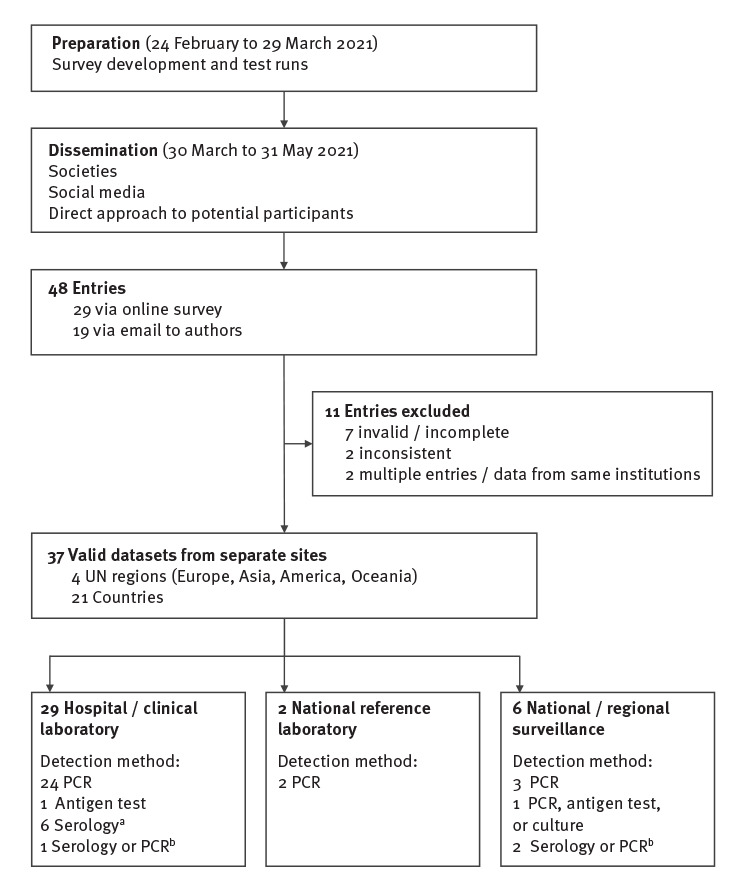
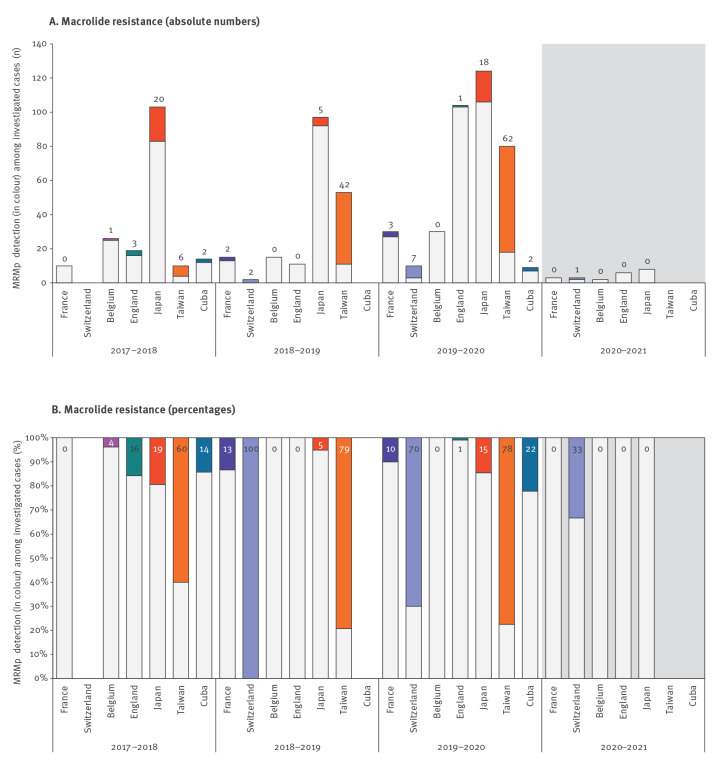
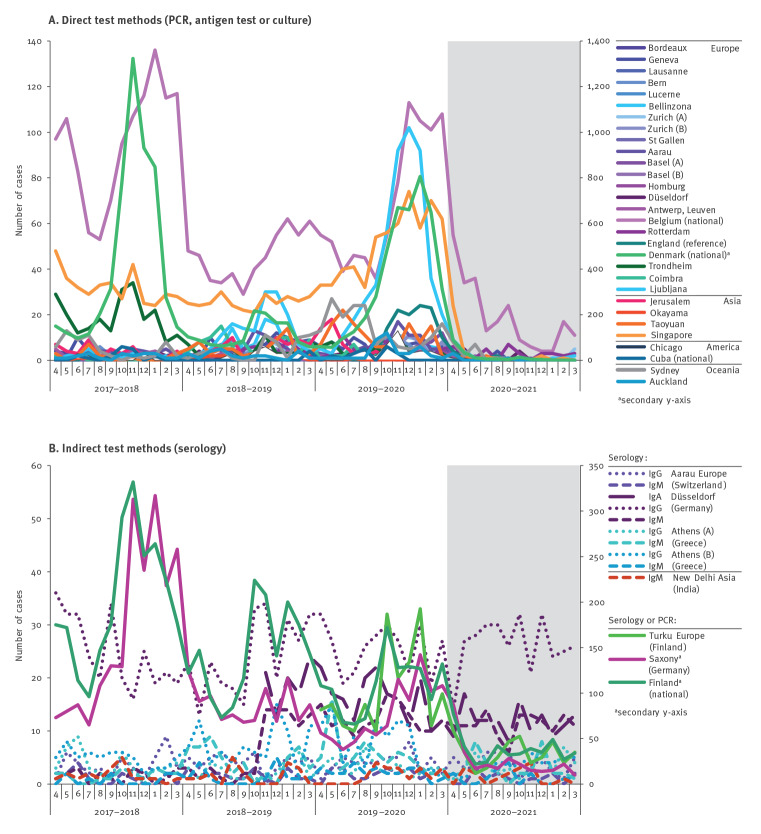
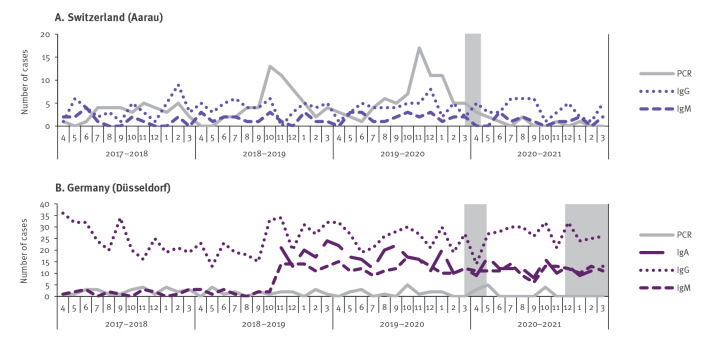
Background respiratory infections are transmitted by aerosol and droplets in close contact.AimWe investigated global incidence after implementation of non-pharmaceutical interventions (NPIs) against COVID-19 in March 2020.MethodsWe surveyed detections from laboratories and surveillance systems (national or regional) across the world from 1 April 2020 to 31 March 2021 and compared them with cases from corresponding months between 2017 and 2020. Macrolide-resistant (MRMp) data were collected from 1 April 2017 to 31 March 2021.ResultsThirty-seven sites from 21 countries in Europe, Asia, America and Oceania submitted valid datasets (631,104 tests). Among the 30,617 detections, 62.39% were based on direct test methods (predominantly PCR), 34.24% on a combination of PCR and serology (no distinction between methods) and 3.37% on serology alone (only IgM considered). In all countries, incidence by direct test methods declined significantly after implementation of NPIs with a mean of 1.69% (SD ± 3.30) compared with 8.61% (SD ± 10.62) in previous years (p < 0.01). Detection rates decreased with direct but not with indirect test methods (serology) (-93.51% vs + 18.08%; p < 0.01). Direct detections remained low worldwide throughout April 2020 to March 2021 despite widely differing lockdown or school closure periods. Seven sites (Europe, Asia and America) reported MRMp detections in one of 22 investigated cases in April 2020 to March 2021 and 176 of 762 (23.10%) in previous years (p = 0.04).ConclusionsThis comprehensive collection of detections worldwide shows correlation between COVID-19 NPIs and significantly reduced detection numbers.
背景呼吸道感染通过密切接触时的飞沫和气溶胶传播。目的我们调查了 2020 年 3 月实施 COVID-19 非药物干预(NPI)后全球的发病率。方法我们调查了 2020 年 4 月 1 日至 2021 年 3 月 31 日期间全球实验室和监测系统(国家或地区)的检测结果,并将其与 2017 年至 2020 年同期的病例进行比较。从 2017 年 4 月 1 日至 2021 年 3 月 31 日收集了大环内酯类耐药(MRMp)数据。结果来自欧洲、亚洲、美洲和大洋洲 21 个国家的 37 个地点提交了有效的数据集(631,104 次检测)。在 30,617 例检测中,62.39%基于直接检测方法(主要为 PCR),34.24%基于 PCR 和血清学的组合(不区分方法),3.37%仅基于血清学(仅考虑 IgM)。在所有国家,实施 NPI 后,直接检测方法的发病率显著下降,平均值为 1.69%(标准差 ± 3.30),而前几年为 8.61%(标准差 ± 10.62)(p<0.01)。检测率随直接检测方法(血清学)而降低(-93.51%对+18.08%;p<0.01)。尽管锁定或学校关闭期有很大差异,但 2020 年 4 月至 2021 年 3 月期间,全球的直接检测结果仍然很低。2020 年 4 月至 2021 年 3 月期间,7 个地点(欧洲、亚洲和美洲)在 22 例调查病例中的 1 例报告了大环内酯类耐药(MRMp)检测结果,而前几年为 762 例中的 176 例(23.10%)(p=0.04)。结论这项全球范围内的检测综合收集表明,COVID-19 的 NPI 与检测数量的显著减少之间存在相关性。