National Center Chalbibelkahia of Pharmacovigilance of Tunis, Laboratory of Clinical Pharmacology, Boulevard 9 Dr Zouhier Essafi, Tunis 1006, Tunisia; University of Tunis El Manar, Faculty of Medicine of Tunis, LR16SP02, 1007 Tunis, Tunisia.
Charles Nicolle Hospital, Laboratory of Microbiology, Virology unit, National Influenza and other Respiratory Viruses Center-Tunisia, Boulevard 9 Avril, Tunis 1006, Tunisia; University of Tunis El Manar, Faculty of Medicine of Tunis, LR99ES09, 1007 Tunis, Tunisia.
Infect Genet Evol. 2022 Aug;102:105300. doi: 10.1016/j.meegid.2022.105300. Epub 2022 May 10.
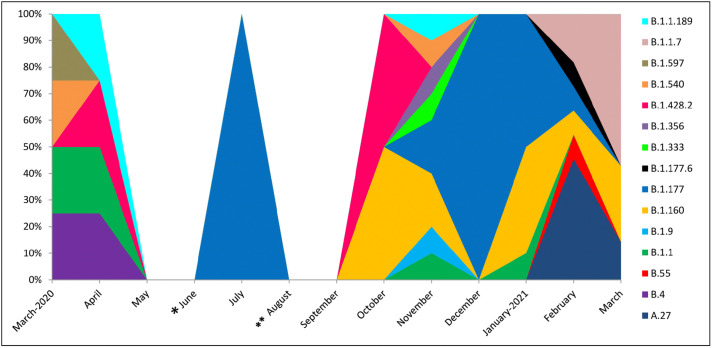
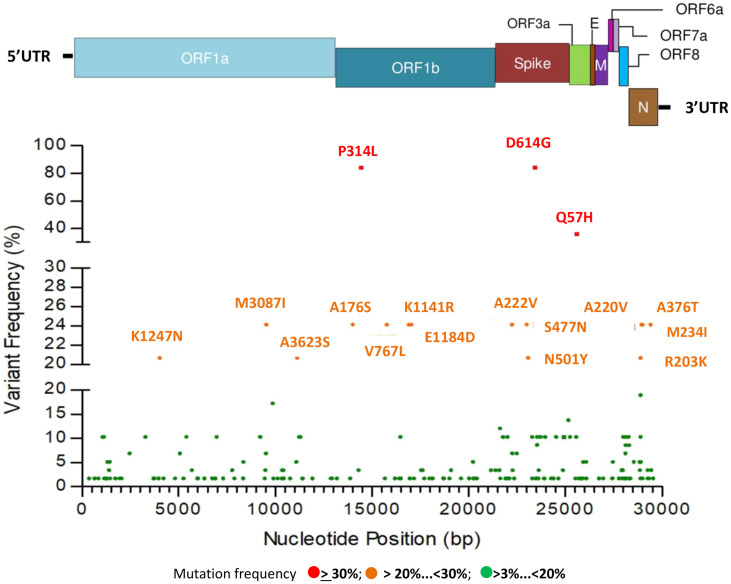
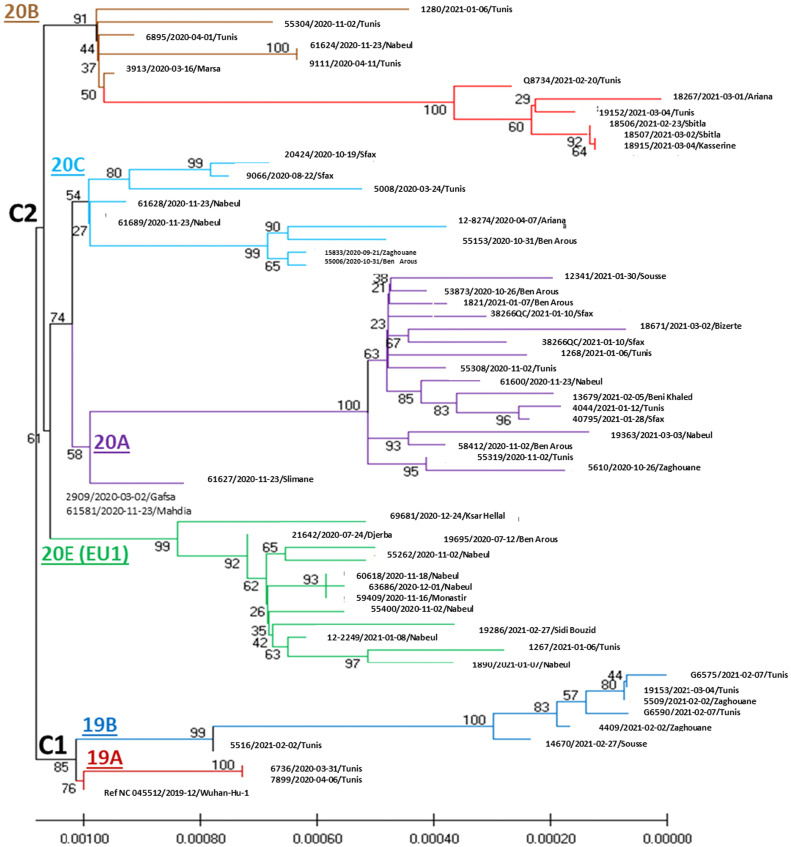
Since the beginning of the Coronavirus disease-2019 pandemic, there has been a growing interest in exploring SARS-CoV-2 genetic variation to understand the origin and spread of the pandemic, improve diagnostic methods and develop the appropriate vaccines. The objective of this study was to identify the SARS-CoV-2s lineages circulating in Tunisia and to explore their amino acid signature in order to follow their genome dynamics. Whole genome sequencing and genetic analyses of fifty-eight SARS-CoV-2 samples collected during one-year between March 2020 and March 2021 from the National Influenza Center were performed using three sampling strategies.. Multiple lineage introductions were noted during the initial phase of the pandemic, including B.4, B.1.1, B.1.428.2, B.1.540 and B.1.1.189. Subsequently, lineages B1.160 (24.2%) and B1.177 (22.4%) were dominant throughout the year. The Alpha variant (B.1.1.7 lineage) was identified in February 2021 and firstly observed in the center of our country. In addition, A clear diversity of lineages was observed in the North of the country. A total of 335 mutations including 10 deletions were found. The SARS-CoV-2 proteins ORF1ab, Spike, ORF3a, and Nucleocapsid were observed as mutation hotspots with a mutation frequency exceeding 20%. The 2 most frequent mutations, D614G in S protein and P314L in Nsp12 appeared simultaneously and are often associated with increased viral infectivity. Interestingly, deletions in coding regions causing consequent deletions of amino acids and frame shifts were identified in NSP3, NSP6, S, E, ORF7a, ORF8 and N proteins. These findings contribute to define the COVID-19 outbreak in Tunisia. Despite the country's limited resources, surveillance of SARS-CoV-2 genomic variation should be continued to control the occurrence of new variants.
自 2019 年冠状病毒病大流行开始以来,人们越来越关注探索 SARS-CoV-2 的遗传变异,以了解大流行的起源和传播,改进诊断方法并开发合适的疫苗。本研究的目的是鉴定在突尼斯流行的 SARS-CoV-2 谱系,并探索其氨基酸特征,以跟踪其基因组动态。使用三种采样策略,对 2020 年 3 月至 2021 年 3 月在国家流感中心收集的 58 份 SARS-CoV-2 样本进行了全基因组测序和遗传分析。在大流行的初始阶段,注意到了多种谱系的传入,包括 B.4、B.1.1、B.1.428.2、B.1.540 和 B.1.1.189。随后,B1.160(24.2%)和 B1.177(22.4%)谱系在整个一年中占主导地位。阿尔法变异株(B.1.1.7 谱系)于 2021 年 2 月被鉴定出来,并首次在我国中心观察到。此外,在该国北部观察到了明显的谱系多样性。发现了总共 335 个突变,包括 10 个缺失。ORF1ab、Spike、ORF3a 和 Nucleocapsid 等 SARS-CoV-2 蛋白被观察为突变热点,突变频率超过 20%。S 蛋白中的 D614G 和 Nsp12 中的 P314L 这两个最常见的突变同时出现,并且经常与病毒感染力增加有关。有趣的是,在 NSP3、NSP6、S、E、ORF7a、ORF8 和 N 蛋白中发现了导致氨基酸缺失和框架移位的编码区缺失。这些发现有助于确定突尼斯的 COVID-19 爆发。尽管该国资源有限,但仍应继续监测 SARS-CoV-2 基因组变异,以控制新变体的发生。