Laboratório de Ciências e Tecnologias Aplicadas Em Saúde, Instituto Carlos Chagas, FIOCRUZ, Curitiba, Paraná, Brazil.
Laboratório de Biologia Básica de Células Tronco, Instituto Carlos Chagas, FIOCRUZ, Curitiba, Paraná, Brazil.
Virol J. 2021 Nov 17;18(1):222. doi: 10.1186/s12985-021-01690-1.
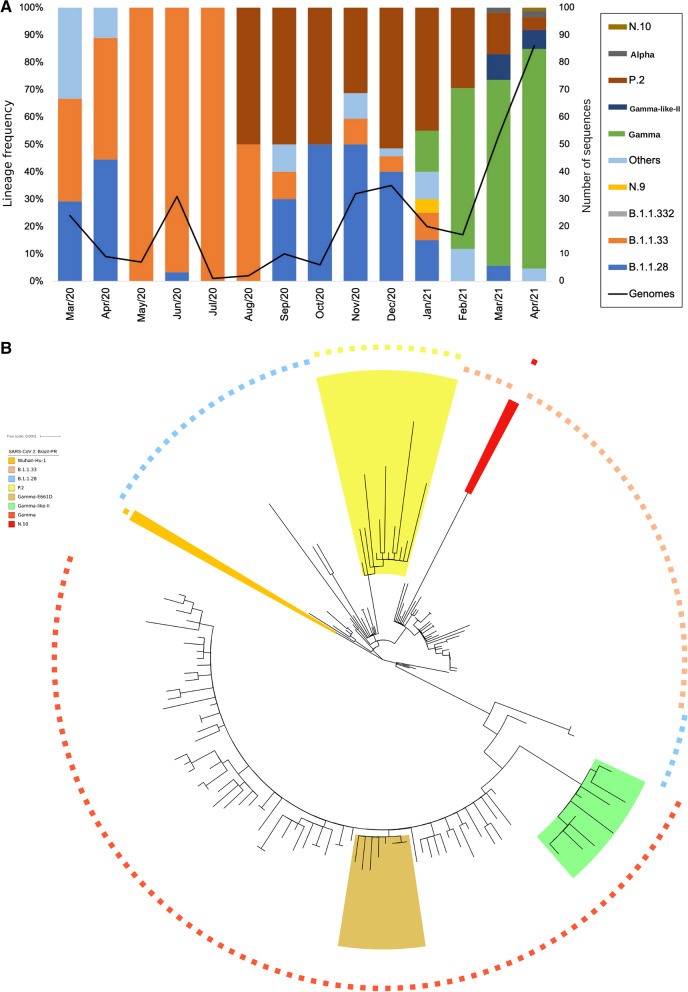
We report a genomic surveillance of SARS-CoV-2 lineages circulating in Paraná, southern Brazil, from March 2020 to April 2021. Our analysis, based on 333 genomes, revealed that the first variants detected in the state of Paraná in March 2020 were the B.1.1.33 and B.1.1.28 variants. The variants B.1.1.28 and B.1.1.33 were predominant throughout 2020 until the introduction of the variant P.2 in August 2020 and a variant of concern (VOC), Gamma (P.1), in January 2021. The VOC Gamma, a ramification of the B.1.1.28 lineage first detected in Manaus (northern Brazil), has grown rapidly since December 2020 and was thought to be responsible for the deadly second wave of COVID-19 throughout Brazil.
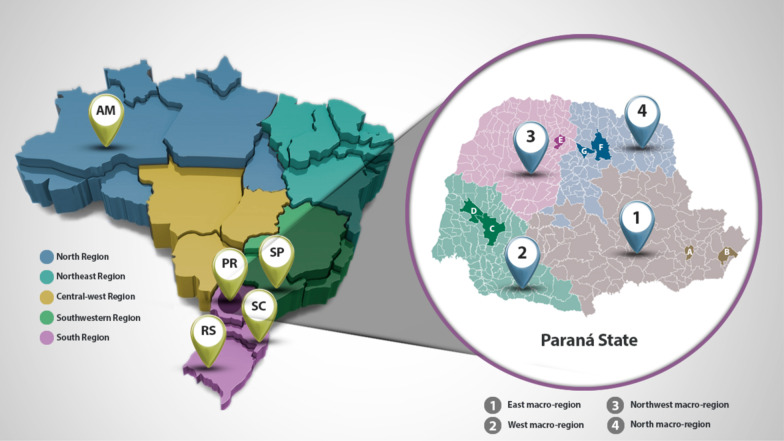
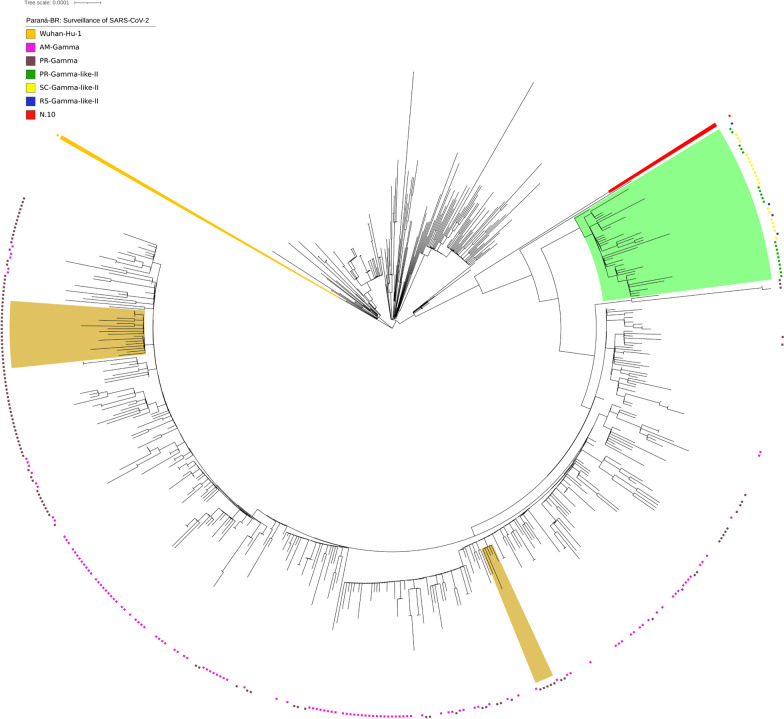
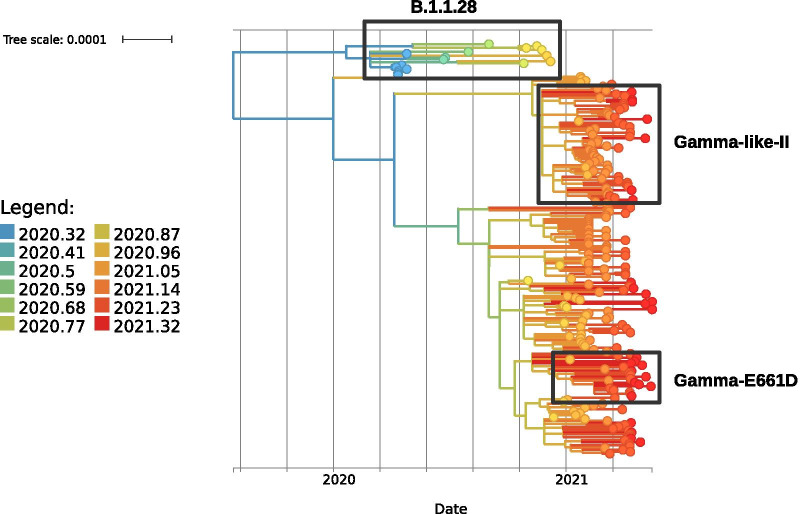
The 333 genomic sequences of SARS-CoV-2 from March 2020 to April 2021 were generated as part of the genomic surveillance carried out by Fiocruz in Brazil Genomahcov Fiocruz. SARS-CoV-2 sequencing was performed using representative samples from all geographic areas of Paraná. Phylogenetic analyses were performed using the 333 genomes also included other SARS-CoV-2 genomes from the state of Paraná and other states in Brazil that were deposited in the GISAID. In addition, the time-scaled phylogenetic tree was constructed with up to 3 random sequences of the Gamma variant from each state in Brazil in each month of 2021. In this analysis we also added the sequences identified as the B.1.1.28 lineage of the Amazonas state and and the Gamma-like-II (P.1-like-II) lineage identified in different regions of Brazil.
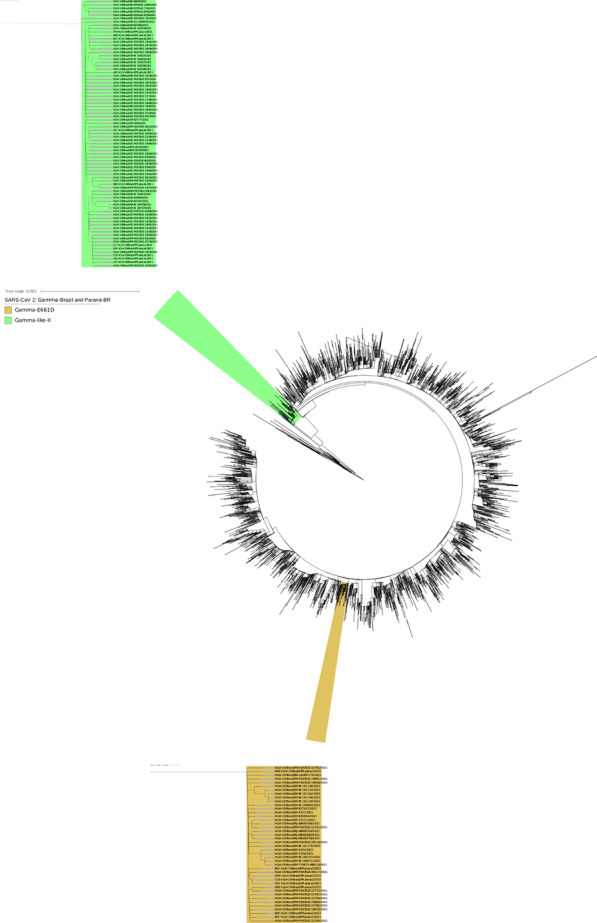
Phylogenetic analyses of the SARS-CoV-2 genomes that were previously classified as the VOC Gamma lineage by WHO/PANGO showed that some genomes from February to April 2021 branched in a monophyletic clade and that these samples grouped together with genomes recently described with the lineage Gamma-like-II. Additionally, a new mutation (E661D) in the spike (S) protein has been identified in nearly 10% of the genomes classified as the VOC Gamma from Paraná in March and April 2021.Finally, we analyzed the correlation between the lineage and the Gamma variant frequency, age group (patients younger or older than 60 years old) and the clinical data of 86 cases from the state of Paraná.
Our results provided a reliable picture of the evolution of the SARS-CoV-2 pandemic in the state of Paraná characterized by the dominance of the Gamma strain, as well as a high frequencies of the Gamma-like-II lineage and the S:E661D mutation. Epidemiological and genomic surveillance efforts should be continued to unveil the biological relevance of the novel mutations detected in the VOC Gamma in Paraná.
我们报告了 2020 年 3 月至 2021 年 4 月期间在巴西南部巴拉那州流行的 SARS-CoV-2 谱系的基因组监测情况。我们的分析基于 333 个基因组,结果显示 2020 年 3 月在巴拉那州检测到的第一批变体是 B.1.1.33 和 B.1.1.28 变体。变体 B.1.1.28 和 B.1.1.33 在 2020 年全年占主导地位,直到 2020 年 8 月引入变体 P.2 和 2021 年 1 月的关注变体(VOC)Gamma(P.1)。VOC Gamma 是在巴西北部马瑙斯首次检测到的 B.1.1.28 谱系的一个分支,自 2020 年 12 月以来迅速增长,被认为是巴西 COVID-19 第二波致命疫情的罪魁祸首。
2020 年 3 月至 2021 年 4 月期间的 333 个 SARS-CoV-2 基因组序列是由 Fiocruz 在巴西进行的基因组监测计划中生成的,该计划名为巴西基因组学 Fiocruz。使用来自巴拉那州所有地理区域的代表性样本进行 SARS-CoV-2 测序。使用包括来自巴拉那州和巴西其他州的其他 SARS-CoV-2 基因组的 333 个基因组进行系统发育分析,并在 GISAID 中进行了基因库注册。此外,还构建了包含巴西各州 2021 年每个月每个州随机选择的 3 个 Gamma 变体序列的时间尺度系统发育树。在这项分析中,我们还添加了来自亚马逊州被归类为 B.1.1.28 谱系的序列以及在巴西不同地区发现的 Gamma-like-II(P.1-like-II)谱系的序列。
先前被世界卫生组织/ pangolin 归类为 VOC Gamma 谱系的 SARS-CoV-2 基因组的系统发育分析表明,2021 年 2 月至 4 月的一些基因组在一个单系分支中分支,这些样本与最近描述的带有 Gamma-like-II 谱系的基因组聚集在一起。此外,在 2021 年 3 月和 4 月被归类为巴拉那州 VOC Gamma 的近 10%的基因组中发现了刺突(S)蛋白中的一个新突变(E661D)。最后,我们分析了谱系与 Gamma 变体频率、年龄组(60 岁以下或以上的患者)以及来自巴拉那州的 86 例病例的临床数据之间的相关性。
我们的研究结果提供了巴拉那州 SARS-CoV-2 大流行演变的可靠情况,其特征是 Gamma 菌株占主导地位,以及 Gamma-like-II 谱系和 S:E661D 突变的高频。应继续进行流行病学和基因组监测,以揭示在巴拉那州 VOC Gamma 中检测到的新突变的生物学意义。