De Gregori Simona, Falaschi Francesco, Ballesio Alessia, Fusco Alessandra, Cremonte Elisa, Canta Roberta, Sabatini Umberto, Molinaro Mariadelfina, Soffiantini Carlo, Nardone Alba, Vicentini Alessandro, De Silvestri Annalisa, Di Sabatino Antonio
Clinical and Experimental Pharmacokinetics Unit, Fondazione IRCCS Policlinico San Matteo, Pavia, Italy.
Internal Medicine 2, Fondazione I.R.C.C.S. Policlinico San Matteo, Pavia, Italy.
Drugs R D. 2022 Jun;22(2):155-163. doi: 10.1007/s40268-022-00387-2. Epub 2022 May 13.
Hydroxychloroquine was widely used during the severe acute respiratory syndrome coronavirus 2 pandemic as an antiviral drug. Most previous pharmacokinetic/pharmacodynamic studies on hydroxychloroquine were conducted on healthy volunteers or patients receiving long-term therapy. There are no studies on the elimination of hydroxychloroquine after short-term treatments. Hydroxychloroquine is known to have a pro-arrhythmic effect through QT interval prolongation, but data in this setting are not conclusive. Our aims were to estimate the time needed for hydroxychloroquine concentrations (C) to drop to a safe concentration (500 ng/mL) after a short-term therapeutic cycle and to correlate the corrected QT interval with C.
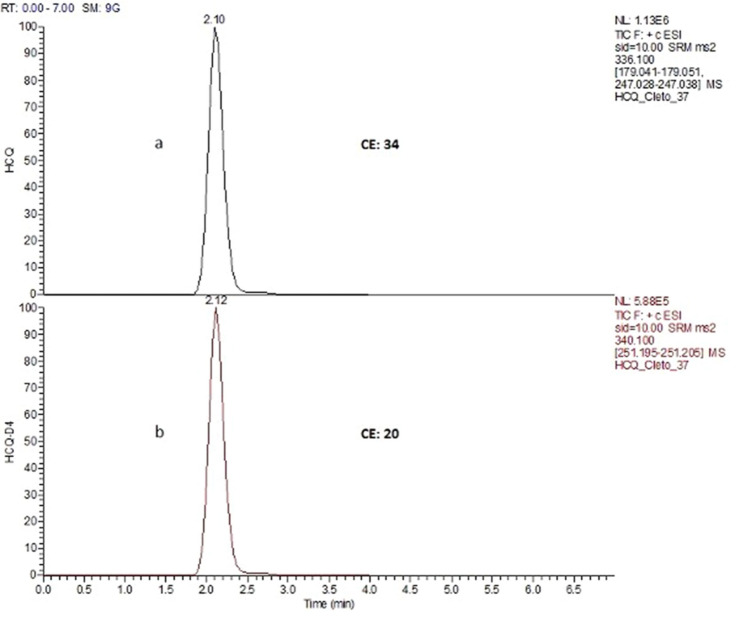
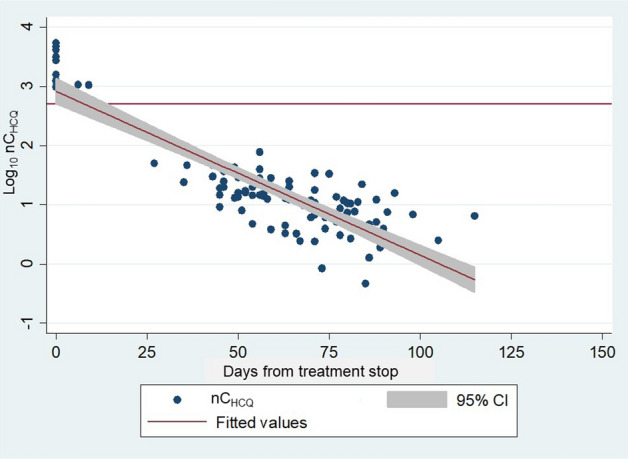
We collected blood samples and electrocardiograms of patients who underwent short-term therapy with hydroxychloroquine during drug intake and after discontinuation. Hydroxychloroquine concentrations were determined by high-performance liquid chromatography-tandem mass spectrometry and analysed with a linear regression model to estimate the elimination time of the drug after its discontinuation. We conducted a multivariate analysis of the corrected QT interval correlation with C.
Our data suggest that short-term hydroxychloroquine courses can generate significant C persisting above 500 ng/mL up to 16 days after discontinuation of treatment. Corrected QT interval prolongation significantly correlates with C.
The study confirms the long half-life of hydroxychloroquine and its effect on the corrected QT interval even after short-term courses of the drug. This can inform the clinician using hydroxychloroquine treatments that it would be safer to start or re-initiate treatments with corrected QT interval-prolonging potential 16 days after hydroxychloroquine discontinuation.
在严重急性呼吸综合征冠状病毒2大流行期间,羟氯喹作为一种抗病毒药物被广泛使用。此前大多数关于羟氯喹的药代动力学/药效学研究是在健康志愿者或接受长期治疗的患者中进行的。目前尚无关于短期治疗后羟氯喹消除情况的研究。已知羟氯喹可通过延长QT间期产生促心律失常作用,但这方面的数据尚无定论。我们的目的是估计短期治疗周期后羟氯喹浓度(C)降至安全浓度(500 ng/mL)所需的时间,并将校正QT间期与C进行关联。
我们收集了在服用羟氯喹期间及停药后接受短期治疗的患者的血样和心电图。通过高效液相色谱-串联质谱法测定羟氯喹浓度,并采用线性回归模型进行分析,以估计停药后药物的消除时间。我们对校正QT间期与C的相关性进行了多变量分析。
我们的数据表明,短期服用羟氯喹疗程可使血药浓度在停药后长达16天内持续显著高于500 ng/mL。校正QT间期延长与C显著相关。
该研究证实了羟氯喹的半衰期较长,即使在短期用药后其对校正QT间期仍有影响。这可以告知使用羟氯喹治疗的临床医生,在羟氯喹停药16天后开始或重新开始具有延长校正QT间期潜在风险的治疗可能更安全。