Netherlands Institute for Neuroscience, Department of Sleep and Cognition, Amsterdam, The Netherlands.
Department of Integrative Neurophysiology, Center for Neurogenomics and Cognitive Research, Amsterdam Neuroscience, VU University, Amsterdam, The Netherlands.
Sleep. 2022 May 12;45(5). doi: 10.1093/sleep/zsac031. Epub 2022 Mar 31.
The objective assessment of insomnia has remained difficult. Multisensory devices collecting heart rate (HR) and motion are regarded as the future of ambulatory sleep monitoring. Unfortunately, reports on altered average HR or heart rate variability (HRV) during sleep in insomnia are equivocal. Here, we evaluated whether the objective quantification of insomnia improves by assessing state-related changes in cardiac measures.
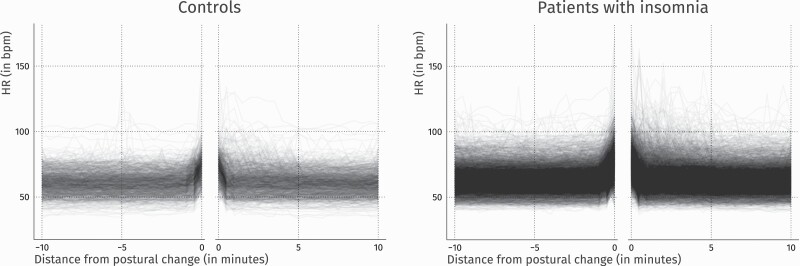
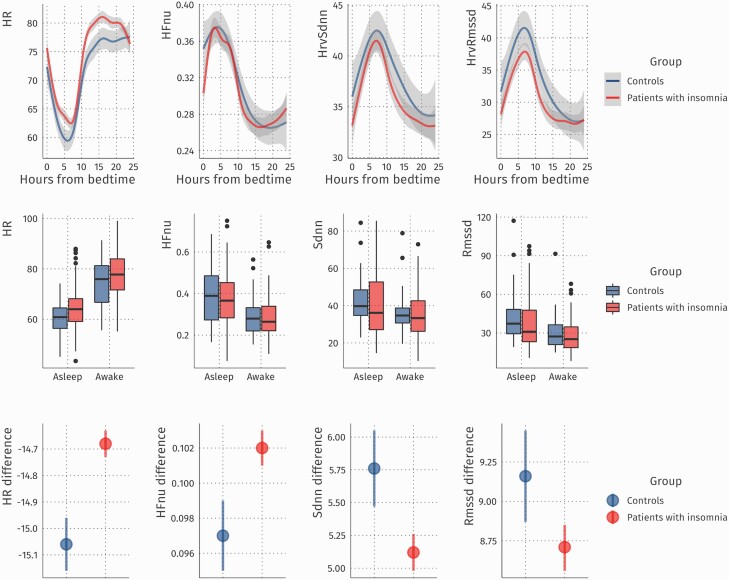
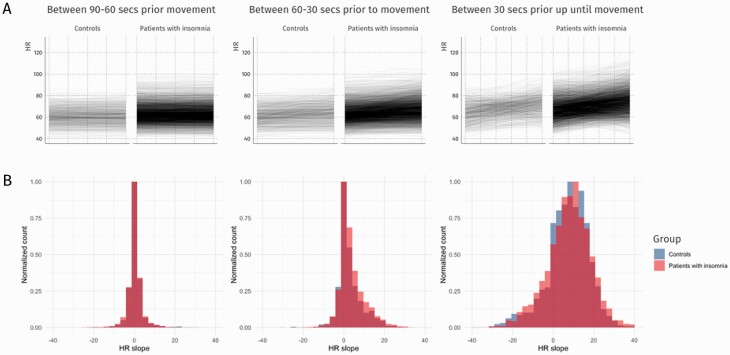
We recorded electrocardiography, posture, and actigraphy in 33 people without sleep complaints and 158 patients with mild to severe insomnia over 4 d in their home environment. At the microscale, we investigated whether HR changed with proximity to gross (body) and small (wrist) movements at nighttime. At the macroscale, we calculated day-night differences in HR and HRV measures. For both timescales, we tested whether outcome measures were related to insomnia diagnosis and severity.
At the microscale, an increase in HR was often detectable already 60 s prior to as well as following a nocturnal chest, but not wrist, movement. This increase was slightly steeper in insomnia and was associated with insomnia severity, but future EEG recordings are necessary to elucidate whether these changes occur prior to or simultaneously with PSG-indicators of wakefulness. At the macroscale, we found an attenuated cardiac response to sleep in insomnia: patients consistently showed smaller day-night differences in HR and HRV.
Incorporating state-related changes in cardiac features in the ambulatory monitoring of sleep might provide a more sensitive biomarker of insomnia than the use of cardiac activity averages or actigraphy alone.
对失眠的客观评估一直很困难。收集心率(HR)和运动的多感觉设备被认为是动态睡眠监测的未来。不幸的是,关于失眠期间平均 HR 或心率变异性(HRV)改变的报告尚无定论。在这里,我们评估了通过评估与心脏测量相关的状态变化,是否可以改善对失眠的客观量化。
我们在 4 天的时间里,在他们的家庭环境中,记录了 33 名无睡眠问题的人和 158 名轻度至重度失眠患者的心电图、姿势和活动。在微观尺度上,我们研究了 HR 是否随夜间身体(身体)和手腕(手腕)运动的接近而变化。在宏观尺度上,我们计算了 HR 和 HRV 措施的昼夜差异。对于这两个时间尺度,我们都测试了结果指标是否与失眠诊断和严重程度有关。
在微观尺度上,经常可以在夜间胸部运动之前和之后的 60 秒内检测到 HR 的增加,但手腕运动除外。在失眠症中,这种增加略微陡峭,并与失眠症的严重程度相关,但未来的 EEG 记录对于阐明这些变化是在 PSG 指示的清醒之前还是同时发生是必要的。在宏观尺度上,我们发现失眠症患者的睡眠心脏反应减弱:患者的 HR 和 HRV 的昼夜差异始终较小。
在睡眠的动态监测中纳入与心脏特征相关的状态变化可能比单独使用心脏活动平均值或活动监测提供更敏感的失眠生物标志物。