Kato Takehiro, Lim Bumhee, Cheng Yangyang, Pham Anh-Tuan, Maynard John, Moreau Dimitri, Poblador-Bahamonde Amalia I, Sakai Naomi, Matile Stefan
Department of Organic Chemistry, University of Geneva, 1211 Geneva, Switzerland.
JACS Au. 2022 Mar 22;2(4):839-852. doi: 10.1021/jacsau.1c00573. eCollection 2022 Apr 25.
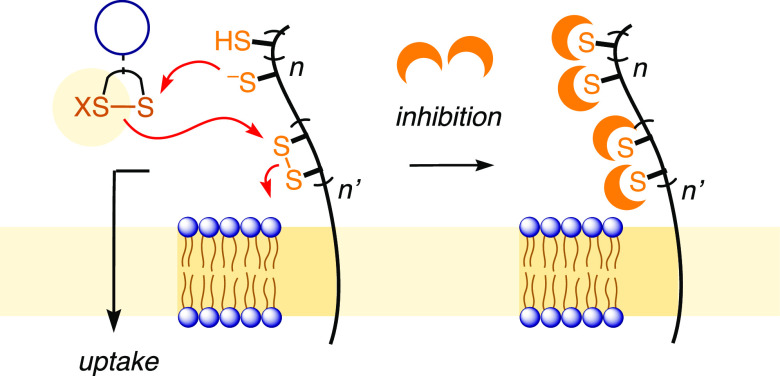
Thiol-mediated uptake is emerging as a powerful method to penetrate cells. Cyclic oligochalcogenides (COCs) have been identified as privileged scaffolds to enable and inhibit thiol-mediated uptake because they can act as dynamic covalent cascade exchangers, i.e., every exchange produces a new, covalently tethered exchanger. In this study, our focus is on the essentially unexplored COCs of higher oxidation levels. Quantitative characterization of the underlying dynamic covalent exchange cascades reveals that the initial ring opening of cyclic thiosulfonates (CTOs) proceeds at a high speed even at a low pH. The released sulfinates exchange with disulfides in aprotic but much less in protic environments. Hydrophobic domains were thus introduced to direct CTOs into hydrophobic pockets to enhance their reactivity. Equipped with such directing groups, fluorescently labeled CTOs entered the cytosol of living cells more efficiently than the popular asparagusic acid. Added as competitive agents, CTOs inhibit the uptake of various COC transporters and SARS-CoV-2 lentivectors. Orthogonal trends found with different transporters support the existence of multiple cellular partners to account for the diverse expressions of thiol-mediated uptake. Dominant self-inhibition and high activity of dimers imply selective and synergistic exchange in hydrophobic pockets as distinguishing characteristics of thiol-mediated uptake with CTOs. The best CTO dimers with hydrophobic directing groups inhibit the cellular entry of SARS-CoV-2 lentivectors with an IC significantly lower than the previous best CTO, below the 10 μM threshold and better than ebselen. Taken together, these results identify CTOs as an intriguing motif for use in cytosolic delivery, as inhibitors of lentivector entry, and for the evolution of dynamic covalent networks in the broadest sense, with reactivity-based selectivity of cascade exchange emerging as a distinguishing characteristic that deserves further attention.
硫醇介导的摄取正成为一种强大的细胞穿透方法。环状低聚硫属化物(COCs)已被确定为实现和抑制硫醇介导摄取的特殊支架,因为它们可以作为动态共价级联交换剂,即每次交换都会产生一个新的、共价连接的交换剂。在本研究中,我们关注的是氧化水平较高且基本未被探索的COCs。对潜在的动态共价交换级联的定量表征表明,即使在低pH值下,环状硫代磺酸盐(CTOs)的初始开环也能快速进行。释放的亚磺酸盐在非质子环境中与二硫化物交换,但在质子环境中交换较少。因此引入疏水结构域以将CTOs引导至疏水口袋中,从而增强其反应性。配备了此类导向基团后,荧光标记的CTOs进入活细胞胞质溶胶的效率比常用的天冬氨酸更高。作为竞争剂添加时,CTOs会抑制各种COC转运体和严重急性呼吸综合征冠状病毒2(SARS-CoV-2)慢病毒载体的摄取。在不同转运体中发现的正交趋势支持存在多个细胞伴侣,以解释硫醇介导摄取的多种表现形式。二聚体的主要自我抑制和高活性意味着在疏水口袋中的选择性和协同交换是CTOs介导的硫醇摄取的显著特征。具有疏水导向基团的最佳CTO二聚体抑制SARS-CoV-2慢病毒载体进入细胞的半数抑制浓度(IC)显著低于之前最佳的CTO,低于10 μM阈值且优于依布硒仑。综上所述,这些结果表明CTOs是一种有趣的基序,可用于胞质递送、作为慢病毒载体进入的抑制剂,以及在最广泛意义上用于动态共价网络的进化,基于反应性的级联交换选择性成为一个值得进一步关注的显著特征。