Bagde Saket R, Fromme J Christopher
Department of Molecular Biology and Genetics and Weill Institute for Cell and Molecular Biology, Cornell University, Ithaca, NY 14853, USA.
Sci Adv. 2022 May 13;8(19):eabn7446. doi: 10.1126/sciadv.abn7446.
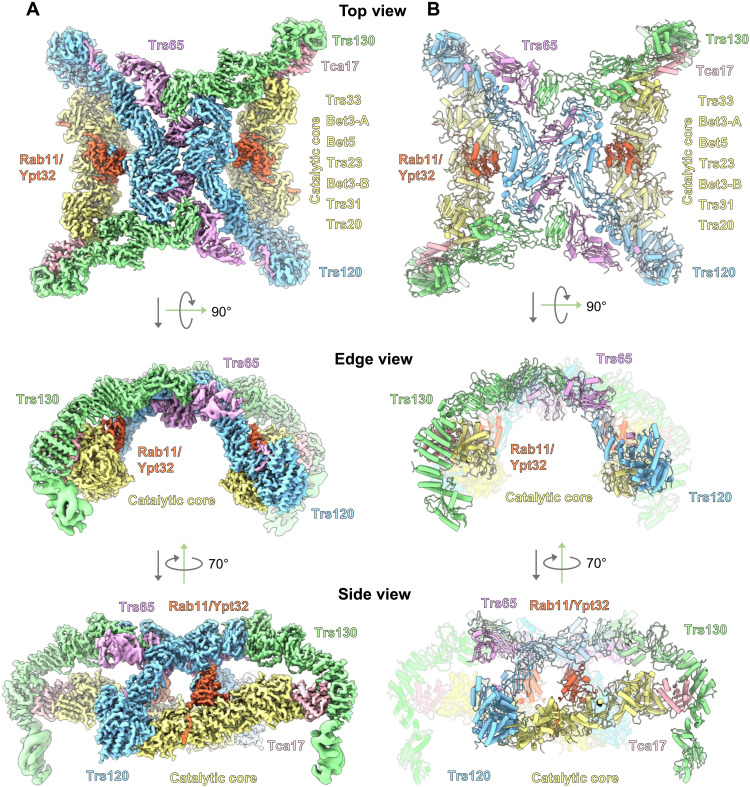
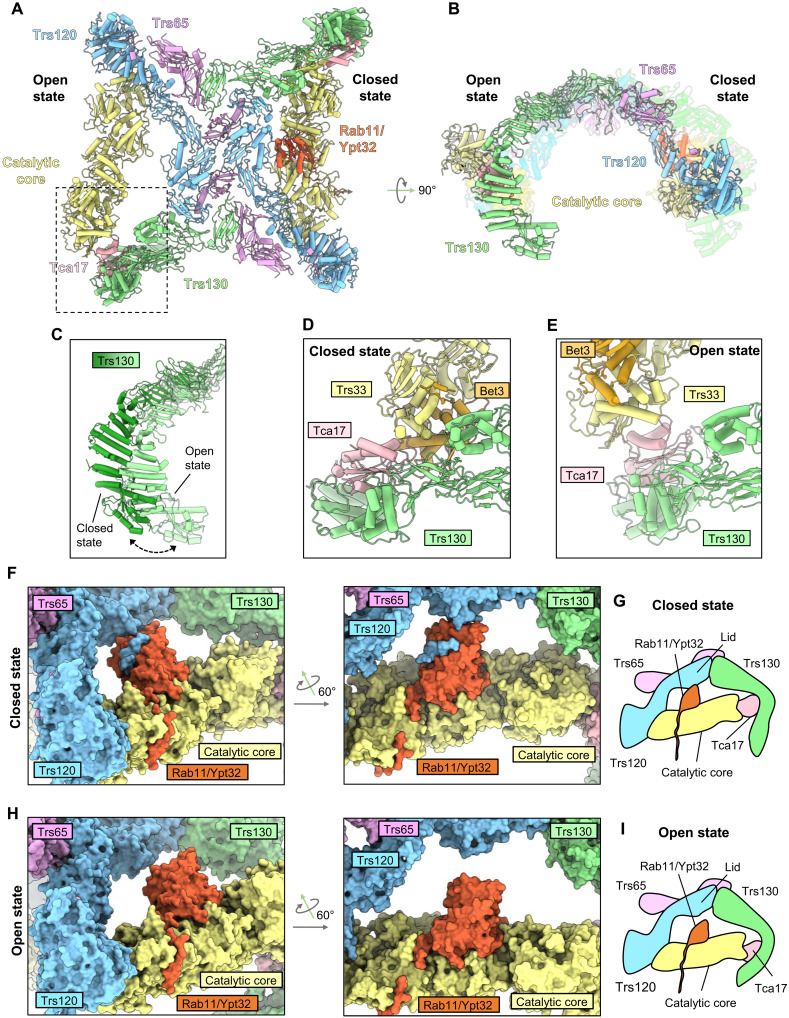
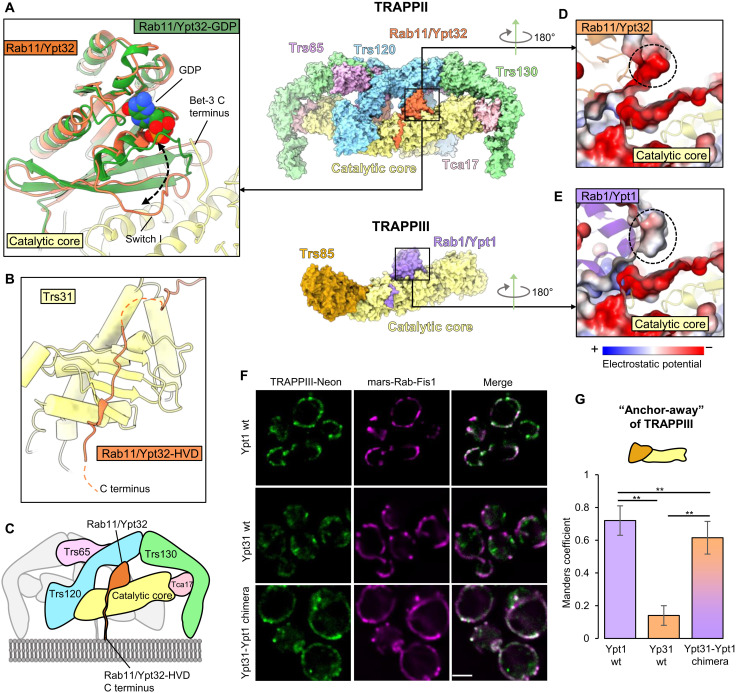
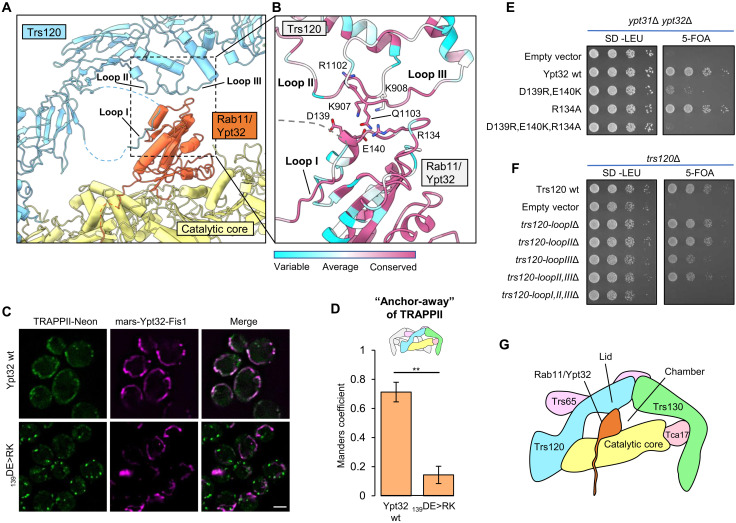
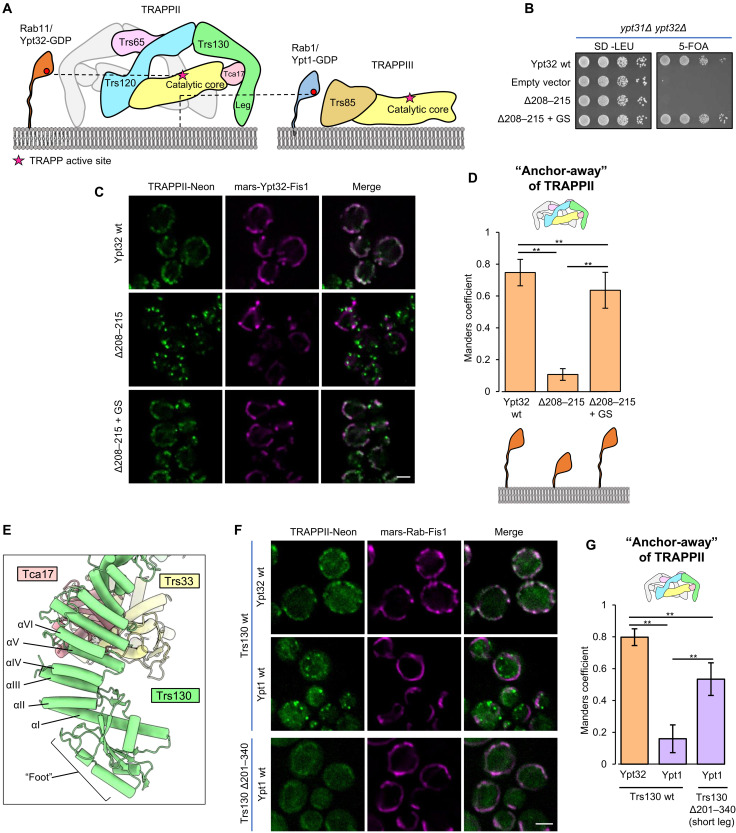
Rab1 and Rab11 are essential regulators of the eukaryotic secretory and endocytic recycling pathways. The transport protein particle (TRAPP) complexes activate these guanosine triphosphatases via nucleotide exchange using a shared set of core subunits. The basal specificity of the TRAPP core is toward Rab1, yet the TRAPPII complex is specific for Rab11. A steric gating mechanism has been proposed to explain TRAPPII counterselection against Rab1. Here, we present cryo-electron microscopy structures of the 22-subunit TRAPPII complex from budding yeast, including a TRAPPII-Rab11 nucleotide exchange intermediate. The Trs130 subunit provides a "leg" that positions the active site distal to the membrane surface, and this leg is required for steric gating. The related TRAPPIII complex is unable to activate Rab11 because of a repulsive interaction, which TRAPPII surmounts using the Trs120 subunit as a "lid" to enclose the active site. TRAPPII also adopts an open conformation enabling Rab11 to access and exit from the active site chamber.
Rab1和Rab11是真核生物分泌和内吞再循环途径的重要调节因子。转运蛋白颗粒(TRAPP)复合物通过使用一组共享的核心亚基进行核苷酸交换来激活这些鸟苷三磷酸酶。TRAPP核心的基础特异性针对Rab1,而TRAPPII复合物对Rab11具有特异性。有人提出一种空间门控机制来解释TRAPPII对Rab1的反选择。在这里,我们展示了来自芽殖酵母的22亚基TRAPPII复合物的冷冻电子显微镜结构,包括一个TRAPPII-Rab11核苷酸交换中间体。Trs130亚基提供了一条“腿”,将活性位点定位在远离膜表面的位置,并且这条腿是空间门控所必需的。相关的TRAPPIII复合物由于排斥相互作用而无法激活Rab11,TRAPPII利用Trs120亚基作为“盖子”来封闭活性位点从而克服了这种排斥作用。TRAPPII还采用开放构象,使Rab11能够进入和离开活性位点腔室。