Placental Development Group, Department of Obstetrics and Gynaecology, Reproductive Biology Unit, Medical University of Vienna, Währinger Gürtel 18-20, 5Q, 1090, Vienna, Austria.
Maternal-Fetal Immunology Group, Department of Obstetrics and Gynaecology, Reproductive Biology Unit, Medical University of Vienna, Währinger Gürtel 18-20, 5Q, 1090, Vienna, Austria.
Cell Mol Life Sci. 2022 May 13;79(6):292. doi: 10.1007/s00018-022-04285-3.
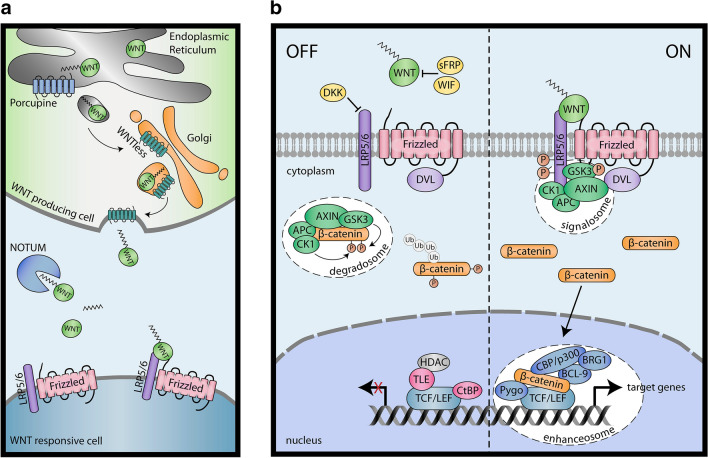
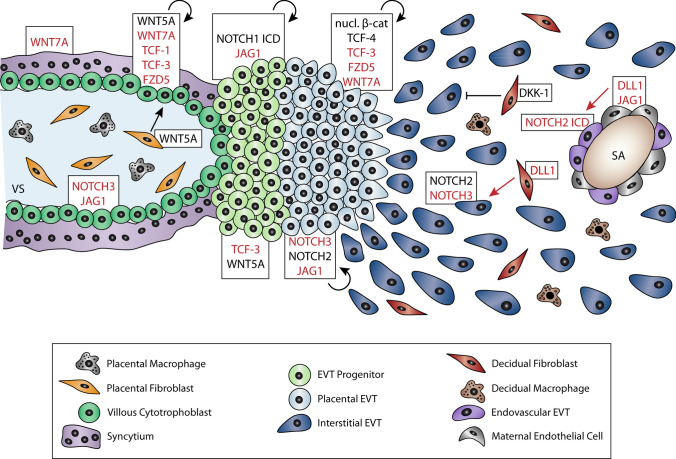
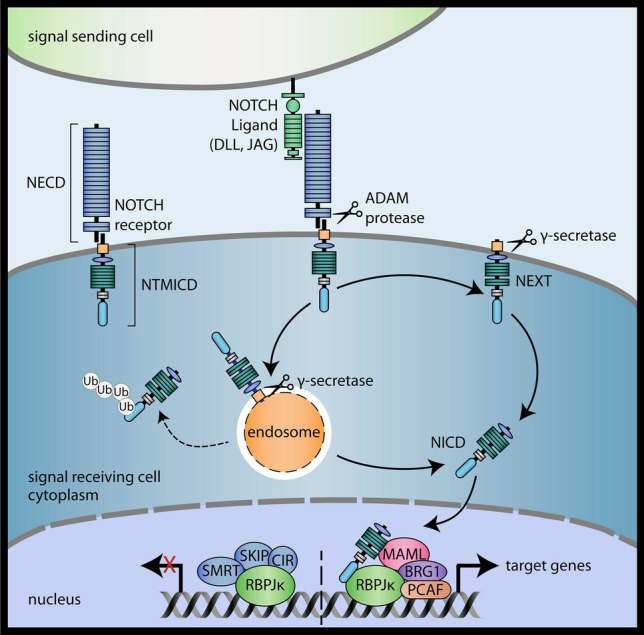
Correct development of the human placenta and its differentiated epithelial cells, syncytial trophoblasts (STBs) and extravillous trophoblasts (EVTs), is crucial for a successful pregnancy outcome. STBs develop by cell fusion of mononuclear cytotrophoblasts (CTBs) in placental floating villi, whereas migratory EVTs originate from specialized villi anchoring to the maternal decidua. Defects in trophoblast differentiation have been associated with severe pregnancy disorders such as early-onset preeclampsia and fetal growth restriction. However, the evolutionary pathways underlying normal and adverse placentation are poorly understood. Herein, we discuss Wingless (WNT) and NOTCH signaling, two pathways that play pivotal roles in human placenta and trophoblast development. Whereas WNT is necessary for expansion of trophoblast progenitors and stem cells, NOTCH1 is required for proliferation and survival of EVT precursors. Differentiation of the latter is orchestrated by a switch in NOTCH receptor expression as well as by changes in WNT ligands and their downstream effectors.
人类胎盘及其分化的上皮细胞、合体滋养层(STB)和绒毛外滋养层(EVT)的正常发育对于成功的妊娠结局至关重要。STB 通过胎盘浮膜中单核细胞滋养层(CTB)的细胞融合发育而成,而迁移的 EVT 则起源于专门锚定于母体蜕膜的绒毛。滋养层分化缺陷与严重的妊娠疾病有关,如早发型子痫前期和胎儿生长受限。然而,正常和不良胎盘形成的进化途径尚不清楚。本文讨论了 WNT 和 NOTCH 信号通路,这两个通路在人类胎盘和滋养层发育中发挥着关键作用。WNT 对于滋养层祖细胞和干细胞的扩增是必需的,而 NOTCH1 对于 EVT 前体的增殖和存活是必需的。后者的分化由 NOTCH 受体表达的转变以及 WNT 配体及其下游效应物的变化来协调。