Department of Microbiology and Parasitology, University of Buea, P. O. Box 63, Buea, Cameroon.
Biotechnology Unit, Faculty of Science, University of Buea, P.O. Box 63, Buea, South West Region, Cameroon.
BMC Infect Dis. 2022 May 13;22(1):461. doi: 10.1186/s12879-022-07445-9.
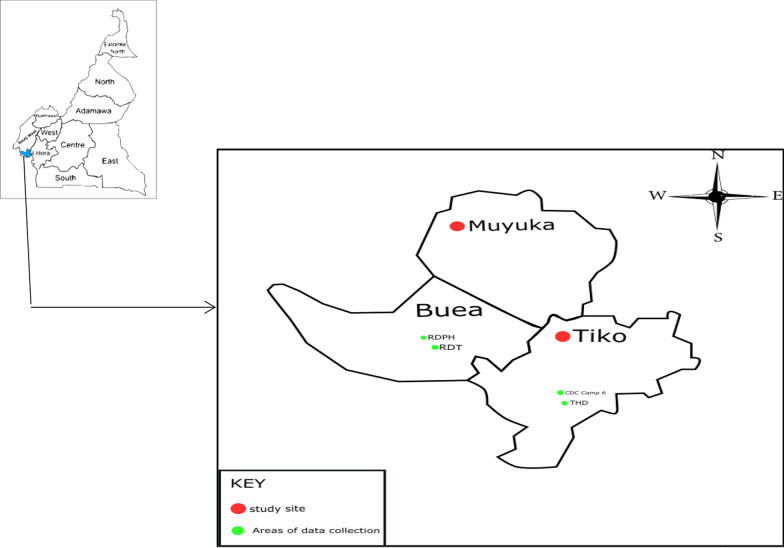
Weather fluctuation affects the incidence of malaria through a network of causuative pathays. Globally, human activities have ultered weather conditions over time, and consequently the number of malaria cases. This study aimed at determining the influence of humidity, temperature and rainfall on malaria incidence in an inland (Muyuka) and a coastal (Tiko) settings for a period of seven years (2011-2017) as well as predict the number of malaria cases two years after (2018 and 2019).
Malaria data for Muyuka Health District (MHD) and Tiko Health District (THD) were obtained from the Regional Delegation of Public Health and Tiko District Health service respectively. Climate data for MHD was obtained from the Regional Delegation of Transport while that of THD was gotten from Cameroon Development Coorporation. Spearman rank correlation was used to investigate the relationship between number of malaria cases and the weather variables and the simple seasonal model was used to forecast the number of malaria cases for 2018 and 2019.
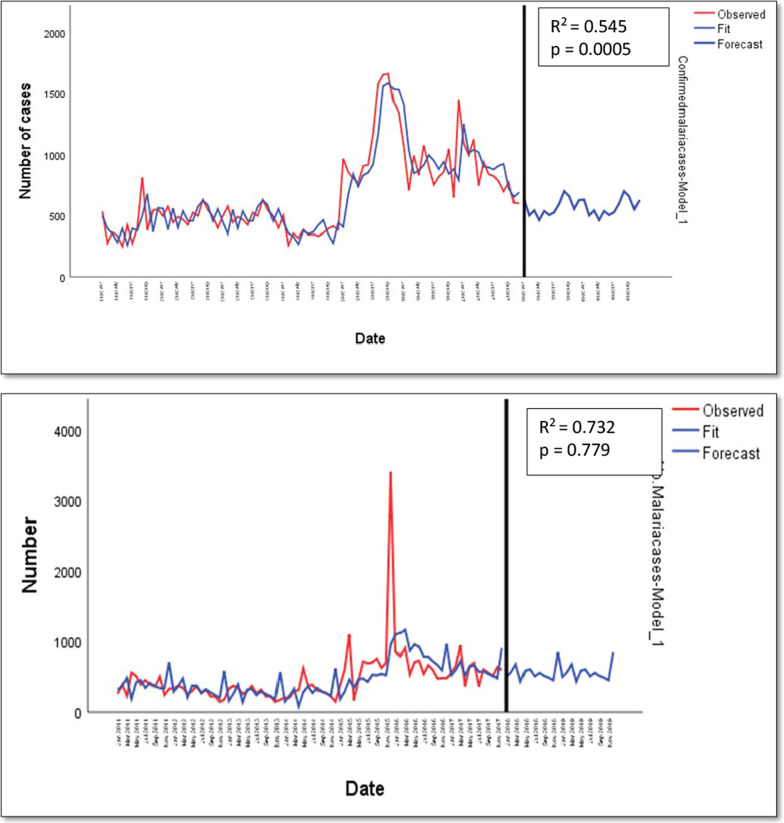
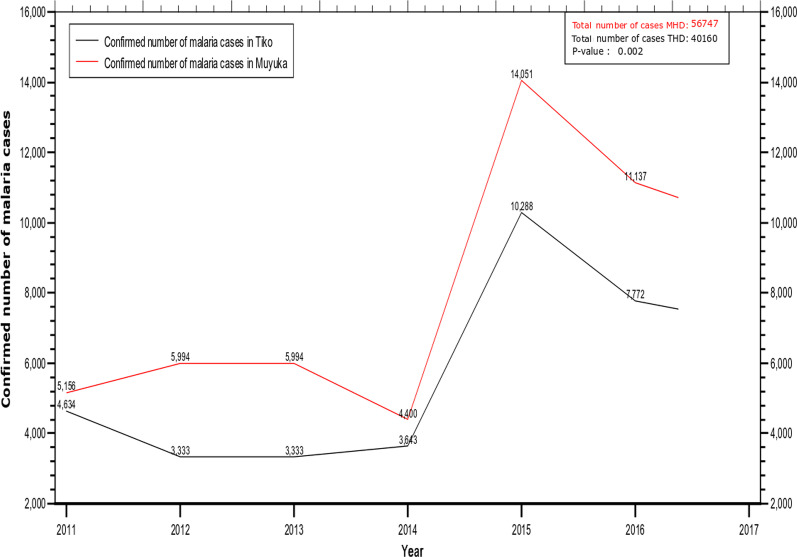
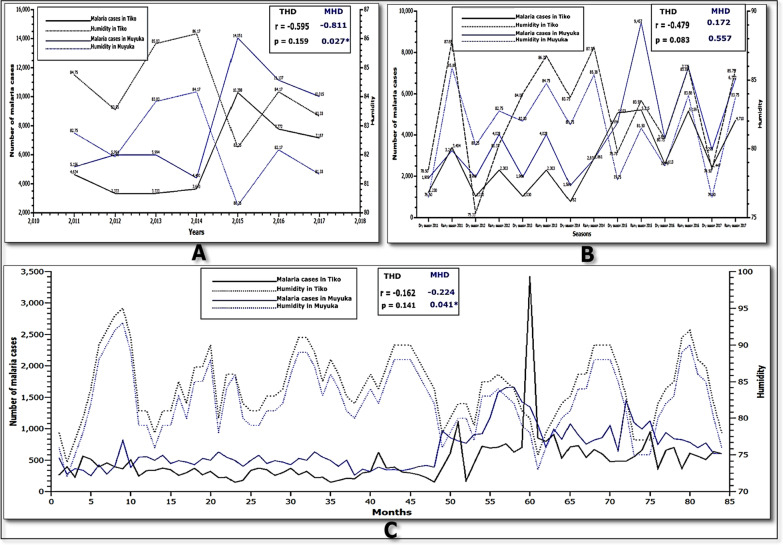
The mean monthly rainfall, temperature and relative humidity for MHD were 200.38 mm, 27.05C, 82.35% and THD were 207.36 mm, 27.57 °C and 84.32% respectively, with a total number of malaria cases of 56,745 and 40,160. In MHD, mean yearly humidity strongly correlated negatively with number of malaria cases (r = - 0.811, p = 0.027) but in THD, a moderate negative yearly correlation was observed (r = - 0.595, p = 0.159). In THD, the mean seasonal temperature moderately correlated (r = 0.599, p = 0.024) positively with the number of malaria cases, whereas MHD had a very weak negative correlation (r = - 0.174, p = 0.551). Likewise mean seasonal rainfall in THD moderately correlated (r = - 0.559, p = 0.038) negatively with malaria cases, contrary to MHD which showed a very weak positive correlation (r = 0.425, p = 0.130). The simple seasonal model predicted 6,842 malaria cases in Muyuka, for 2018 and same number for 2019, while 3167 cases were observed in 2018 and 2848 in 2019. Also 6,738 cases of malaria were predicted for MHD in 2018 likewise 2019, but 7327 cases were observed in 2018 and 21,735 cases in 2019.
Humidity is the principal climatic variable that negatively influences malaria cases in MHD, while higher seasonal temperatures and lower seasonal rain fall significantly increase malaria cases in THD.
天气波动通过一系列因果途径影响疟疾的发病率。在全球范围内,人类活动随着时间的推移改变了天气条件,从而导致疟疾病例的增加。本研究旨在确定湿度、温度和降雨量对内陆(Muyuka)和沿海(Tiko)地区疟疾发病率的影响,研究时间为七年(2011-2017 年),并预测两年后(2018 年和 2019 年)的疟疾病例数。
Muyuka 卫生区(MHD)和 Tiko 卫生区(THD)的疟疾数据分别从地区公共卫生代表团和 Tiko 地区卫生服务处获得。MHD 的气候数据来自地区交通代表团,而 THD 的气候数据则来自喀麦隆发展公司。采用 Spearman 秩相关分析来研究疟疾病例数与天气变量之间的关系,采用简单季节性模型来预测 2018 年和 2019 年的疟疾病例数。
MHD 的月平均降雨量、温度和相对湿度分别为 200.38 毫米、27.05°C 和 82.35%,THD 分别为 207.36 毫米、27.57°C 和 84.32%,总疟疾病例数为 56745 例和 40160 例。在 MHD 中,年平均湿度与疟疾病例数呈强烈负相关(r=-0.811,p=0.027),而在 THD 中,年平均湿度与疟疾病例数呈中度负相关(r=-0.595,p=0.159)。在 THD 中,季节性温度与疟疾病例数呈中度正相关(r=0.599,p=0.024),而 MHD 则呈非常弱的负相关(r=-0.174,p=0.551)。同样,THD 的季节性降雨量与疟疾病例数呈中度负相关(r=-0.559,p=0.038),而 MHD 则呈非常弱的正相关(r=0.425,p=0.130)。简单季节性模型预测 2018 年 Muyuka 将有 6842 例疟疾病例,2019 年同样有 6842 例,而 2018 年观察到 6842 例,2019 年观察到 2848 例。同样,2018 年 MHD 预测有 6738 例疟疾病例,2019 年同样有 6738 例,但 2018 年观察到 7327 例,2019 年观察到 21735 例。
湿度是影响 MHD 疟疾病例的主要气候变量,而较高的季节性温度和较低的季节性降雨量显著增加了 THD 的疟疾病例数。