Huang Xiaowei, Zhang Ning, Li Zhihua, Shi Jiyong, Tahir Haroon Elrasheid, Sun Yue, Zhang Yang, Zhang Xinai, Holmes Melvin, Zou Xiaobo
School of Agricultural Engineering, Jiangsu University, Zhenjiang 212013, China.
School of Food and Biological Engineering, Jiangsu University, Zhenjiang 212013, China.
Foods. 2022 Apr 28;11(9):1287. doi: 10.3390/foods11091287.
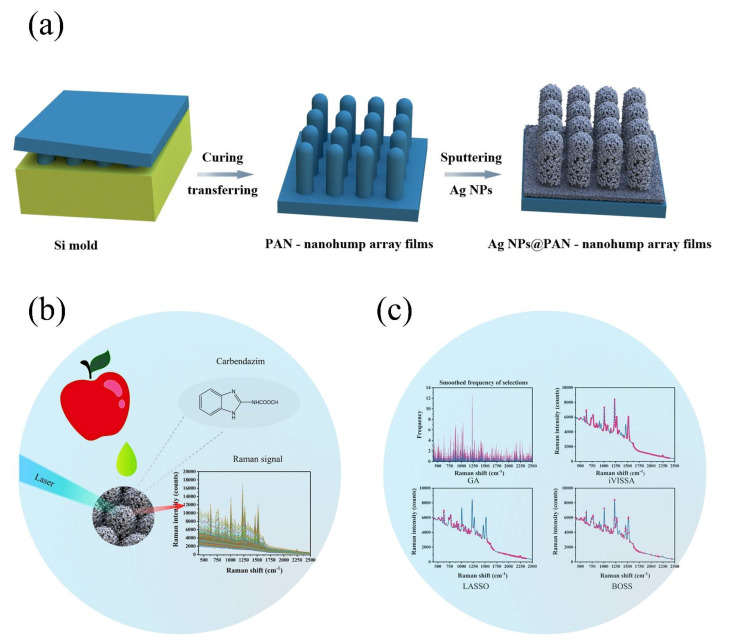
In order to achieve rapid and precise quantification detection of carbendazim residues, surface-enhanced Raman spectroscopy (SERS) combined with variable selected regression methods were developed. A higher sensitivity and greater density of "hot spots" in three-dimensional (3D) SERS substrates based on silver nanoparticles compound polyacrylonitrile (Ag-NPs @PAN) nanohump arrays were fabricated to capture and amplify the SERS signal of carbendazim. Four Raman spectral variable selection regression models were established and comparatively assessed. The results showed that the bootstrapping soft shrinkage-partial least squares (BOSS-PLS) method achieved the best predictive capacity after variable selection, and the final BOSS-PLS model has the correlation coefficient () of 0.992. Then, this method used to detect the carbendazim residue in apple samples; the recoveries were 86~116%, and relative standard deviation (RSD) is less than 10%. The 3D SERS substrates combined with the BOSS-PLS algorithm can deliver a simple and accurate method for trace detection of carbendazim residues in apples.
为实现多菌灵残留的快速、精确定量检测,开发了表面增强拉曼光谱(SERS)结合变量选择回归方法。制备了基于银纳米颗粒复合聚丙烯腈(Ag-NPs@PAN)纳米驼峰阵列的三维(3D)SERS基底,其具有更高的灵敏度和更大密度的“热点”,以捕获和放大多菌灵的SERS信号。建立并比较评估了四种拉曼光谱变量选择回归模型。结果表明,自训练软收缩-偏最小二乘法(BOSS-PLS)在变量选择后具有最佳预测能力,最终BOSS-PLS模型的相关系数()为0.992。然后,该方法用于检测苹果样品中的多菌灵残留;回收率为86%~116%,相对标准偏差(RSD)小于10%。3D SERS基底结合BOSS-PLS算法可为苹果中多菌灵残留的痕量检测提供一种简单准确的方法。