School of Sociology and Population Sciences, Nanjing University of Posts and Telecommunications, Nanjing 210023, China.
School of Health and Social Wellbeing, University of the West of England, Bristol BS16 1DD, UK.
Int J Environ Res Public Health. 2022 Apr 22;19(9):5105. doi: 10.3390/ijerph19095105.
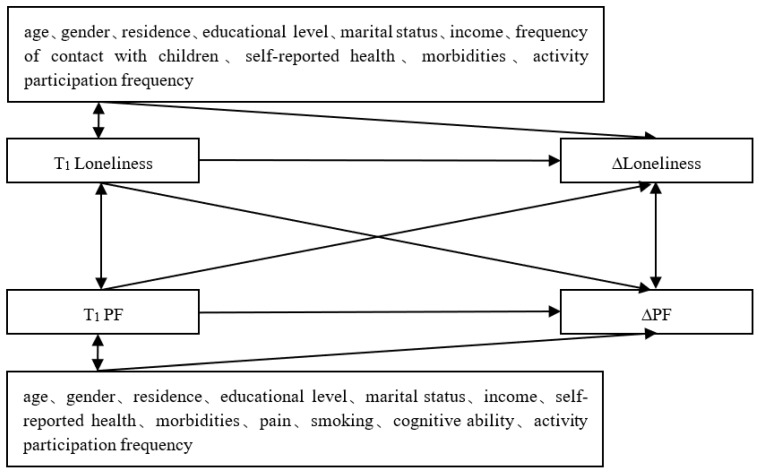
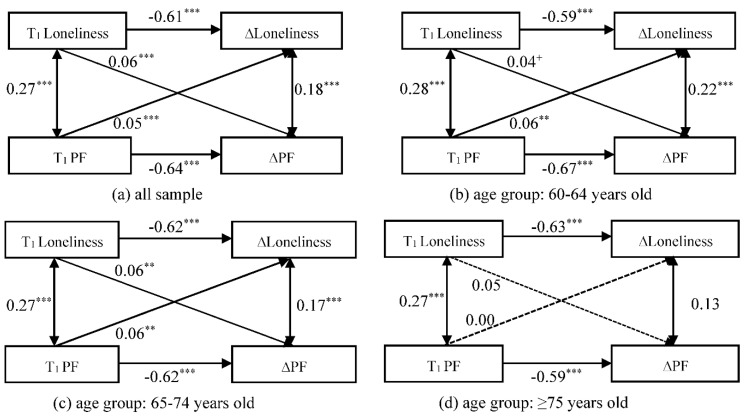
Background: The present study aimed to examine age differences in the relationship between trajectories of loneliness and physical frailty among Chinese older adults. Methods: A total of 4618 participants aged ≥60 years old were taken from pooled data created from the 2011−2015 China Health and Retirement Longitudinal Study (CHARLS). Loneliness was assessed by a single question from the Centre for Epidemiological Studies scale, whereas physical frailty (PF) was examined by the physical frailty phenotype scale. We characterized trajectories of loneliness and PF using transition types and changes within the survey period. Results: Logistic regression models revealed that baseline loneliness was significantly related to remaining robust PF (OR = 0.55, 95% CI = 0.49−0.63, p < 0.001) and worsening in PF (OR = 1.17, 95% CI = 1.05−1.30, p < 0.01) at follow-up. Baseline PF status was also significantly related to the transitions in loneliness (worsen: OR = 1.41, 95% CI = 1.11−1.78, p < 0.01; improve: OR = 0.65, 95% CI = 0.47−0.91, p < 0.05). The cross-lagged panel model found that baseline PF or loneliness had a significant predictive effect on the changes in each other. The associations between trajectories of loneliness and PF were weakened with age and clustered in the under 75 age groups. Conclusions: Bidirectional associations may exist between trajectories of loneliness and PF among Chinese older adults. Interventions should mainly target the young-old to reduce the adverse reciprocal effects of loneliness and PF.
本研究旨在探讨中国老年人孤独轨迹与身体衰弱之间的关系随年龄的差异。
本研究共纳入了来自中国健康与养老追踪调查(CHARLS)2011-2015 年数据集中的 4618 名年龄≥60 岁的参与者。孤独感通过流行病学研究中心量表中的一个问题进行评估,而身体衰弱(PF)通过身体衰弱表型量表进行评估。我们使用过渡类型和调查期间的变化来描述孤独和 PF 的轨迹。
逻辑回归模型显示,基线孤独感与保持强健的 PF(OR=0.55,95%CI=0.49-0.63,p<0.001)和 PF 恶化(OR=1.17,95%CI=1.05-1.30,p<0.01)显著相关。基线 PF 状态也与孤独感的变化显著相关(恶化:OR=1.41,95%CI=1.11-1.78,p<0.01;改善:OR=0.65,95%CI=0.47-0.91,p<0.05)。交叉滞后面板模型发现,基线 PF 或孤独感对彼此的变化具有显著的预测作用。孤独轨迹和 PF 之间的关联随着年龄的增长而减弱,并集中在 75 岁以下的年龄组中。
中国老年人孤独轨迹和 PF 之间可能存在双向关联。干预措施应主要针对年轻老年人,以减少孤独感和 PF 的不良相互影响。