School of Psychology, Nanjing Normal University, Nanjing 210097, China.
Int J Environ Res Public Health. 2022 Apr 28;19(9):5396. doi: 10.3390/ijerph19095396.
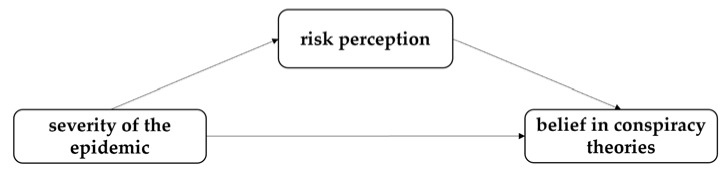
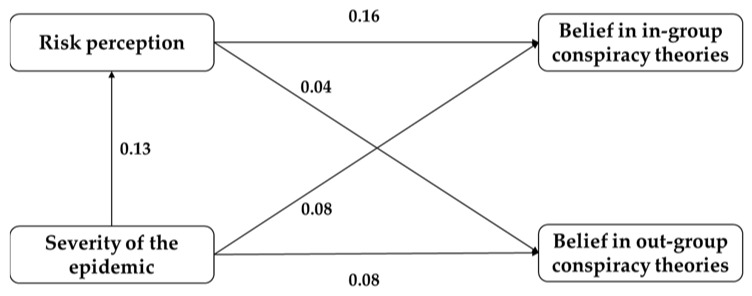
Conspiracy theories often emerge during public health crises, and can provide some explanation for the causes behind the crises. However, the prevalence of conspiracy theories also poses a serious threat to public health order and hinders the implementation of disease prevention and control measures. No studies have examined the role of multiple risk perceptions in the formation of beliefs in conspiracy theories from a cognitive perspective in the context of the epidemic. In this cross-sectional study, participants filled in an online survey in order to investigate the relationship between epidemic severity and beliefs in conspiracy theories and the mediating role of risk perception in this relationship. The results showed that COVID-19 epidemic severity positively predicted beliefs in both in- and out-group conspiracy theories. Risk perception mediated the positive relationship between COVID-19 epidemic severity and belief in in-group conspiracy theories. These results suggest that in a major public health crisis event: (1) residents at the epicenter may be more prone to believing in both in- and out-group conspiracy theories; and (2) beliefs in in- and out-group conspiracy theories may have different psychological mechanisms. Therefore, conspiracy theories about public health incidents, such as the COVID-19 pandemic, should be classified and treated by policy stakeholders.
阴谋论常常在公共卫生危机期间出现,并能为危机背后的原因提供一些解释。然而,阴谋论的盛行也对公共卫生秩序构成了严重威胁,阻碍了疾病防控措施的实施。目前还没有研究从认知的角度考察在疫情背景下,多种风险感知在形成对阴谋论的信念中的作用。在这项横断面研究中,参与者填写了在线调查,以调查疫情严重程度与对阴谋论的信念之间的关系,以及风险感知在这种关系中的中介作用。结果表明,COVID-19 疫情严重程度正向预测了对内外群体阴谋论的信念。风险感知在 COVID-19 疫情严重程度与对内群体阴谋论信念之间的正向关系中起中介作用。这些结果表明,在重大公共卫生危机事件中:(1)疫区居民可能更容易相信内外群体的阴谋论;(2)对内外群体阴谋论的信念可能具有不同的心理机制。因此,政策利益相关者应该对 COVID-19 等公共卫生事件的阴谋论进行分类和处理。