Constantinou Marios, Gloster Andrew T, Karekla Maria
Department of Social Sciences, University of Nicosia, 46 Makedonitissas Avenue, 1700, Nicosia, Cyprus.
Department of Psychology, Division of Clinical Psychology and Intervention Science, University of Basel, Missionsstrasse 62 A, 4055 Basel, Switzerland.
J Contextual Behav Sci. 2021 Apr;20:46-51. doi: 10.1016/j.jcbs.2021.03.001. Epub 2021 Mar 9.
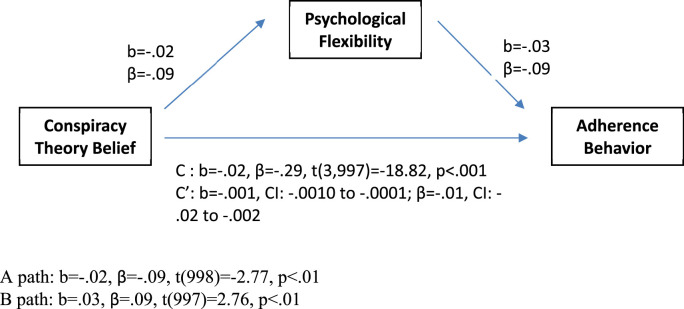
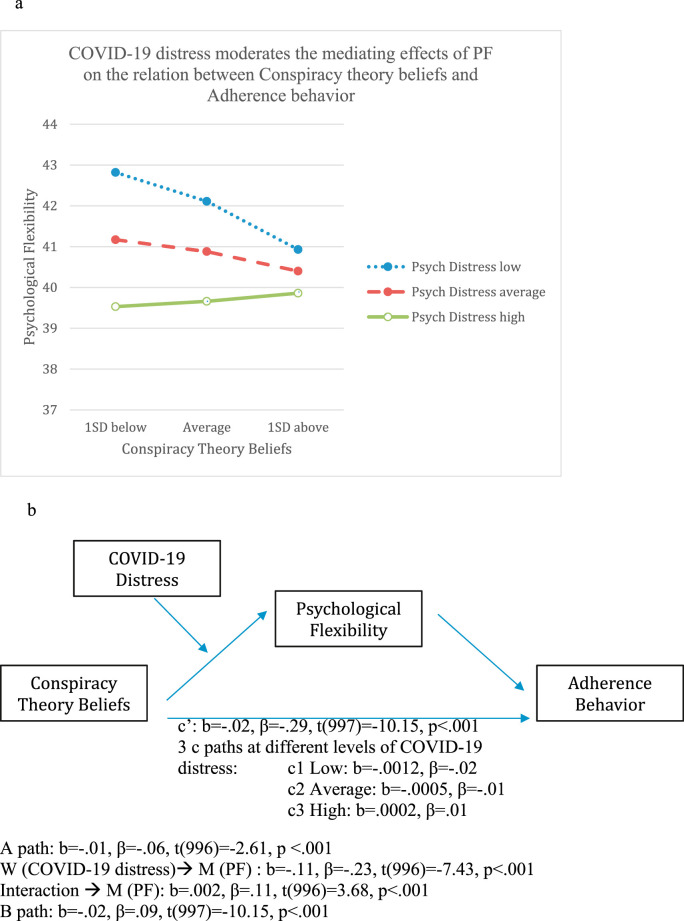
The COVID-19 pandemic has brought unprecedented situations (government lockdowns, quarantines, etc.) and stressors (a seemingly "phantom" virus that can be lurking anywhere) causing uncertainty for the future, uncontrollable and unpredictable situations. It appears that especially during times of uncertainty and high stress, conspiracy theories flourish and these can affect the way individuals behave, especially in response to governmental recommendations for social isolation and quarantine. Psychological flexibility, we hypothesized, may act as a protective factor in the relation between COVID-19 distress, conspiracy theory beliefs and consequent behaving. In this respect, the aim of this paper was to examine how conspiracy theory beliefs, COVID-19 distress, adherence behavior, and psychological flexibility interact. Participants were 1001 individuals (802 women; Mage = 35.59years, SD = 10.07), who completed an online survey approximately one month after the first governmental measures of self-isolation and quarantine were enforced. Psychological flexibility was found to mediate the relation between conspiracy theory beliefs and compliance behavior. Further, being highly stressed appeared to increase the probability that a person will believe conspiracy theories, while such beliefs influenced whether a person would follow public health recommendations. Psychological flexibility appeared to be a protective factor at low and moderate distress levels. However, at high levels of COVID-19 distress, individuals prone to conspiracy theory beliefs would be less likely to conform to governmental public health recommendations irrespective of their psychological flexibility levels.
新冠疫情带来了前所未有的情况(政府封锁、隔离等)和压力源(一种看似“无形”、可能潜伏在任何地方的病毒),导致未来充满不确定性,局势难以控制和预测。似乎尤其是在不确定和高压力时期,阴谋论盛行,而这会影响个体的行为方式,特别是在应对政府关于社交隔离和检疫的建议时。我们假设,心理灵活性可能在新冠疫情困扰、阴谋论信念及相应行为之间的关系中起到保护作用。在这方面,本文旨在研究阴谋论信念、新冠疫情困扰、依从行为和心理灵活性是如何相互作用的。研究参与者为1001名个体(802名女性;年龄中位数=35.59岁,标准差=10.07),他们在政府首次实施自我隔离和检疫措施约一个月后完成了一项在线调查。研究发现,心理灵活性在阴谋论信念与依从行为之间的关系中起中介作用。此外,压力过大似乎会增加一个人相信阴谋论的可能性,而这种信念会影响一个人是否会遵循公共卫生建议。在低至中度困扰水平下,心理灵活性似乎是一个保护因素。然而,在新冠疫情高困扰水平下,无论心理灵活性水平如何,倾向于相信阴谋论的个体都不太可能遵守政府的公共卫生建议。