School of Management, Zhejiang University of Technology, Hangzhou 310023, China.
School of Cultural Creativity and Management, Communication University of Zhejiang, Hangzhou 310019, China.
Int J Environ Res Public Health. 2022 Apr 29;19(9):5414. doi: 10.3390/ijerph19095414.
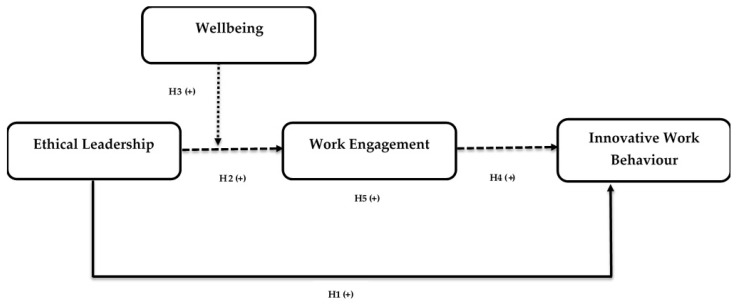
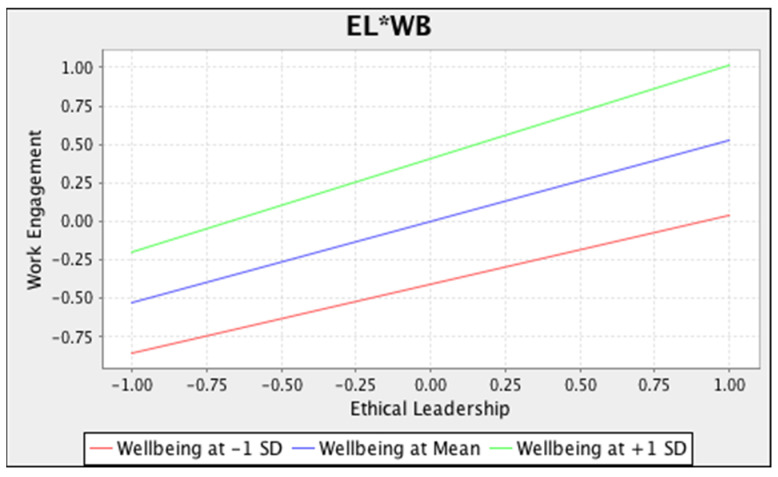
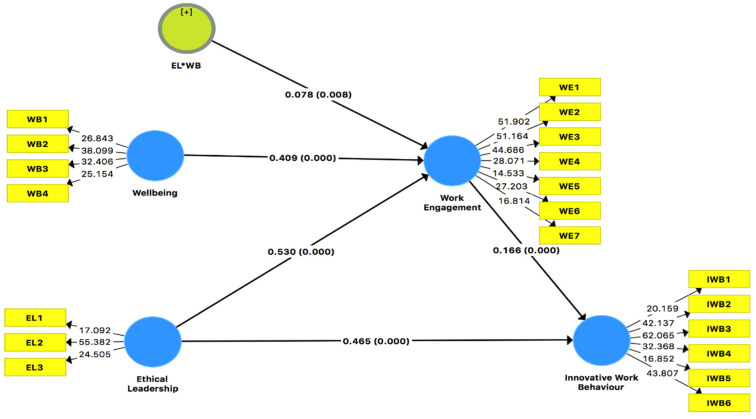
In this study, we investigate the relationship between ethical leadership (EL), work engagement (WE), well-being, and innovative work behavior (IWB). The significance of these variables has increased in the current era when the influence of technology is exponentially increasing in the education sector. We investigate the role of ethical leadership in determining innovative work behavior. Moreover, we investigate the moderating effect of WB in the relationship between EL and WE. We also examine the mediating impact of WE in the relationship between EL and IWB. We used a questionnaire survey approach to collect data. The target population of this study was the academic personnel, i.e., senior professors, lecturers, and supporting staff associated with the higher education sector located in Zhejiang Province, China. Data were collected in two phases. In the first phase, we sent 300 research questionnaires and received 251 responses. In the second phase, after a three-month interval, we sent 200 questionnaires and received 162 responses. However, over the two phases, we collected a total of 413 questionnaires; 43 were discarded. Therefore, for analysis, we used 370 questionnaires. The data were analyzed using the structural equation modeling through SmartPLS 3.2.2. First, in the direct relationship, results confirm that EL positively influences the IWB. Secondly, WB has a positive and moderating relationship between EL and IWB. Thirdly, we address the relationship between EL and WE. The outcome indicates that there is a positive and significant relationship. Fourth, the results of this study indicate that there is positive and significant relationship between WE and IWB. Finally, the outcomes imply that WE positively mediates between EL and IWB. Ethical leadership and well-being are important for innovative work behavior that supports managers in introducing a supportive workplace environment that promotes good interpersonal relationships with subordinates. Therefore, a good interpersonal relationship between managers and subordinates enhances the work quality. So, ethical leaders provide a supportive work environment to all subordinates regarding their work.
在这项研究中,我们调查了伦理领导(EL)、工作投入(WE)、幸福感和创新工作行为(IWB)之间的关系。在当前时代,技术对教育领域的影响呈指数级增长,这些变量的重要性日益增加。我们调查了伦理领导在决定创新工作行为中的作用。此外,我们还调查了 WB 在 EL 和 WE 之间关系中的调节作用。我们还研究了 WE 在 EL 和 IWB 之间关系中的中介作用。我们采用问卷调查方法收集数据。本研究的目标人群是学术人员,即中国浙江省高等教育领域的高级教授、讲师和支持人员。数据分两个阶段收集。在第一阶段,我们发送了 300 份研究问卷,收到了 251 份回复。在第二阶段,三个月后,我们发送了 200 份问卷,收到了 162 份回复。然而,在两个阶段中,我们共收到了 413 份问卷,其中 43 份被丢弃。因此,在分析中,我们使用了 370 份问卷。数据通过 SmartPLS 3.2.2 结构方程模型进行分析。首先,在直接关系中,结果证实 EL 对 IWB 有正向影响。其次,WB 在 EL 和 IWB 之间具有正向和调节关系。第三,我们探讨了 EL 和 WE 之间的关系。结果表明两者之间存在正向且显著的关系。第四,本研究的结果表明 WE 和 IWB 之间存在正向且显著的关系。最后,研究结果表明 WE 在 EL 和 IWB 之间具有正向的中介作用。伦理领导和幸福感对创新工作行为很重要,这有助于管理者引入支持性的工作环境,促进与下属的良好人际关系。因此,管理者与下属之间的良好人际关系可以提高工作质量。因此,伦理领导者为所有下属提供支持性的工作环境,关注他们的工作。