School of Management Engineering, Zhengzhou University, Zhengzhou 450001, China.
National Engineering Laboratory for Internet Medical Systems and Applications, Zhengzhou 450052, China.
Int J Environ Res Public Health. 2022 May 5;19(9):5594. doi: 10.3390/ijerph19095594.
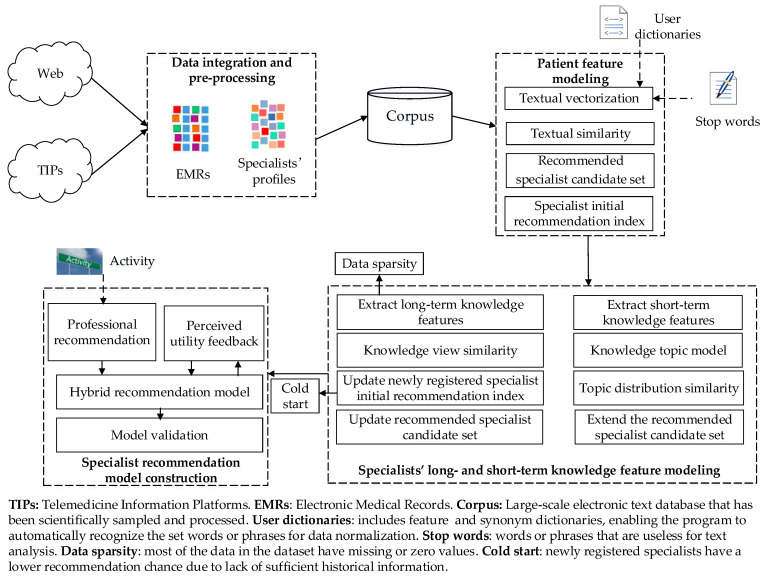
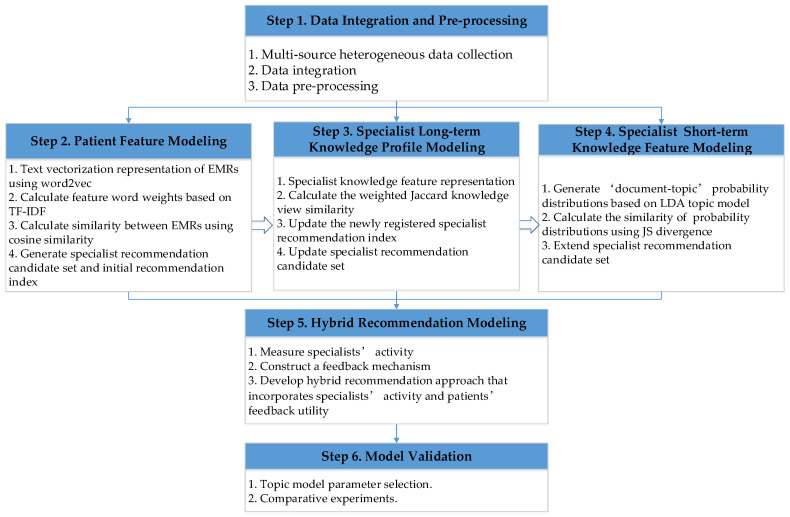
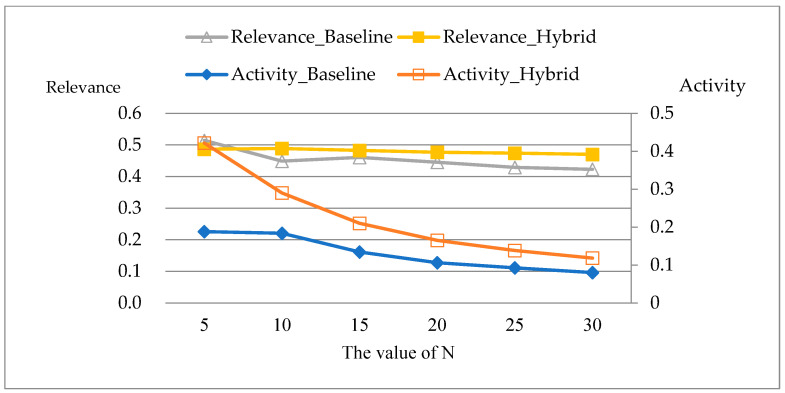
With the rapid development of medical informatization, information overload and asymmetry have become major obstacles that limit patients' ability to find appropriate telemedicine specialists. Although doctor recommendation methods have been proposed, they fail to address data sparsity and cold-start issues, and electronic medical records (EMRs), patient preferences, potential interest of service providers and the changes over time are largely under-explored. Therefore, this study develops a self-adaptive telemedicine specialist recommendation method that incorporates specialist activity and patient utility feedback from the perspective of privacy protection to fill the research gaps. First, text vectorization, view similarity and probabilistic topic model are used to construct the patient and specialist feature models based on patients' EMRs and specialists' long- and short-term knowledge backgrounds, respectively. Second, the recommended specialist candidate set and recommendation index are obtained based on the similarity between patient features. Then, the specialist long-term knowledge feature model is used to update the newly registered specialist recommendation index and the recommended specialist candidate set to overcome the data sparsity and cold-start issues, and the specialist short-term knowledge feature model is adopted to extend the recommended specialist candidate set at the semantic level. Finally, we introduce the specialists' activity and patients' perceived utility feedback mechanism to construct a closed-loop adjusted and optimized specialist recommendation method. An empirical study was conducted integrating EMRs of telemedicine patients from the National Telemedicine Center of China and specialists' profiles and ratings from an online healthcare platform. The proposed method successfully recommended relevant and active telemedicine specialists to the target patient, and increased the recommended opportunities for newly registered specialists to some extent. The proposed method emphasizes the adaptability and acceptability of the recommended results while ensuring their accuracy and relevance. Specialists' activity and patients' perceived utility jointly contribute to the acceptability of recommended results, and the recommendation strategy achieves the organic fusion of the two. Several comparative experiments demonstrate the effectiveness and operability of the hybrid recommendation strategy under the premise of data sparsity and privacy protection, enabling effective matching of patients' demand and service providers' capabilities, and providing beneficial insights for data-driven telemedicine services.
随着医疗信息化的快速发展,信息过载和不对称已成为限制患者寻找合适远程医疗专家能力的主要障碍。尽管已经提出了医生推荐方法,但它们未能解决数据稀疏和冷启动问题,并且电子病历(EMR)、患者偏好、服务提供商的潜在利益以及随时间的变化在很大程度上尚未得到充分探索。因此,本研究从隐私保护的角度开发了一种自适应远程医疗专家推荐方法,该方法结合了专家活动和患者效用反馈,以填补研究空白。
首先,使用文本向量、视图相似度和概率主题模型分别构建基于患者 EMR 和专家长短期知识背景的患者和专家特征模型。其次,基于患者特征的相似度获得推荐专家候选集和推荐指数。然后,使用专家长期知识特征模型更新新注册专家的推荐指数和推荐专家候选集,以克服数据稀疏和冷启动问题,并采用专家短期知识特征模型在语义级别扩展推荐专家候选集。最后,引入专家活动和患者感知效用反馈机制,构建闭环调整和优化的专家推荐方法。
通过整合中国国家远程医疗中心的远程医疗患者 EMR 和在线医疗保健平台的专家档案和评分,进行了实证研究。所提出的方法成功地为目标患者推荐了相关和活跃的远程医疗专家,并在一定程度上增加了新注册专家的推荐机会。
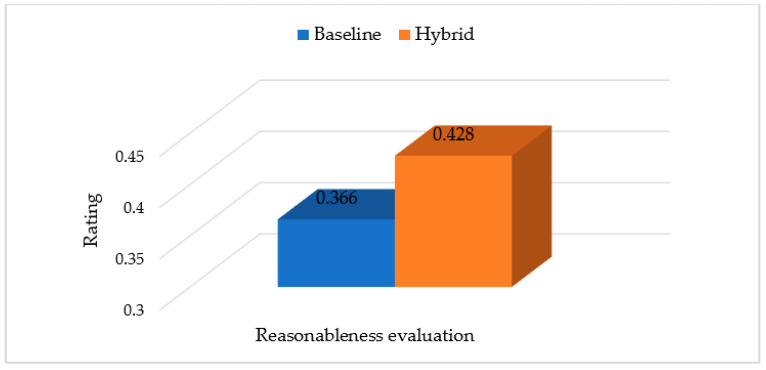
所提出的方法在确保准确性和相关性的同时,强调推荐结果的适应性和可接受性。专家活动和患者感知效用共同促进推荐结果的可接受性,并且推荐策略实现了两者的有机融合。几个比较实验证明了在数据稀疏和隐私保护的前提下,混合推荐策略的有效性和可操作性,有效地匹配了患者的需求和服务提供商的能力,为数据驱动的远程医疗服务提供了有益的见解。