Jørgensen Jan Trøst, Mollerup Jens
Department: Medical Sciences, Dx-Rx Institute, Baunevaenget 76, 3480 Fredensborg, Denmark.
Pathology Division, Agilent Technologies Denmark ApS, Produktionsvej 42, 2600 Glostrup, Denmark.
Cancers (Basel). 2022 Apr 26;14(9):2150. doi: 10.3390/cancers14092150.
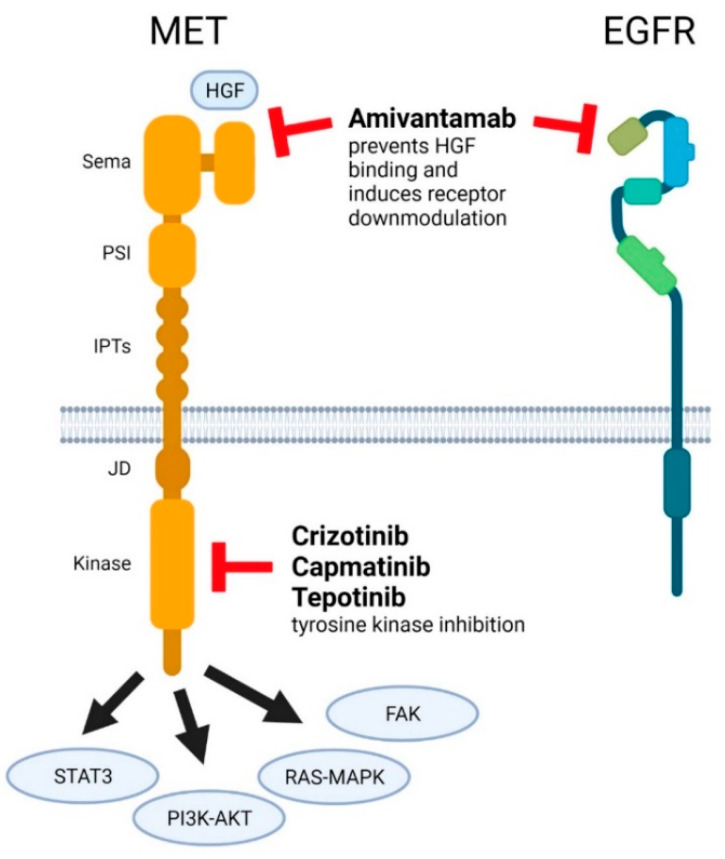
Dysregulation of the MET tyrosine kinase receptor is a known oncogenic driver, and multiple genetic alterations can lead to a clinically relevant oncogenesis. Currently, a number of drugs targeting MET are under development as potential therapeutics for different cancer indications, including non-small cell lung cancer (NSCLC). However, relatively few of these drugs have shown sufficient clinical activity and obtained regulatory approval. One of the reasons for this could be the lack of effective predictive biomarkers to select the right patient populations for treatment. So far, capmatinib is the only MET-targeted drug approved with a companion diagnostic (CDx) assay, which is indicated for the treatment of metastatic NSCLC in patients having a mutation resulting in exon 14 skipping. An alternative predictive biomarker for MET therapy is amplification, which has been identified as a resistance mechanism in patients with -mutated NSCLC. Results obtained from different clinical trials seem to indicate that the /CEP7 ratio detected by FISH possesses the best predictive properties, likely because this method excludes amplification caused by polysomy. In this article, the concept of CDx assays will be discussed, with a focus on the currently FDA-approved MET targeted therapies for the treatment of NSCLC.
MET酪氨酸激酶受体的失调是一种已知的致癌驱动因素,多种基因改变可导致具有临床相关性的肿瘤发生。目前,一些靶向MET的药物正在开发中,作为针对不同癌症适应症(包括非小细胞肺癌(NSCLC))的潜在治疗药物。然而,这些药物中相对较少的已显示出足够的临床活性并获得监管批准。其原因之一可能是缺乏有效的预测生物标志物来选择合适的患者群体进行治疗。到目前为止,卡马替尼是唯一一种通过伴随诊断(CDx)检测获批的靶向MET的药物,该检测适用于治疗具有导致第14外显子跳跃突变的转移性NSCLC患者。MET治疗的另一种预测生物标志物是扩增,它已被确定为携带突变的NSCLC患者的耐药机制。不同临床试验获得的结果似乎表明,通过荧光原位杂交(FISH)检测的/CEP7比值具有最佳的预测特性,这可能是因为该方法排除了多倍体引起的扩增。在本文中,将讨论CDx检测的概念,重点是目前FDA批准的用于治疗NSCLC的靶向MET疗法。