Leveau Lucas M, Ibáñez Isis
Departamento de Ecología, Genética y Evolución, Facultad de Ciencias Exactas y Naturales, Universidad de Buenos Aires-IEGEBA (CONICET-UBA), Ciudad Universitaria, Pab 2, Piso 4, Buenos Aires 1426, Argentina.
Animals (Basel). 2022 Apr 29;12(9):1148. doi: 10.3390/ani12091148.
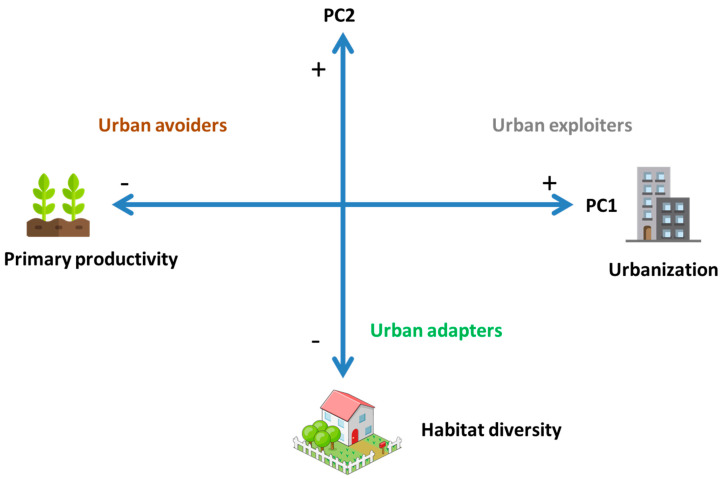
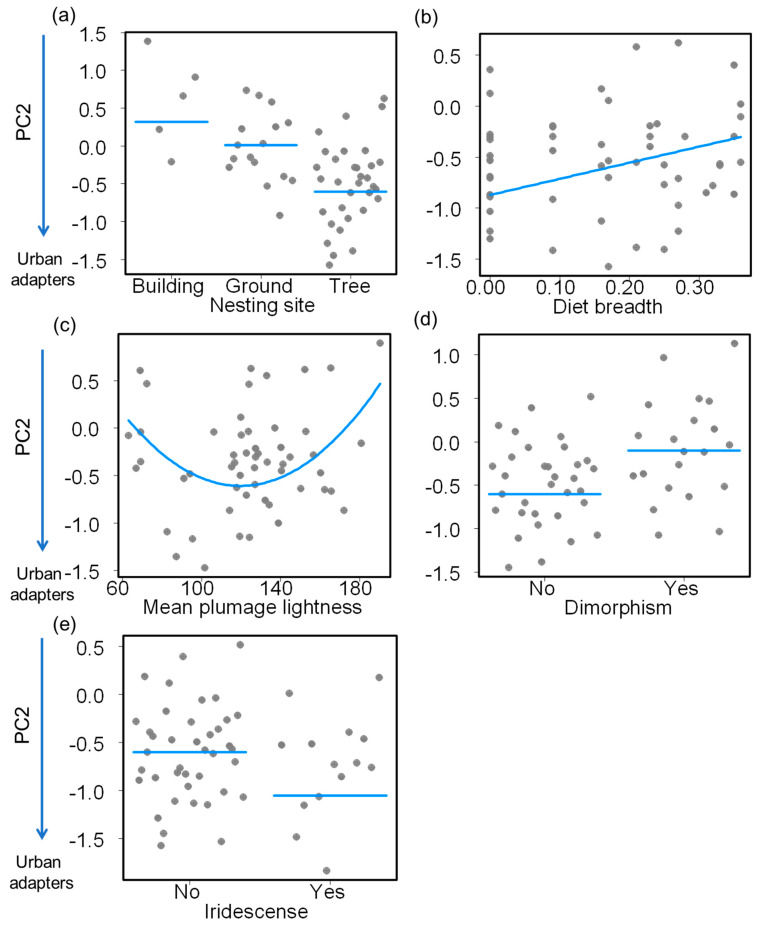
Urban areas are expected to grow in the next decades, filtering bird species from the regional pool based on their life history traits. Although the impact of urbanization on traits such as diet, habitat and migratory behavior has been analyzed, their joint role with other traits related to plumage color has not yet been analyzed. Urban characteristics such as impervious surfaces, human presence and pollutants may be related to dark and uniform plumages. The objective of this study is to determine different bird species responses to urbanization using ordination analysis, and to characterize their life history traits combining information about diet, habitat and plumage color. Birds were surveyed along urban-rural gradients located in three cities of central Argentina. Species associations with urban characteristics were assessed through principal component analysis. Two axes were obtained: the first related positively to urban exploiters and negatively to urban avoiders, and a second axis related negatively to urban adapters. The scores of each axis were related to species traits through phylogenetic generalized least squares models. Species identified as 'urban exploiters' tended to nest in buildings and have uniform plumage, whereas those identified as 'urban avoiders' tended to be ground-nesting species with variable plumage. A third type, 'urban adapters', tended to be tree-nesting species with a low diet breadth, intermediate plumage lightness, low presence of plumage sexual dimorphism and high presence of iridescence. The results suggest that nest predation and habitat loss may exclude ground nesting birds from urban areas. The high density of pedestrians and domestic animals, such as cats and dogs, in urban centers may favor uniform plumages in birds that enhance camouflage.
预计在未来几十年中城市地区将会扩大,根据鸟类的生活史特征从区域鸟类群落中筛选出不同的物种。尽管城市化对饮食、栖息地和迁徙行为等特征的影响已得到分析,但它们与其他与羽毛颜色相关的特征的共同作用尚未得到分析。不透水表面、人类活动和污染物等城市特征可能与深色且单一的羽毛有关。本研究的目的是使用排序分析来确定不同鸟类物种对城市化的反应,并结合饮食、栖息地和羽毛颜色信息来描述它们的生活史特征。在阿根廷中部三个城市的城乡梯度上对鸟类进行了调查。通过主成分分析评估物种与城市特征的关联。得到了两个轴:第一个轴与城市利用者呈正相关,与城市回避者呈负相关,第二个轴与城市适应者呈负相关。通过系统发育广义最小二乘法模型将每个轴的得分与物种特征相关联。被确定为“城市利用者”的物种倾向于在建筑物中筑巢且羽毛单一,而被确定为“城市回避者”的物种倾向于为地面筑巢物种且羽毛多变。第三种类型“城市适应者”倾向于为在树上筑巢的物种,饮食宽度窄,羽毛亮度中等,羽毛性二态性低且虹彩度高。结果表明,巢捕食和栖息地丧失可能会将地面筑巢鸟类排除在城市地区之外。城市中心高密度的行人和猫、狗等家畜可能有利于鸟类形成单一的羽毛,从而增强伪装效果。