Biomedical Research Center, Institute of Nutritional Sciences, Justus-Liebig-University of Giessen, Schubert-Street 81, D-35392 Giessen, Germany.
Department of Food Biofunctionality, Institute of Nutritional Sciences, University of Hohenheim, Ökozentrum, Garbenstr. 28, D-70599 Stuttgart, Germany.
Nutrients. 2022 Apr 19;14(9):1694. doi: 10.3390/nu14091694.
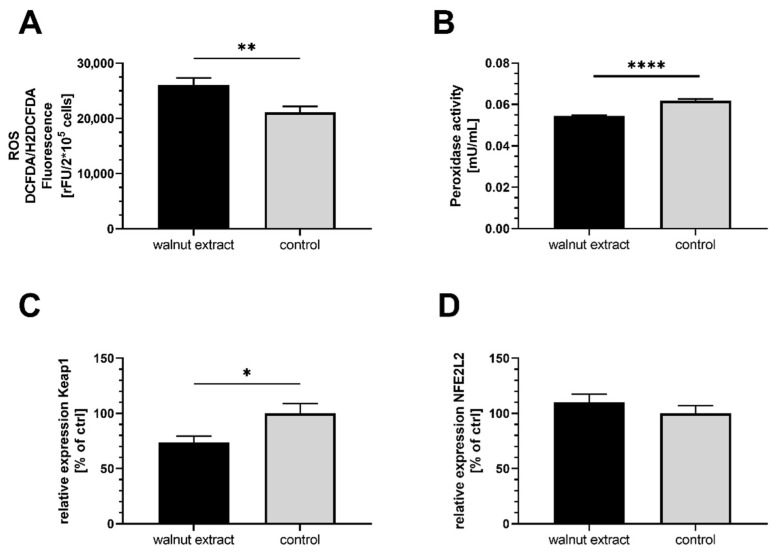
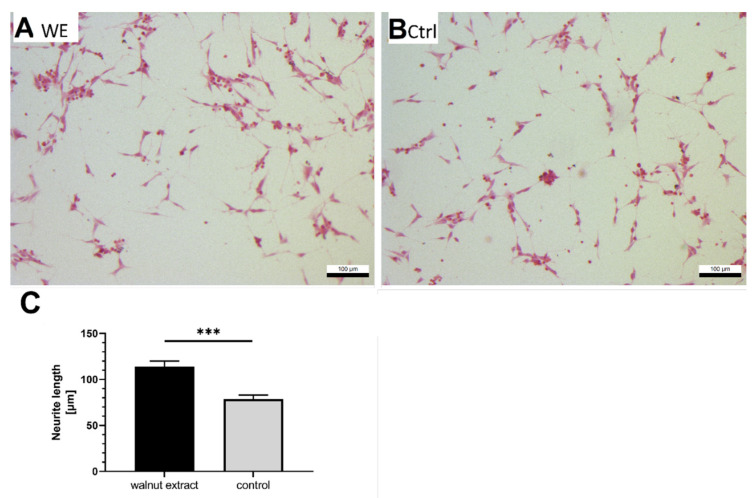
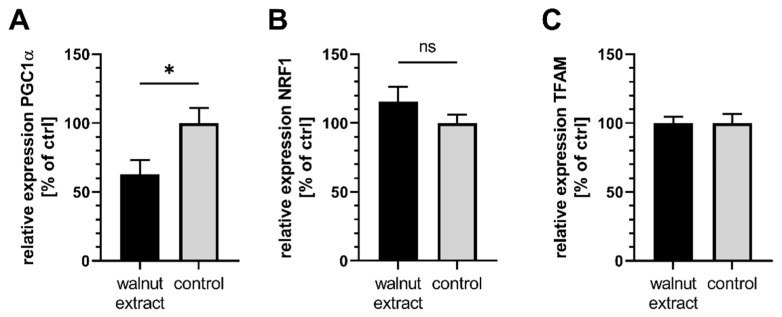
(1) Background: Mitochondria are the cells' main source of energy. Mitochondrial dysfunction represents a key hallmark of aging and is linked to the development of Alzheimer's disease (AD). Maintaining mitochondrial function might contribute to healthy aging and the prevention of AD. The Mediterranean diet, including walnuts, seems to prevent age-related neurodegeneration. Walnuts are a rich source of α-linolenic acid (ALA), an essential n3-fatty acid and the precursor for n3-long-chain polyunsaturated fatty acids (n3-PUFA), which might potentially improve mitochondrial function. (2) Methods: We tested whether a lipophilic walnut extract (WE) affects mitochondrial function and other parameters in human SH-SY5Y cells transfected with the neuronal amyloid precursor protein (APP695). Walnut lipids were extracted using a Soxhlet Extraction System and analyzed using GC/MS and HPLC/FD. Adenosine triphosphate (ATP) concentrations were quantified under basal conditions in cell culture, as well as after rotenone-induced stress. Neurite outgrowth was investigated, as well as membrane integrity, cellular reactive oxygen species, cellular peroxidase activity, and citrate synthase activity. Beta-amyloid (Aβ) was quantified using homogenous time-resolved fluorescence. (3) Results: The main constituents of WE are linoleic acid, oleic acid, α-linolenic acid, and γ- and δ-tocopherol. Basal ATP levels following rotenone treatment, as well as citrate synthase activity, were increased after WE treatment. WE significantly increased cellular reactive oxygen species but lowered peroxidase activity. Membrane integrity was not affected. Furthermore, WE treatment reduced Aβ and stimulated neurite growth. (4) Conclusions: WE might increase ATP production after induction of mitochondrial biogenesis. Decreased Aβ formation and enhanced ATP levels might enhance neurite growth, making WE a potential agent to enhance neuronal function and to prevent the development of AD. In this sense, WE could be a promising agent for the prevention of AD.
(1)背景:线粒体是细胞的主要能量来源。线粒体功能障碍是衰老的一个关键标志,与阿尔茨海默病(AD)的发展有关。维持线粒体功能可能有助于健康衰老和预防 AD。地中海饮食包括核桃,似乎可以预防与年龄相关的神经退行性变。核桃是α-亚麻酸(ALA)的丰富来源,ALA 是一种必需的 n3-脂肪酸,也是 n3-长链多不饱和脂肪酸(n3-PUFA)的前体,可能潜在地改善线粒体功能。
(2)方法:我们测试了一种亲脂性核桃提取物(WE)是否会影响转染神经元淀粉样前体蛋白(APP695)的人 SH-SY5Y 细胞中的线粒体功能和其他参数。使用索氏提取系统提取核桃脂质,并使用 GC/MS 和 HPLC/FD 进行分析。在细胞培养中,在基础条件下以及在鱼藤酮诱导应激后,定量测定三磷酸腺苷(ATP)浓度。研究了神经突生长以及膜完整性、细胞内活性氧、细胞内过氧化物酶活性和柠檬酸合酶活性。使用均相时间分辨荧光法定量β-淀粉样蛋白(Aβ)。
(3)结果:WE 的主要成分是亚油酸、油酸、α-亚麻酸以及γ-和δ-生育酚。鱼藤酮处理后基础 ATP 水平以及柠檬酸合酶活性在 WE 处理后增加。WE 显著增加细胞内活性氧,但降低过氧化物酶活性。膜完整性不受影响。此外,WE 处理减少了 Aβ并刺激了神经突生长。
(4)结论:WE 可能会在诱导线粒体生物发生后增加 ATP 的产生。减少 Aβ的形成和增加 ATP 水平可能会增强神经突生长,使 WE 成为增强神经元功能和预防 AD 发展的潜在药物。从这个意义上说,WE 可能是预防 AD 的有希望的药物。