Unit of Medical Epidemiology, Department of Surgical Sciences, Uppsala University, SE-751 85 Uppsala, Sweden.
Unit of Cardiovascular and Nutritional Epidemiology, Institute of Environmental Medicine, Karolinska Institutet, SE-171 77 Stockholm, Sweden.
Nutrients. 2022 Apr 19;14(9):1697. doi: 10.3390/nu14091697.
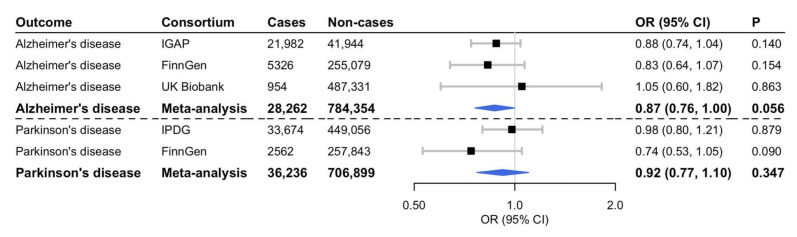
We leveraged genetic variants associated with caffeine metabolism in the two-sample Mendelian randomization framework to investigate the effect of plasma caffeine levels on the risk of Alzheimer's disease and Parkinson's disease. Genetic association estimates for the outcomes were obtained from the International Genomics of Alzheimer's Project, the International Parkinson's Disease Genomics consortium, the FinnGen consortium, and the UK Biobank. Genetically predicted higher plasma caffeine levels were associated with a non-significant lower risk of Alzheimer's disease (odds ratio 0.87; 95% confidence interval 0.76, 1.00; = 0.056). A suggestive association was observed for genetically predicted higher plasma caffeine levels and lower risk of Parkinson's disease in the FinnGen consortium. but not in the International Parkinson's Disease Genomics consortium; no overall association was found (odds ratio 0.92; 95% confidence interval 0.77, 1.10; = 0.347). This study found possible suggestive evidence of a protective role of caffeine in Alzheimer's disease. The association between caffeine and Parkinson's disease requires further study.
我们利用与咖啡因代谢相关的遗传变异,在两样本孟德尔随机化框架中,研究了血浆咖啡因水平对阿尔茨海默病和帕金森病风险的影响。结局的遗传关联估计值来自国际阿尔茨海默病基因组计划、国际帕金森病基因组联盟、芬兰基因联盟和英国生物库。遗传预测的较高血浆咖啡因水平与阿尔茨海默病的风险呈非显著降低相关(比值比 0.87;95%置信区间 0.76,1.00; = 0.056)。在芬兰基因联盟中观察到遗传预测的较高血浆咖啡因水平与较低的帕金森病风险之间存在提示性关联,但在国际帕金森病基因组联盟中未观察到这种关联;未发现总体关联(比值比 0.92;95%置信区间 0.77,1.10; = 0.347)。本研究发现咖啡因对阿尔茨海默病可能具有保护作用的提示性证据。咖啡因与帕金森病之间的关联需要进一步研究。