Department of Food Science, Gyeongsang National University, Jinju 52725, Korea.
Department of GreenBio Science, Gyeongsang National University, Jinju 52725, Korea.
Nutrients. 2022 Apr 27;14(9):1822. doi: 10.3390/nu14091822.
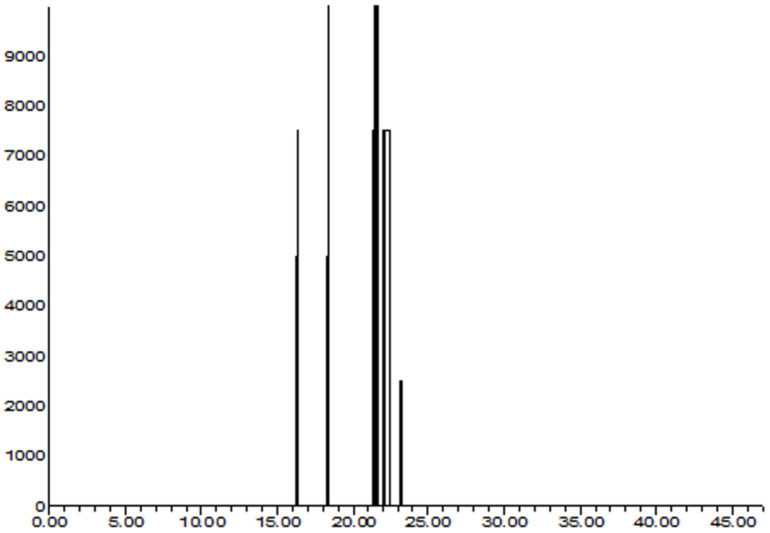
We explored the physiological effects of inhaling basil essential oil (BEO) and/or linalool and identified odor-active aroma compounds in BEO using gas chromatography/mass spectrometry (GC-MS) and GC-olfactometry (GC-O). Linalool was identified as the major volatile compound in BEO. Three groups of rats were administered BEO and linalool via inhalation, while rats in the control group were not. Inhalation of BEO for 20 min only reduced the total weight gain (190.67 ± 2.52 g) and increased the forced swimming time (47.33 ± 14.84 s) compared with the control group (219.67 ± 2.08 g, 8.33 ± 5.13 s). Inhalation of BEO for 5 min (392 ± 21 beats/min) only reduced the pulse compared with the control group (420 ± 19 beats/min). Inhalation of linalool only reduced the weight of white adipose tissue (5.75 ± 0.61 g). The levels of stress-related hormones were not significantly different among the groups. The total cholesterol and triglyceride levels decreased after inhalation of BEO for 20 min (by more than -10% and -15%, respectively). Low-density lipoprotein cholesterol levels were lowered (by more than -10%) by the inhalation of BEO and linalool, regardless of the inhalation time. In particular, BEO inhalation for 20 min was associated with the lowest level of low-density lipoprotein cholesterol (53.94 ± 2.72 mg/dL). High-density lipoprotein cholesterol levels increased after inhalation of BEO (by more than +15%). The atherogenic index and cardiac risk factors were suppressed by BEO inhalation. Animals exposed to BEO and linalool had no significant differences in hepatotoxicity. These data suggest that the inhalation of BEO and linalool may ameliorate cardiovascular and lipid dysfunctions. These effects should be explored further for clinical applications.
我们研究了吸入罗勒精油(BEO)和/或芳樟醇的生理效应,并使用气相色谱/质谱(GC-MS)和 GC-嗅闻(GC-O)鉴定了 BEO 中的气味活性香气化合物。芳樟醇被鉴定为 BEO 中的主要挥发性化合物。三组大鼠通过吸入给予 BEO 和芳樟醇,而对照组大鼠则不给予。与对照组(219.67 ± 2.08 g,8.33 ± 5.13 s)相比,仅吸入 BEO 20 分钟就会降低总体重增加量(190.67 ± 2.52 g)并增加强迫游泳时间(47.33 ± 14.84 s)。与对照组(420 ± 19 次/分钟)相比,仅吸入 BEO 5 分钟(392 ± 21 次/分钟)就会降低脉搏。仅吸入芳樟醇会降低白色脂肪组织的重量(5.75 ± 0.61 g)。各组的应激相关激素水平没有显着差异。吸入 BEO 20 分钟后,总胆固醇和甘油三酯水平分别降低(超过-10%和-15%)。无论吸入时间如何,吸入 BEO 和芳樟醇均可降低低密度脂蛋白胆固醇水平(超过-10%)。特别是,BEO 吸入 20 分钟与最低的低密度脂蛋白胆固醇水平(53.94 ± 2.72 mg/dL)相关。吸入 BEO 后高密度脂蛋白胆固醇水平增加(超过+15%)。BEO 吸入可抑制动脉粥样硬化指数和心脏危险因素。暴露于 BEO 和芳樟醇的动物在肝毒性方面没有显着差异。这些数据表明,吸入 BEO 和芳樟醇可能改善心血管和脂质功能障碍。这些影响应进一步探索用于临床应用。