PhD Program in Endocrinological Sciences, University of Rome "La Sapienza", 00161 Rome, Italy.
Department of Human Sciences and Promotion of the Quality of Life, San Raffaele Roma Open University, 00166 Rome, Italy.
Nutrients. 2022 Apr 29;14(9):1884. doi: 10.3390/nu14091884.
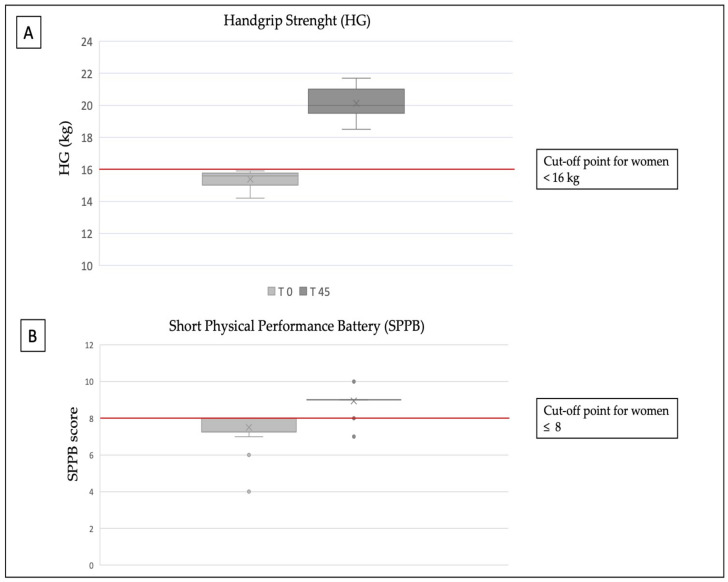
In sarcopenic obese subjects it is essential to reduce body weight and preserve lean mass, in order to avoid a worsening of muscle function. Several studies have shown that leucine supplementation can be useful to improve skeletal muscle mass in sarcopenic patients. The aim of our study was to evaluate the effectiveness of a short-term low-calorie diet (LCD) combined with supplementation with whey protein and leucine on weight loss, lean mass and muscle strength in sarcopenic, obese, hyperinsulinemic and post-menopausal women. Sixteen females with a mean age of 60 years (range: 50-70 years), BMI 37.6 kg/m (range: 31.7-44.1 Kg/m), HOMA-index ≥ 2.5 (range: 2.9-12) were assigned to an LCD regimen (1000 kcal/day) with supplementation of 18 g whey proteins which 4.1 g of leucine for 45 days. Anthropometric indexes, blood and urine chemistry, body composition by DEXA, muscle strength by handgrip test and Short Physical Performance Battery (SPPB) were assessed at baseline and at the end of the treatment. A significant reduction in BMI (37.6 vs. 35.7 Kg/m), waist circumference (107 vs. 102.4 cm), HOMA index (4.8 vs. 2.3) and fasting insulin (17.4 vs. 10.4 μIU/mL) was observed in all patients. Women preserved total lean body mass (55 vs. 5%) and significantly improved their muscle strength, as measured by handgrip (15.3 vs. 20.1 Kg), and their muscle function, as measured by SPPB (7.5 vs. 8.9). A significant increase in BUN was also observed (36.1 vs. 46.3). We conclude that LCD with adequate protein intake and supplementation with whey protein and leucine should be promoted to maintain muscle mass and improve muscle strength in post-menopausal women with sarcopenic obesity.
在患有肌肉减少症和肥胖的患者中,必须减轻体重并保留瘦体重,以避免肌肉功能恶化。几项研究表明,亮氨酸补充剂可有助于改善肌肉减少症患者的骨骼肌质量。我们的研究旨在评估短期低热量饮食(LCD)与乳清蛋白和亮氨酸补充相结合对患有肌肉减少症、肥胖、高胰岛素血症和绝经后妇女的体重减轻、瘦体重和肌肉力量的有效性。
我们招募了 16 名年龄在 60 岁左右(50-70 岁)的女性,平均 BMI 为 37.6kg/m(31.7-44.1kg/m),HOMA-index≥2.5(2.9-12),并将她们分配到 LCD 方案(1000kcal/天),并补充 18 克乳清蛋白,其中 4.1 克亮氨酸,持续 45 天。在基线和治疗结束时评估了人体测量学指标、血液和尿液化学、DEXA 体成分、握力测试和简短身体表现电池(SPPB)的肌肉力量。
所有患者的 BMI(37.6 与 35.7kg/m)、腰围(107 与 102.4cm)、HOMA 指数(4.8 与 2.3)和空腹胰岛素(17.4 与 10.4μIU/mL)均显著降低。女性保留了总瘦体重(55%与 5%),并显著改善了握力(15.3 与 20.1kg)和 SPPB (7.5 与 8.9)的肌肉力量。BUN 也显著增加(36.1 与 46.3)。
我们得出结论,在患有肌肉减少性肥胖的绝经后妇女中,应提倡低热量饮食和充足的蛋白质摄入,并补充乳清蛋白和亮氨酸,以维持肌肉质量并改善肌肉力量。