Li Huazheng, Li Linling, Sha Ye, Lu Yuyuan, Teng Chao, Zhou Dongshan, Chen Wei, Xue Gi
Department of Polymer Science and Engineering, State Key Laboratory of Coordination Chemistry, Key Laboratory of High Performance Polymer Materials and Technology of Ministry of Education, Nanjing University, Nanjing 210023, China.
Institute of Critical Materials for Integrated Circuit, Shenzhen Polytechnic, Shenzhen 518055, China.
Polymers (Basel). 2022 Apr 20;14(9):1652. doi: 10.3390/polym14091652.
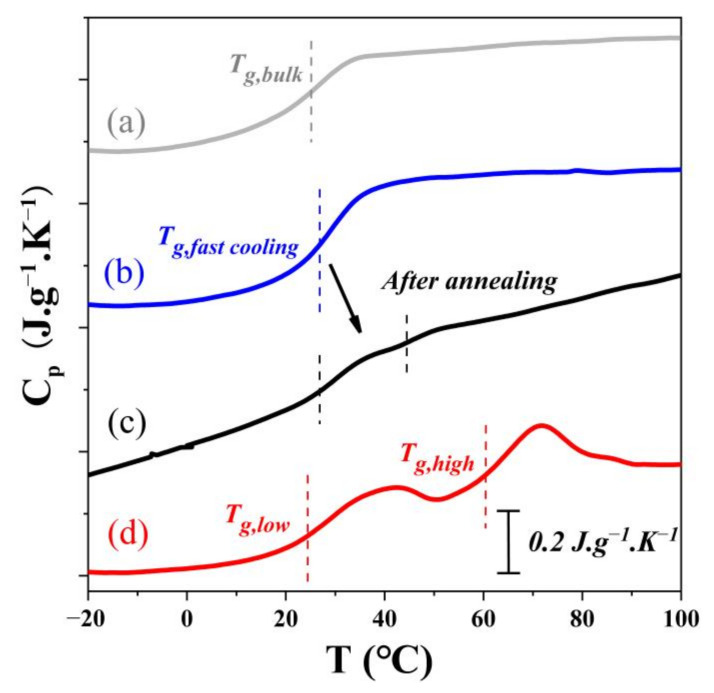
The anchor effect in nanomolding technology (NMT) refers to the effect that polymer nanorods in nanopores on metal surfaces act as anchors to firmly bond the outside polymer components onto the metal surface. In this work, the influences of thermal treatments on the anchor effect are studied at microscopic level from the perspective of interfacial interaction by a model system (poly(-butyl methacrylate) (PBMA) and alumina nanopore composite). The differential scanning calorimeter and fluorescence results indicate that the formation of a dense polymer layer in close contact with the pore walls after proper thermal treatments is the key for a strong interfacial interaction. Such polymer layers were formed in NMT products composed of PBMA and aluminum after slow cooling or annealing, with an up to eighteen-fold improvement of the interfacial bonding strength. The polymer chains near the nanopore walls eliminate the thermal stress induced by the mismatch of thermal expansion coefficients through relaxation over time and remain in close proximity with the pore walls during the cooling process of nanomolding. The above dynamic behaviors of the polymer chains ensure the formation of stable interfacial interaction, and then lead to the formation of the anchor effect.
纳米成型技术(NMT)中的锚定效应是指金属表面纳米孔中的聚合物纳米棒作为锚,将外部聚合物组分牢固地粘结在金属表面上的效应。在这项工作中,通过一个模型体系(聚甲基丙烯酸丁酯(PBMA)与氧化铝纳米孔复合材料),从界面相互作用的角度在微观层面研究了热处理对锚定效应的影响。差示扫描量热仪和荧光结果表明,经过适当热处理后,与孔壁紧密接触形成致密聚合物层是实现强界面相互作用的关键。在由PBMA和铝组成的NMT产品中,经过缓慢冷却或退火后形成了这样的聚合物层,界面粘结强度提高了多达18倍。纳米孔壁附近的聚合物链通过随时间松弛消除了由热膨胀系数不匹配引起的热应力,并在纳米成型的冷却过程中与孔壁保持紧密接触。聚合物链的上述动态行为确保了稳定界面相互作用的形成,进而导致锚定效应的形成。