Merta Ildiko, Poletanovic Bojan, Dragas Jelena, Carevic Vedran, Ignjatovic Ivan, Komljenovic Miroslav
Institute of Material Technology, Building Physics, and Building Ecology, Faculty of Civil Engineering, TU Wien, 1040 Vienna, Austria.
Faculty of Civil Engineering, University of Belgrade, 11000 Belgrade, Serbia.
Polymers (Basel). 2022 Apr 28;14(9):1799. doi: 10.3390/polym14091799.
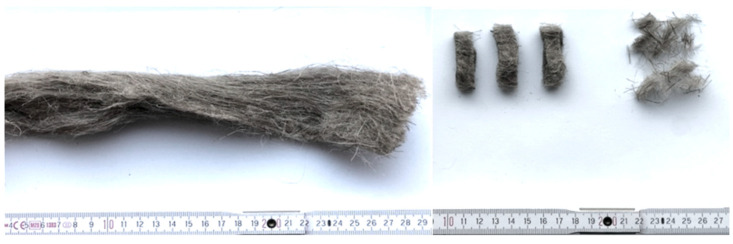
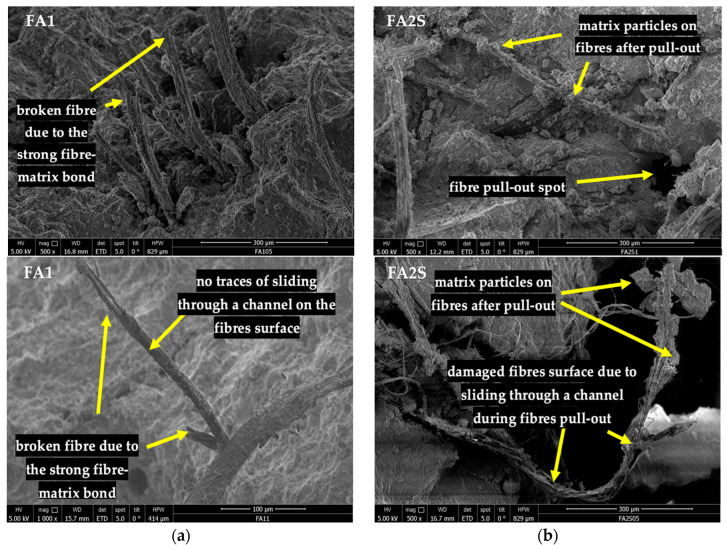
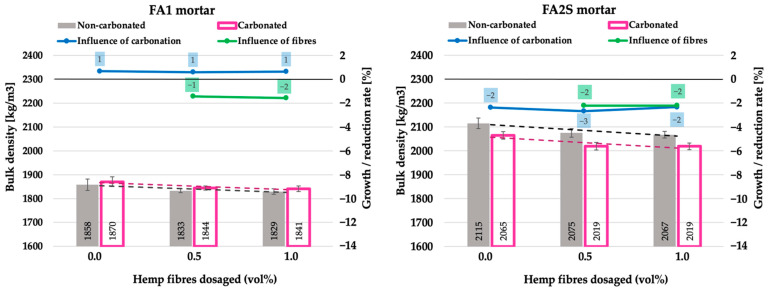
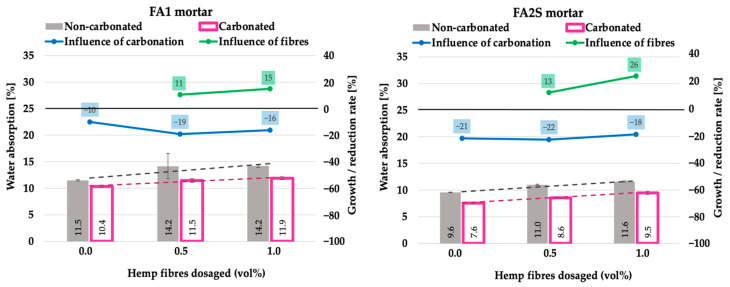
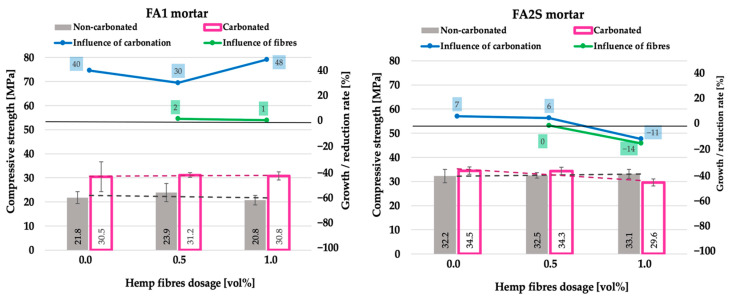
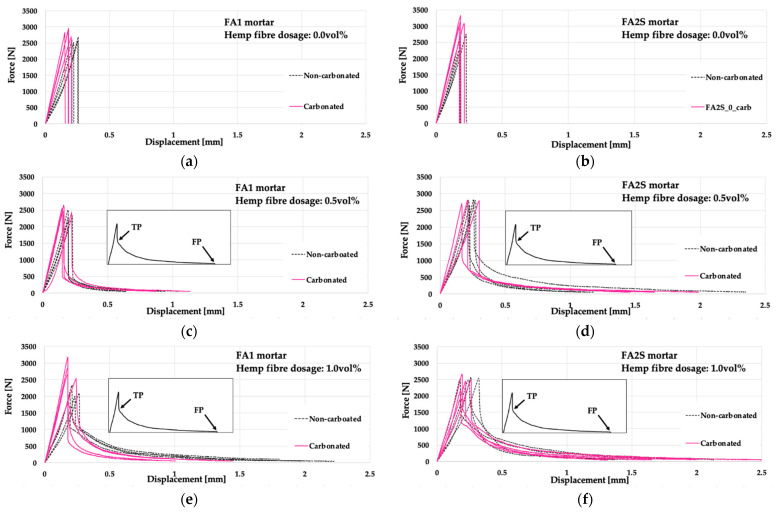
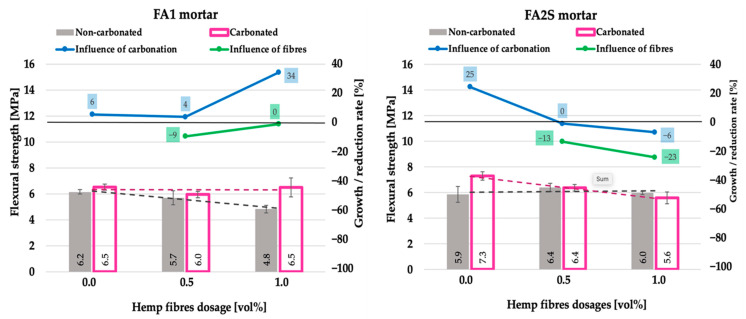
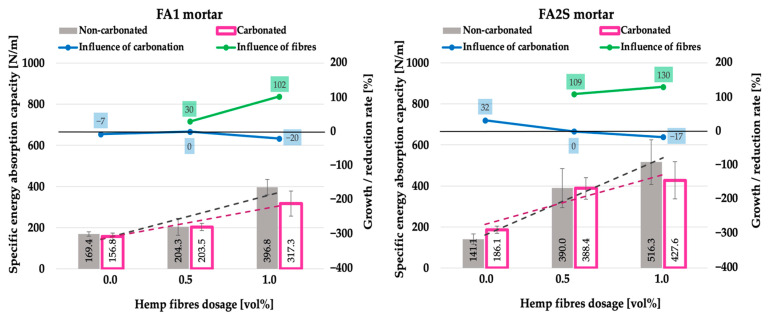
The physical and mechanical properties of hemp-fibre-reinforced alkali-activated (AA) mortars under accelerated carbonation were evaluated. Two matrices of different physical and chemical properties, i.e., a low Ca-containing and less dense one with fly ash (FA) and a high Ca-containing and denser one with FA and granulated blast furnace slag (GBFS), were reinforced with fibres (10 mm, 0.5 vol% and 1.0 vol%). Under accelerated carbonation, due to the pore refinement resulting from alkali and alkaline earth salt precipitation, AA hemp fibre mortars markedly (20%) decreased their water absorption. FA-based hemp mortars increased significantly their compressive and flexural strength (40% and 34%, respectively), whereas in the denser FA/GBFS matrix (due to the hindered CO penetration, i.e., lower chemical reaction between CO and pore solution and gel products), only a slight variation (±10%) occurred. Under accelerated carbonation, embrittlement of the fibre/matrix interface and of the whole composite occurred, accompanied by increased stiffness, decreased deformation capacity and loss of the energy absorption capacity under flexure. FA-based matrices exhibited more pronounced embrittlement than the denser FA/GBFS matrices. A combination of FA/GBFS-based mortar reinforced with 0.5 vol% fibre dosage ensured an optimal fibre/matrix interface and stress transfer, mitigating the embrittlement of the material under accelerated carbonation.
对加速碳化条件下麻纤维增强碱激发(AA)砂浆的物理和力学性能进行了评估。用纤维(10毫米,0.5体积%和1.0体积%)增强了两种具有不同物理和化学性质的基体,即一种含低钙且密度较小的粉煤灰(FA)基体,以及一种含高钙且密度较大的粉煤灰和粒化高炉矿渣(GBFS)基体。在加速碳化条件下,由于碱和碱土盐沉淀导致孔隙细化,AA麻纤维砂浆的吸水率显著降低(20%)。基于FA的麻砂浆的抗压强度和抗折强度显著提高(分别提高40%和34%),而在密度较大的FA/GBFS基体中(由于CO渗透受阻,即CO与孔隙溶液和凝胶产物之间的化学反应较低),仅发生了轻微变化(±10%)。在加速碳化条件下,纤维/基体界面和整个复合材料发生脆化,同时伴随着刚度增加、变形能力降低以及弯曲时能量吸收能力丧失。基于FA的基体比密度较大的FA/GBFS基体表现出更明显的脆化。用0.5体积%纤维剂量增强的基于FA/GBFS的砂浆组合确保了最佳的纤维/基体界面和应力传递,减轻了加速碳化条件下材料的脆化。