Flores-Duarte Noris J, Mateos-Naranjo Enrique, Redondo-Gómez Susana, Pajuelo Eloísa, Rodriguez-Llorente Ignacio D, Navarro-Torre Salvadora
Departamento de Microbiología y Parasitología, Facultad de Farmacia, Universidad de Sevilla, García González 2, 41012 Sevilla, Spain.
Departamento de Biología Vegetal y Ecología, Facultad de Biología, Universidad de Sevilla, Apartado 1095, 41012 Sevilla, Spain.
Plants (Basel). 2022 Apr 26;11(9):1164. doi: 10.3390/plants11091164.
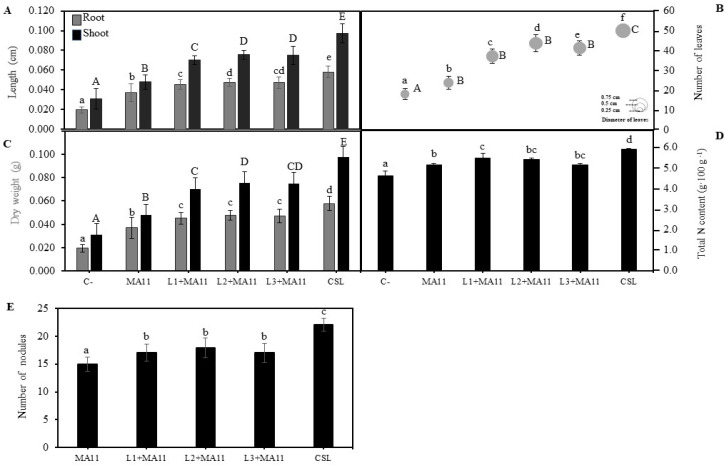
Legumes are usually used as cover crops to improve soil quality due to the biological nitrogen fixation that occurs due to the interaction of legumes and rhizobia. This symbiosis can be used to recover degraded soils using legumes as pioneer plants. In this work, we screened for bacteria that improve the legume-rhizobia interaction in nutrient-poor soils. Fourteen phosphate solubilizer-strains were isolated, showing at least three out of the five tested plant growth promoting properties. Furthermore, cellulase, protease, pectinase, and chitinase activities were detected in three of the isolated strains. sp. L1, L2, and L3 were selected to inoculate seeds and plants of using a nutrient-poor soil as substrate under greenhouse conditions. The effects of the three bacteria individually and in showed more vigorous plants with increased numbers of nodules and a higher nitrogen content than non-inoculated plants. Moreover, bacterial inoculation increased plants' antioxidant activities and improved their development in nutrient-poor soils, suggesting an important role in the stress mechanisms of plants. In conclusion, the selected strains are nodulation-enhancing rhizobacteria that improve leguminous plants growth and nodulation in nutrient-poor soils and could be used by sustainable agriculture to promote plants' development in degraded soils.
由于豆科植物与根瘤菌相互作用会发生生物固氮作用,豆科植物通常被用作覆盖作物来改善土壤质量。这种共生关系可用于利用豆科植物作为先锋植物来恢复退化土壤。在这项工作中,我们筛选了能在营养贫瘠土壤中改善豆科植物与根瘤菌相互作用的细菌。分离出了14株解磷菌株,这些菌株在测试的五项促进植物生长特性中至少表现出三项。此外,在其中三株分离菌株中检测到了纤维素酶、蛋白酶、果胶酶和几丁质酶活性。选择菌株L1、L2和L3在温室条件下以营养贫瘠土壤为基质接种的种子和植株。这三种细菌单独接种和混合接种的效果表明,与未接种的植株相比,接种后的植株更健壮,根瘤数量增加,氮含量更高。此外,细菌接种提高了植株的抗氧化活性,并改善了它们在营养贫瘠土壤中的生长,这表明其在植物应激机制中发挥着重要作用。总之,所选菌株是结瘤增强型根际细菌,可改善豆科植物在营养贫瘠土壤中的生长和结瘤,可持续农业可利用它们来促进退化土壤中植物的生长。