Vanlauwe B, Hungria M, Kanampiu F, Giller K E
International Institute of Tropical Agriculture, PO Box 30772, Nairobi, 00100, Kenya.
Embrapa Soja, PO Box 231, CEP 86001-970, Londrina, PR, Brazil.
Agric Ecosyst Environ. 2019 Nov 15;284:106583. doi: 10.1016/j.agee.2019.106583.
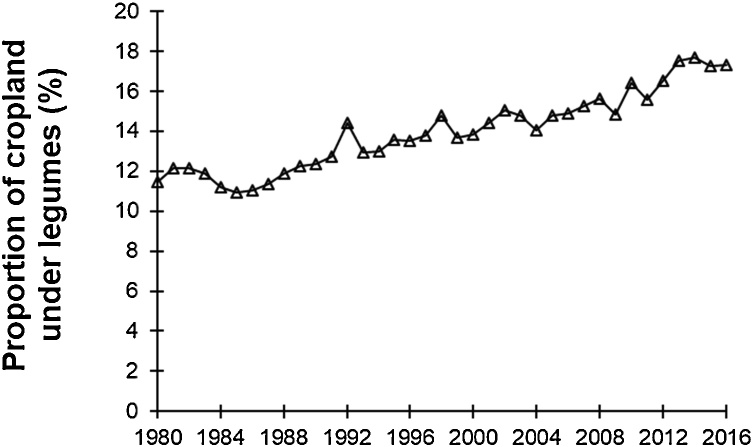
Grain legumes play a key role in smallholder farming systems in sub-Saharan Africa (SSA), in relation to food and nutrition security and income generation. Moreover, because of their N-fixation capacity, such legumes can also have a positive influence on soil fertility. Notwithstanding many decades of research on the agronomy of grain legumes, their N-fixation capacity, and their contribution to overall system productivity, several issues remain to be resolved to realize fully the benefits of grain legumes. In this paper we highlight major lessons learnt and expose key knowledge gaps in relation to grain legumes and their contributions to farming system productivity. The symbiosis between legumes and rhizobia forms the basis for its benefits and biological N-fixation (BNF) relies as much on the legume genotype as on the rhizobial strains. As such, breeding grain legumes for BNF deserves considerably more attention. Even promiscuous varieties usually respond to inoculation, and as African soils contain a huge pool of unexploited biodiversity with potential to contribute elite rhizobial strains, strain selection should go hand-in-hand with legume breeding for N-fixation. Although inoculated strains can outcompete indigenous strains, our understanding of what constitutes a good competitor is rudimentary, as well as which factors affect the persistence of inoculated rhizobia, which in its turn determines whether a farmer needs to re-inoculate each and every season. Although it is commonly assumed that indigenous rhizobia are better adapted to local conditions than elite strains used in inoculants, there is little evidence that this is the case. The problems of delivering inoculants to smallholders through poorly-developed supply chains in Africa necessitates inoculants based on sterile carriers with long shelf life. Other factors critical for a well-functioning symbiosis are also central to the overall productivity of grain legumes. Good agronomic practices, including the use of phosphorus (P)-containing fertilizer, improve legume yields though responses to inputs are usually very variable. In some situations, a considerable proportion of soils show no response of legumes to applied inputs, often referred to as non-responsive soils. Understanding the causes underlying this phenomenon is limited and hinders the uptake of legume agronomy practices. Grain legumes also contribute to the productivity of farming systems, although such effects are commonly greater in rotational than in intercropping systems. While most cropping systems allow for the integration of legumes, intercropped legumes provide only marginal benefits to associated crops. Important rotational benefits have been shown for most grain legumes though those with the highest N accumulation and lowest N harvest index appear to demonstrate higher residual benefits. N balance estimates often results in contradictory observations, mostly caused by the lack of understanding of belowground contributions of legumes to the N balance. Lastly, the ultimate condition for increased uptake of grain legumes by smallholder farmers lies in the understanding of how legume technologies and management practices can be tailored to the enormous diversity of agroecologies, farming systems, and smallholder farms in SSA. In conclusion, while research on grain legumes has revealed a number of important insights that will guide realization of the full potential of such legumes to the sustainable intensification of smallholder farming systems in SSA, many research challenges remain to be addressed to realize the full potential of BNF in these systems.
豆科粮食作物在撒哈拉以南非洲(SSA)的小农农业系统中,对于粮食和营养安全以及创收起着关键作用。此外,由于它们的固氮能力,此类豆科作物还能对土壤肥力产生积极影响。尽管对豆科粮食作物的农艺学、固氮能力及其对整个系统生产力的贡献进行了数十年研究,但要充分实现豆科粮食作物的益处,仍有若干问题有待解决。在本文中,我们着重介绍了主要经验教训,并揭示了与豆科粮食作物及其对农业系统生产力贡献相关的关键知识空白。豆科植物与根瘤菌之间的共生关系是其益处的基础,生物固氮(BNF)既依赖于豆科植物基因型,也依赖于根瘤菌菌株。因此,培育具有生物固氮能力的豆科粮食作物值得更多关注。即使是通用性品种通常也会对接种有反应,而且由于非洲土壤中含有大量未开发的生物多样性,有可能提供优良的根瘤菌菌株,所以菌株选择应与培育固氮豆科植物同步进行。虽然接种菌株可能会胜过本土菌株,但我们对何为优良竞争者以及哪些因素影响接种根瘤菌的持久性(这反过来又决定了农民是否需要每个季节都重新接种)的了解还很初步。尽管人们通常认为本土根瘤菌比接种剂中使用的优良菌株更适应当地条件,但几乎没有证据支持这一点。通过非洲欠发达的供应链向小农提供接种剂存在问题,这就需要基于具有长保质期的无菌载体的接种剂。对于良好共生关系至关重要的其他因素,对豆科粮食作物的整体生产力也很关键。良好的农艺措施,包括使用含磷(P)肥料,可提高豆科作物产量,不过对投入的反应通常差异很大。在某些情况下,相当一部分土壤中的豆科作物对施用的投入物没有反应,通常称为无反应土壤。对这一现象背后原因的了解有限,阻碍了豆科作物农艺措施的采用。豆科粮食作物也有助于农业系统的生产力,尽管这种影响在轮作系统中通常比间作系统中更大。虽然大多数种植系统都允许种植豆科作物,但间作的豆科作物给相关作物带来的益处微乎其微。大多数豆科粮食作物都显示出重要的轮作益处,不过氮积累量最高且氮收获指数最低的那些作物似乎显示出更高的残留益处。氮平衡估计往往得出相互矛盾的结果,这主要是因为对豆科作物对氮平衡的地下贡献缺乏了解。最后,小农更多采用豆科粮食作物的最终条件在于了解如何使豆科作物技术和管理措施适应SSA农业生态、农业系统和小农场的巨大多样性。总之,虽然对豆科粮食作物的研究已经揭示了一些重要见解,这些见解将指导充分发挥此类豆科作物对SSA小农农业系统可持续集约化的潜力,但要充分发挥这些系统中生物固氮的全部潜力,仍有许多研究挑战有待解决。