Camel Biotechnology Center, Presidential Camels & Camel Racing Affairs Centre, Department of the President's Affairs, PO Box 17292, Al Ain, United Arab Emirates.
Camel Biotechnology Center, Presidential Camels & Camel Racing Affairs Centre, Department of the President's Affairs, PO Box 17292, Al Ain, United Arab Emirates.
Dev Comp Immunol. 2022 Aug;133:104443. doi: 10.1016/j.dci.2022.104443. Epub 2022 May 12.
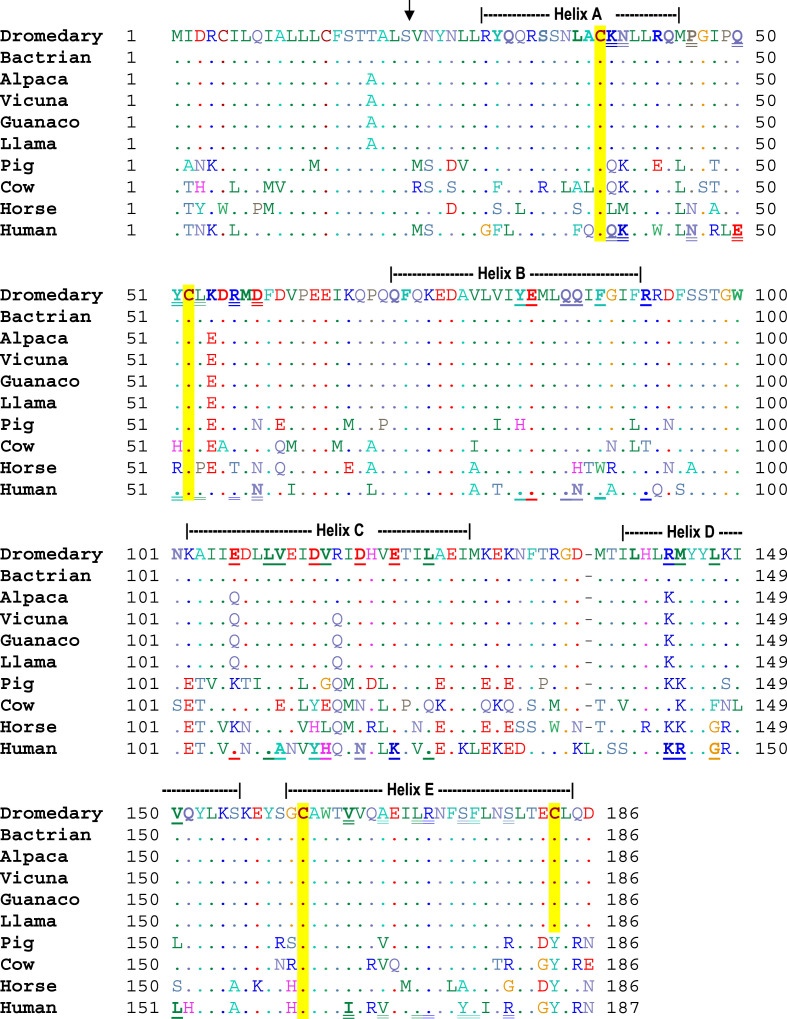
The COVID-19 pandemic is a wake-up call on the zoonotic viral spillover events and the need to be prepared for future outbreaks. Zoonotic RNA viruses like the Middle East respiratory syndrome coronavirus (MERS-CoV) are potential pathogens that could trigger the next pandemic. Dromedary camels are the only known animal source of MERS-CoV zoonotic infections, but little is known about the molecular antiviral response in this species. IFN-β and other type-I interferons provide the first line of defense against invading pathogens in the host immune response. We identified the IFNB gene of the dromedary camel and all extant members of the family Camelidae. Camelid IFN-β is unique with an even number of cysteines in the mature protein compared to other eutherian mammals with an odd number of cysteines. The viral mimetic poly(I:C) strongly induced IFN-β expression in camel kidney cells. Induction of IFN-β expression upon infection with camelpox virus was late and subdued when compared to poly(I:C) treatment. Prokaryotically expressed recombinant dromedary IFN-β induced expression of IFN-responsive genes in camel kidney cells. Further, recombinant IFN-β conferred antiviral resistance to camel kidney cells against the cytopathic effects of the camelpox virus, an endemic zoonotic pathogen. IFN-β from this unique group of mammals will offer insights into antiviral immune mechanisms and aid in the development of specific antivirals against pathogens that have the potential to be the next zoonotic pandemic.
COVID-19 大流行敲响了警钟,提醒人们注意人畜共患病毒溢出事件,并需要为未来的疫情做好准备。中东呼吸综合征冠状病毒(MERS-CoV)等人畜共患 RNA 病毒是可能引发下一次大流行的潜在病原体。单峰驼是已知的唯一 MERS-CoV 人畜共患病感染的动物来源,但对该物种的分子抗病毒反应知之甚少。IFN-β 和其他 I 型干扰素是宿主免疫反应中抵御入侵病原体的第一道防线。我们鉴定了单峰驼和所有现存骆驼科动物的 IFNB 基因。与其他具有奇数个半胱氨酸的真兽类哺乳动物相比,骆驼科 IFN-β 是独特的,其成熟蛋白中具有偶数个半胱氨酸。病毒模拟物聚肌胞可强烈诱导骆驼肾细胞中 IFN-β 的表达。与聚肌胞处理相比,感染骆驼痘病毒后 IFN-β 的表达诱导较晚且较弱。原核表达的重组单峰驼 IFN-β 可诱导骆驼肾细胞中 IFN 反应基因的表达。此外,重组 IFN-β 可赋予骆驼肾细胞抗骆驼痘病毒致细胞病变作用的抗病毒抗性,骆驼痘病毒是一种地方性人畜共患病病原体。来自这群独特哺乳动物的 IFN-β 将为抗病毒免疫机制提供深入了解,并有助于开发针对可能成为下一次人畜共患大流行的病原体的特异性抗病毒药物。