Kheirallah Khalid A, Al-Mistarehi Abdel-Hameed, Alsawalha Lora, Hijazeen Zaidoun, Mahrous Heba, Sheikali Sami, Al-Ramini Salam, Maayeh Mohammad, Dodeen Rachel, Farajeh Mahmoud, Masadeh Nezar, Alemam Amer, Alsulaiman Jomana, Samhouri Dalia
Faculty of Medicine, Jordan University of Science and Technology, Irbid, Jordan.
Jordan Country Office, World Health Organization, Amman, Jordan.
One Health. 2021 May 1;13:100262. doi: 10.1016/j.onehlt.2021.100262. eCollection 2021 Dec.
Zoonotic diseases constitute a threat to humans and animals. The Middle East Region is a hotspot for such a threat; given its geographic location under migratory birds' flight paths, mass gatherings, political conflicts, and refugee crises. Thus, prioritizing zoonotic diseases of national significance is critical for preventing and controlling such threats and optimizing limited resources. Using a multi-sectoral One Health (OH) approach, this study aimed at prioritizing zoonotic diseases of national significance to Jordan and identifying future recommendations and action plans.
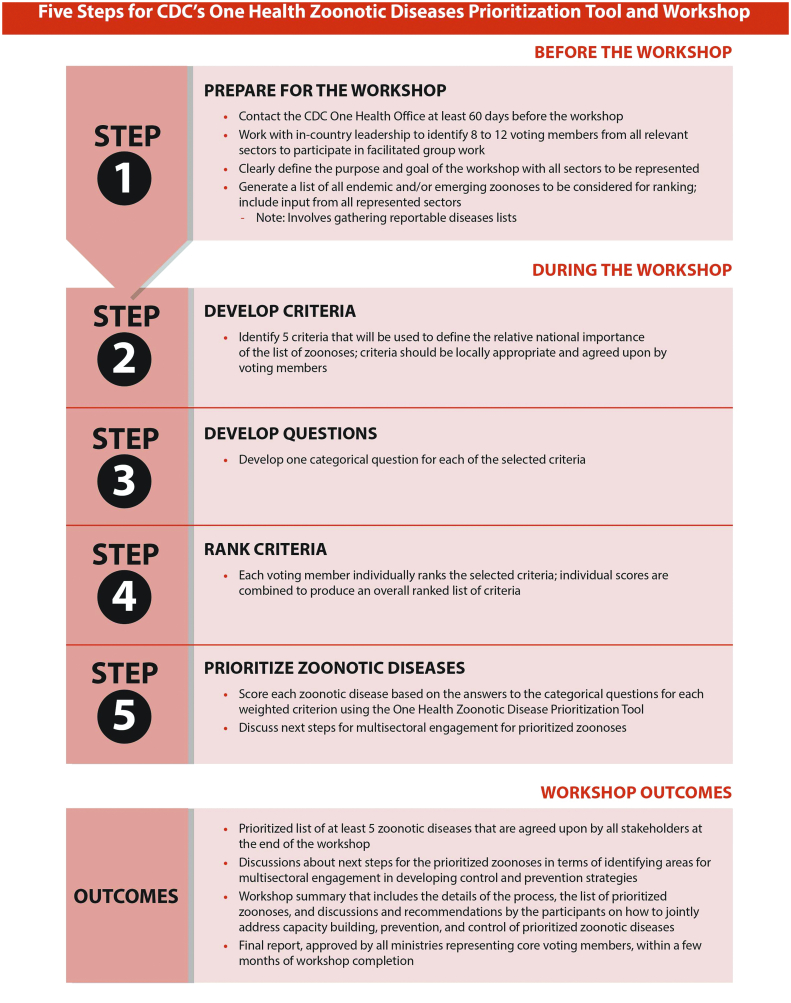
Zoonotic diseases of national significance to Jordan were initially identified ( = 27 diseases). In December 2019, national staff from governmental and non-state sectors were invited to develop ranking criteria, including questions and answers choices, and to weigh each criterion. Then, the national staff were asked to assess zoonotic diseases' priority using the developed criteria and provide recommendations and action plans to strengthen multi-sectoral collaboration.
Seven zoonotic diseases were identified as being of great significance. Rabies was ranked as the number one priority disease, followed by middle east respiratory syndrome, avian influenza, brucellosis, leishmaniasis, rickettsiosis, and salmonellosis. The highest weighted criteria used to rank diseases were disease severity, outbreaks profile, and potential human-to-human transmission. Establishing a one-health platform, surveillance, laboratory, preparedness planning, outbreak response, and workforce were suggested as recommendations for approaching the priority diseases. Respondents identified data sharing, coordination, event-based surveillance, and effective communication channels as vital areas to enhance prevention and control strategies, conduct joint outbreak investigations, and improve multi-sectoral collaboration.
This study represents the first attempt to prioritize zoonotic diseases of national significance in Jordan using the OH approach and a semi-qualitative, transparent, and comparative method. Study results can be used as a decision-making guide for policymakers and stakeholders and a cornerstone for combating zoonotic disease threats.
人畜共患病对人类和动物构成威胁。中东地区是此类威胁的热点地区;鉴于其地理位置处于候鸟飞行路线之下,有大规模集会、政治冲突和难民危机。因此,将具有国家重要性的人畜共患病列为优先事项对于预防和控制此类威胁以及优化有限资源至关重要。本研究采用多部门一体化健康(OH)方法,旨在将对约旦具有国家重要性的人畜共患病列为优先事项,并确定未来的建议和行动计划。
初步确定了对约旦具有国家重要性的人畜共患病(共27种疾病)。2019年12月,邀请了来自政府和非政府部门的国家工作人员制定排名标准,包括问题和答案选项,并对每个标准进行权衡。然后,要求国家工作人员使用制定的标准评估人畜共患病的优先级,并提供加强多部门合作的建议和行动计划。
确定了七种具有重大意义的人畜共患病。狂犬病被列为首要优先疾病,其次是中东呼吸综合征、禽流感、布鲁氏菌病、利什曼病、立克次体病和沙门氏菌病。用于对疾病进行排名的权重最高的标准是疾病严重程度、疫情概况和潜在的人际传播。建议建立一个一体化健康平台、监测、实验室、防备规划、疫情应对和工作人员队伍,作为应对优先疾病的建议。受访者认为数据共享、协调、基于事件的监测和有效的沟通渠道是加强预防和控制战略、开展联合疫情调查以及改善多部门合作的关键领域。
本研究是首次尝试使用OH方法以及半定性、透明和比较性方法对约旦具有国家重要性的人畜共患病进行优先级排序。研究结果可作为政策制定者和利益相关者的决策指南以及抗击人畜共患病威胁的基石。