School of Health Sciences, University of Southampton, Southampton, UK; Centre for Sport, Exercise and Osteoarthritis Versus Arthritis, UK.
Peter Harrison Centre for Disability Sport, School of Sport, Exercise and Health Sciences, Loughborough University, Loughborough, UK.
Disabil Health J. 2022 Jul;15(3):101326. doi: 10.1016/j.dhjo.2022.101326. Epub 2022 Apr 12.
Manual wheelchair users are at high risk of developing shoulder pain. However, it is not known if restrictions to limit the spread of the COVID-19 virus affected physical activity, wheelchair use and shoulder pain.
The aim of the study is to determine whether COVID-19 related restrictions caused changes in physical activity levels and the presence of shoulder pain in persons who use a wheelchair.
Manual wheelchair users completed a survey about the presence and severity of shoulder pain in a cross-sectional study design. Participants completed the Leisure Time Physical Activity Questionnaire and were asked about daily wheelchair activity before and during lockdown. A logistic regression examined the relationship between increase in shoulder pain severity and change in activity levels.
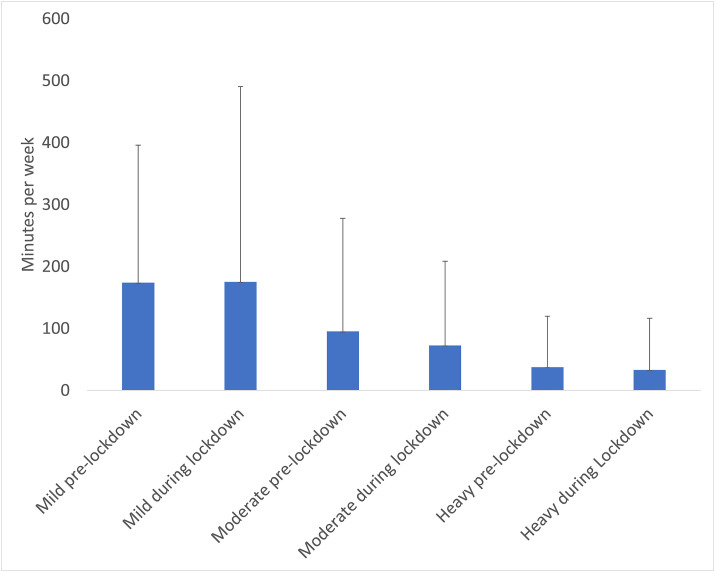
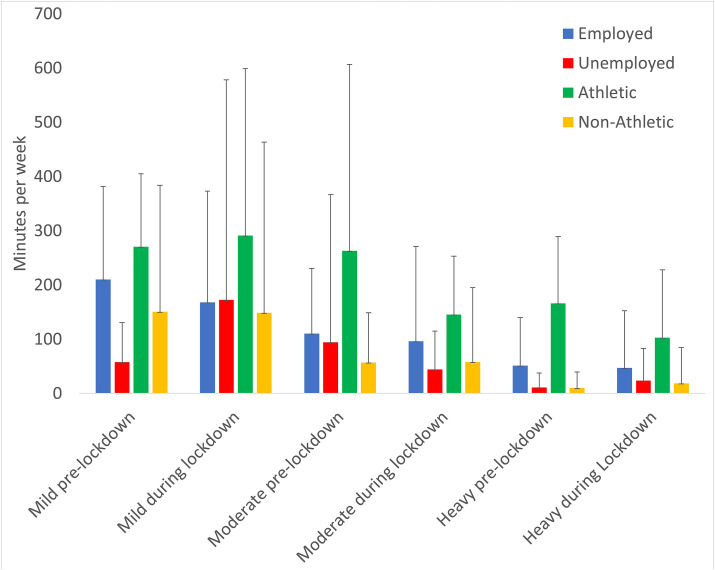
Sixty respondents were included for analysis. There was no significant change in physical activity during lockdown. There was a significant reduction in number of hours of daily wheelchair use and number of chair transfers during lockdown. Of the respondents, 67% reported having shoulder pain and 22% reported their shoulder pain becoming more severe during lockdown. No significant relationship was observed between the change in activity levels and increasing severity of shoulder pain.
Restrictions to reduce the spread of the COVID-19 virus resulted in no changes in physical activity levels in a sample of adult manual wheelchair users; however, there was a reduced time using a wheelchair each day and fewer chair transfers. The changes in wheelchair activities were not related to the worsening of shoulder pain.
手动轮椅使用者患肩部疼痛的风险很高。但是,目前尚不清楚限制新冠病毒传播的措施是否会影响身体活动、轮椅使用和肩部疼痛。
本研究旨在确定与新冠病毒相关的限制措施是否会导致使用轮椅的人群的身体活动水平和肩部疼痛的出现发生变化。
采用横断面研究设计,手动轮椅使用者完成了一份关于肩部疼痛的存在和严重程度的调查。参与者完成了休闲时间体育活动问卷,并被问及封锁期间日常轮椅活动情况。逻辑回归分析了肩部疼痛严重程度增加与活动水平变化之间的关系。
共纳入 60 名受访者进行分析。封锁期间身体活动没有显著变化。封锁期间每日轮椅使用时间和轮椅转移次数均显著减少。在受访者中,67%报告有肩部疼痛,22%报告在封锁期间肩部疼痛加重。活动水平的变化与肩部疼痛严重程度的增加之间没有观察到显著关系。
为减少新冠病毒传播而采取的限制措施并未导致成年手动轮椅使用者的身体活动水平发生变化;但是,每天使用轮椅的时间和轮椅转移次数减少。轮椅活动的变化与肩部疼痛的恶化无关。