Hosana Health Science College, Hosana, Ethiopia.
Epidemiology and Biostatistics Unit, School of Public Health, College of Medicine and Health Sciences, Arba Minch University, Arba Minch, Ethiopia.
BMC Public Health. 2022 May 14;22(1):976. doi: 10.1186/s12889-022-13390-8.
Loss to follow-up (LTFU) from tuberculosis (TB) treatment and care is a major public health problem as patients can be infectious and also may develop a multi-drug resistant TB (MDR-TB). The study aimed to assess whether LTFU differs by the distance TB patients travelled to receive care from the nearest health facility.
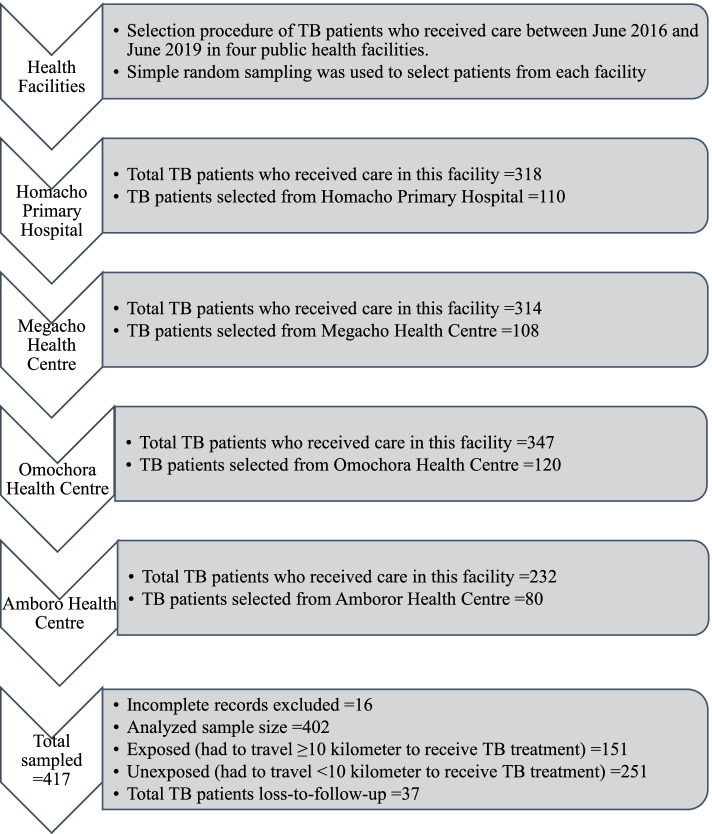
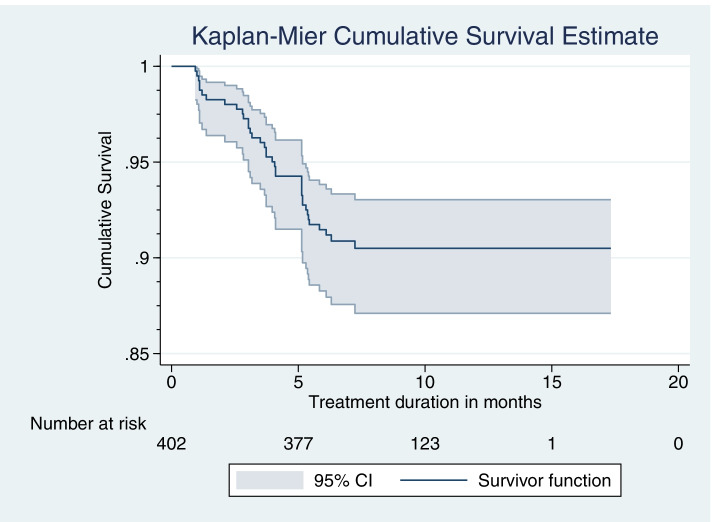
A total of 402 patient cards of TB patients who received care were reviewed from March 1-30, 2020. The Kaplan-Meir curve with the Log-rank test was used to compare differences in LTFU by the distance travelled to reach to the nearest health facility for TB care. The Cox proportional hazard regression model was used to identify predictors. All statistical tests are declared significant at a p-value< 0.05.
A total of 37 patients were LTFU with the incidence rate of 11.26 per 1000 person-months of observations (PMOs) (95% CI: 8.15-15.53). The incidence rate ratio was 12.19 (95% CI: 5.01-35.73) among the groups compared (those who travelled 10 km or more versus those who travelled less than 10 km). Age ≥ 45 years (aHR = 7.71, 95% CI: 1.72, 34.50), educational status (primary schooling, aHR = 3.54, 95% CI: 1.49, 8.40; secondary schooling, aHR = 2.75, 95% CI: 1.08, 7.03), lack of family support (aHR = 2.80, 95% CI: 1.27, 6.19), nutritional support (aHR = 3.40, 95% CI:1.68, 6.89), ≥ 10 km distance to travel to a health facility (aHR = 6.06, 95% CI: 2.33, 15.81) had significantly predicted LTFU from TB treatment and care.
LTFU from adult TB care and treatment was 12 times higher among those who travelled ≥10 km to reach a health facility compared to those who travelled less. To retain adult TB patients in care and ensure appropriate treatment, health professionals and other stakeholders should give due attention to the factors that drive LTFU. We suggest identifying concerns of older patients at admission and those who travel long distance and establish social support platforms that could help people to complete TB treatment.
结核病(TB)治疗和护理的失访(LTFU)是一个主要的公共卫生问题,因为患者可能具有传染性,并且还可能发展为耐多药结核病(MDR-TB)。本研究旨在评估 TB 患者前往最近的医疗机构接受护理的距离是否会导致 LTFU 出现差异。
2020 年 3 月 1 日至 30 日,共审查了 402 名接受治疗的 TB 患者的病历卡。使用 Kaplan-Meier 曲线和对数秩检验来比较因到达最近的 TB 护理医疗机构而导致的 LTFU 差异。使用 Cox 比例风险回归模型来识别预测因素。所有统计检验均在 p 值<0.05 时被宣布为显著。
共有 37 名患者失访,失访率为每 1000 人月观察期(PMO)11.26 例(95%CI:8.15-15.53)。与比较组(旅行 10 公里或以上与旅行少于 10 公里)相比,旅行距离的发生率比为 12.19(95%CI:5.01-35.73)。年龄≥45 岁(aHR=7.71,95%CI:1.72,34.50)、教育程度(小学,aHR=3.54,95%CI:1.49,8.40;中学,aHR=2.75,95%CI:1.08,7.03)、缺乏家庭支持(aHR=2.80,95%CI:1.27,6.19)、营养支持(aHR=3.40,95%CI:1.68,6.89)、旅行距离≥10 公里到达医疗机构(aHR=6.06,95%CI:2.33,15.81)显著预测了成人 TB 治疗和护理的 LTFU。
与旅行距离较短的患者相比,旅行距离≥10 公里到达医疗机构的成人 TB 护理和治疗的 LTFU 高 12 倍。为了使成人 TB 患者继续接受护理并确保进行适当的治疗,卫生专业人员和其他利益相关者应充分关注导致 LTFU 的因素。我们建议在入院时识别出年龄较大患者和长途旅行患者的关注问题,并建立社会支持平台,以帮助人们完成结核病治疗。