Department of Epidemiology and Population Health, Faculty of Health Sciences, American University of Beirut, Beirut, Lebanon.
International Center for Equity in Health, Federal University of Pelotas, Pelotas, Brazil.
J Glob Health. 2022 May 14;12:04038. doi: 10.7189/jogh.12.04038.
Female-headed households (FHHs) are regarded as disadvantaged. There are multiple social trajectories that can lead to women heading households. It is important to distinguish between these trajectories, as well as societal norms and contextual factors, to understand how and when are FHHs represented as a dimension of gender inequity. Our analysis defines and describes a typology of 16 FHH types (FHH16) based on demographic characteristics.
This cross-sectional study used national Demographic Health Surveys (DHS) and Multiple Indicator Cluster Surveys (MICS) in 103 low- and middle-income countries (LMICs) to identify a typology of FHHs based on the family composition and additional household members. We performed descriptive analyses at the household level to generate median proportions of the FHH16 types and selected household characteristics. We conducted cluster analyses to explore FHH16 patterns across naturally grouped clusters of countries and described selected social and economic indicators at the ecological level.
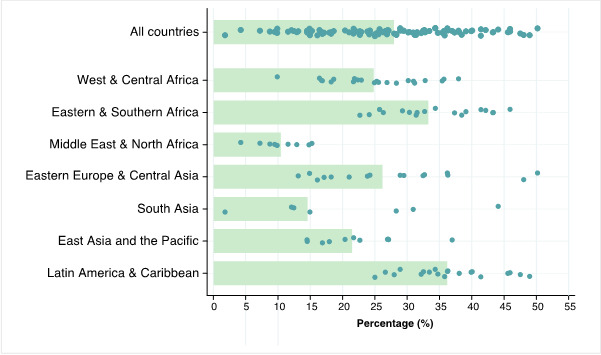
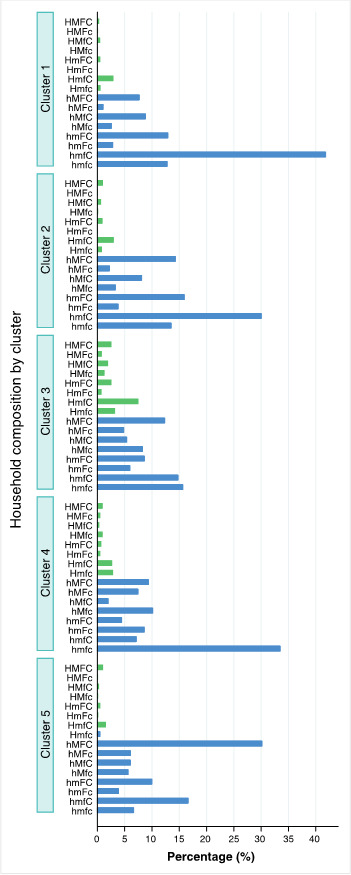
The most common FHH16 types were those where the women household heads lived with children only, were alone, or lived with men, women, and children, but without a husband. In Africa and South Asia, the most common FHH was one where women heads resided with children only. In East Asia and the Pacific, the highest proportion of FHHs were those with men, women, and children. In MENA and Eastern Europe & Central Asia, households with women heads living alone were the most prevalent. Latin America had more FHHs with husbands, comparatively, and the most common FHHs were those with heads living alone or with children. Our exploratory cluster analysis generated five clusters with unique FHH16 patterns. The clusters had distinct geographic, contextual and economic characteristics.
Our typology showed that FHHs are heterogeneous within and between countries. The ecological analysis emphasized further variation created by different societal and cultural factors. Research around their vulnerabilities and strengths needs to consider these factors and their influence on socioeconomic status and health-related outcomes within households headed by women.
女户主家庭(FHH)被视为弱势群体。女性成为户主的原因有很多。区分这些轨迹以及社会规范和背景因素对于了解 FHH 如何以及何时成为性别不平等的一个方面非常重要。我们的分析根据人口特征定义并描述了 16 种 FHH 类型(FHH16)的类型学。
本横断面研究使用了 103 个低收入和中等收入国家(LMIC)的国家人口与健康调查(DHS)和多指标类集调查(MICS),根据家庭构成和其他家庭成员确定了 FHH 的类型学。我们在家庭层面进行描述性分析,以生成 FHH16 类型的中位数比例和选定的家庭特征。我们进行聚类分析,以探索国家自然分组聚类中的 FHH16 模式,并在生态层面描述选定的社会和经济指标。
最常见的 FHH16 类型是那些女性户主仅与子女同住、独居或与男子、妇女和子女同住但没有丈夫的家庭。在非洲和南亚,最常见的 FHH 是女性户主仅与子女同住的家庭。在东亚和太平洋地区,FHH 中比例最高的是那些有男子、妇女和子女的家庭。在中东和北非以及东欧和中亚,女性户主独居的家庭最为普遍。拉丁美洲的 FHH 中相对来说有更多的丈夫,最常见的 FHH 是那些户主独居或与子女同住的家庭。我们的探索性聚类分析生成了五个具有独特 FHH16 模式的聚类。这些聚类具有独特的地理、背景和经济特征。
我们的类型学表明,FHH 在国家内部和国家之间是异构的。生态分析强调了由不同的社会和文化因素造成的进一步差异。围绕他们的脆弱性和优势的研究需要考虑这些因素及其对妇女户主家庭的社会经济地位和与健康相关的结果的影响。