Division of Respirology, Neurology, and Rheumatology, Department of Internal Medicine, Kurume University School of Medicine, Kurume, Japan
Molecular Pathology and Genetics Division, Kanagawa Cancer Center Research Institute, Yokohama, Japan.
J Immunother Cancer. 2022 May;10(5). doi: 10.1136/jitc-2021-004420.
Amino acid metabolism is essential for tumor cell proliferation and regulation of immune cell function. However, the clinical significance of free amino acids (plasma-free amino acids (PFAAs)) and tryptophan-related metabolites in plasma has not been fully understood in patients with non-small cell lung cancer (NSCLC) who receive immune checkpoint inhibitors.
We conducted a single cohort observational study. Peripheral blood samples were collected from 53 patients with NSCLC before treatment with PD-1 (Programmed cell death-1) inhibitors. The plasma concentrations of 21 PFAAs, 14 metabolites, and neopterin were measured by liquid chromatography-mass spectrometry. Using Cox hazard analysis with these variables, a multivariate model was established to stratify patient overall survival (OS). Gene expression in peripheral blood mononuclear cells (PBMCs) was compared between the high-risk and low-risk patients by this multivariate model.
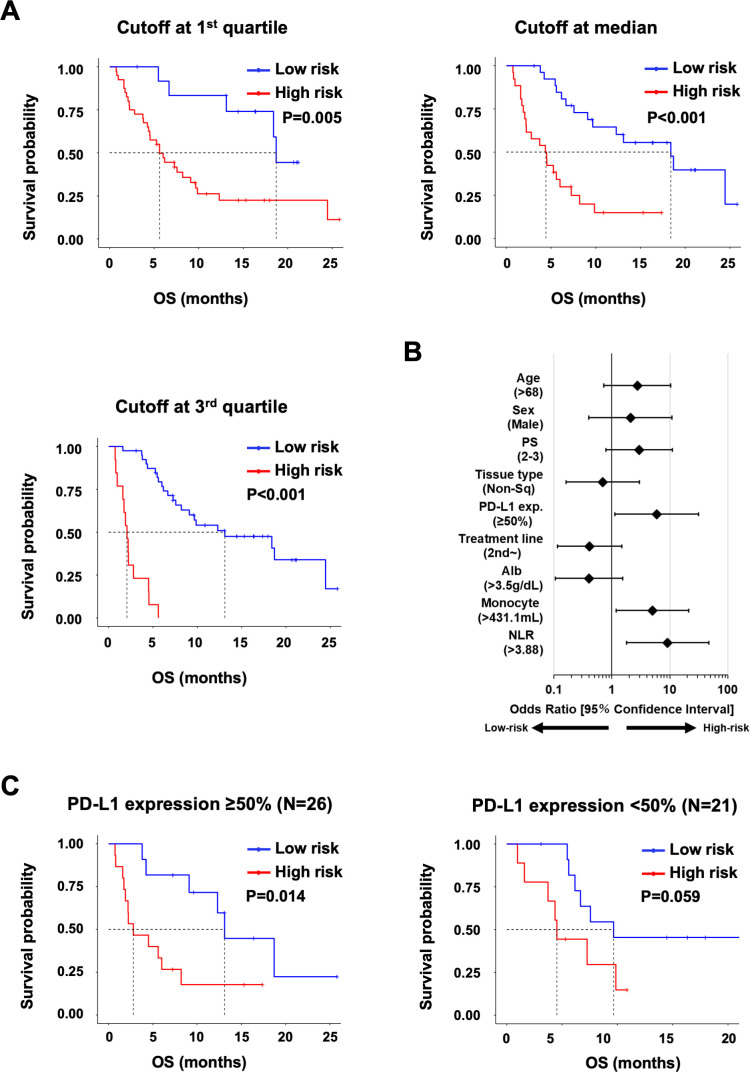
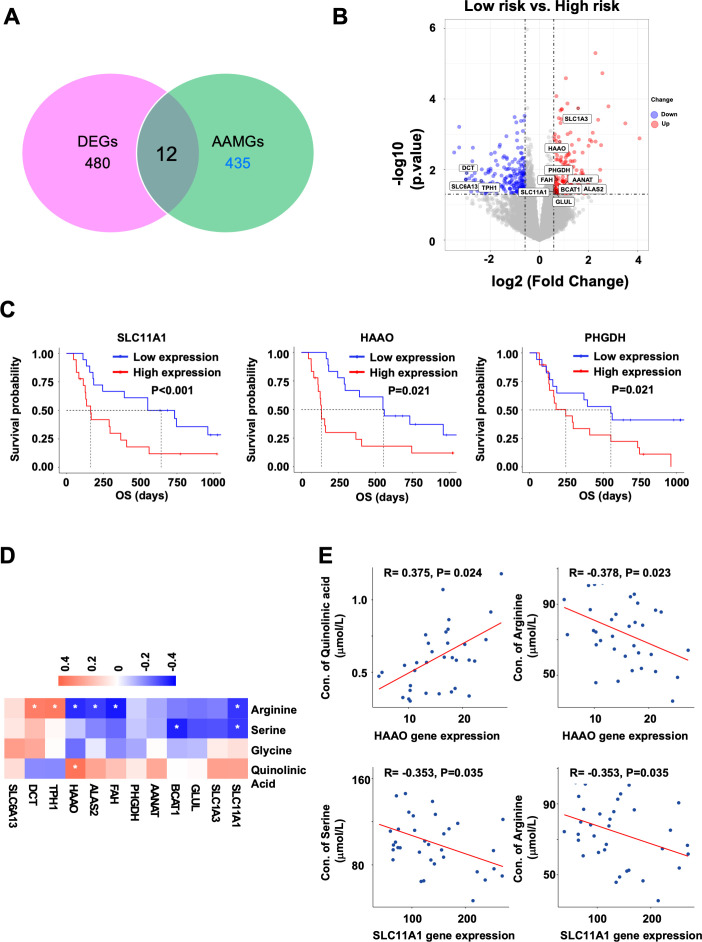
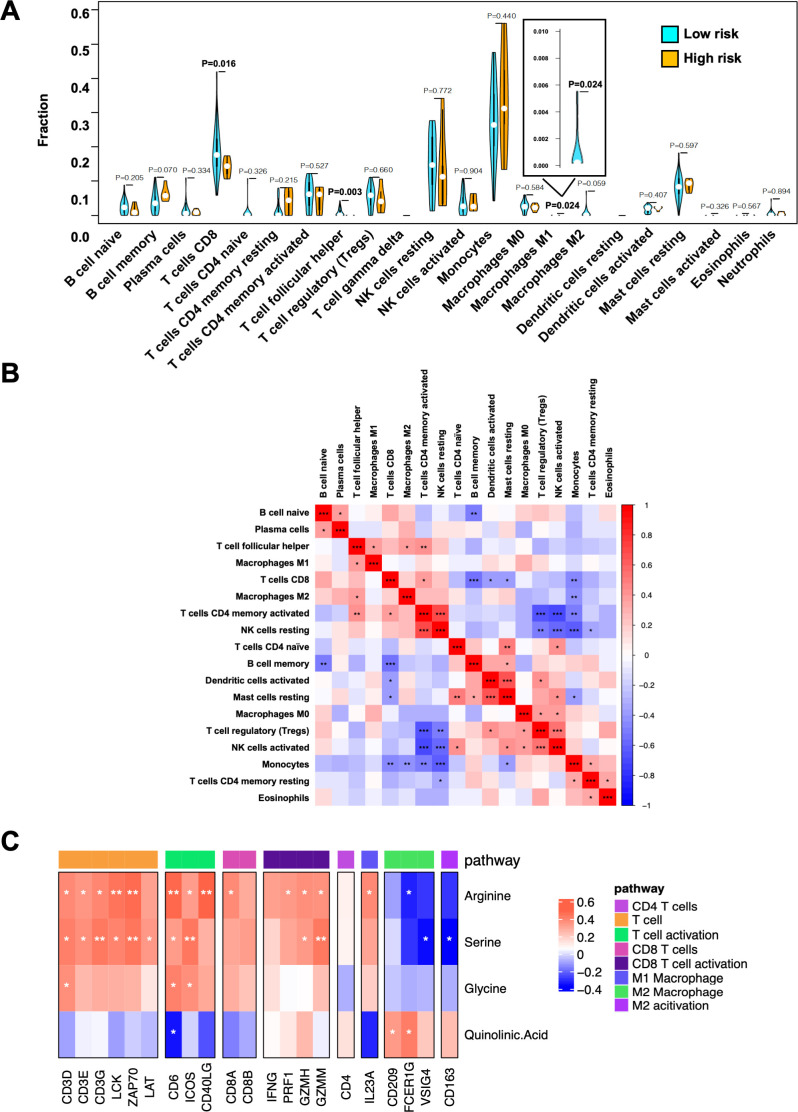
On Cox proportional hazard analysis, higher concentrations of seven PFAAs (glycine, histidine, threonine, alanine, citrulline, arginine, and tryptophan) as well as lower concentrations of three metabolites (3h-kynurenine, anthranilic acid, and quinolinic acid) and neopterin in plasma were significantly correlated with better OS (p<0.05). In particular, the multivariate model, composed of a combination of serine, glycine, arginine, and quinolinic acid, could most efficiently stratify patient OS (concordance index=0.775, HR=3.23, 95% CI 2.04 to 5.26). From the transcriptome analysis in PBMCs, this multivariate model was significantly correlated with the gene signatures related to immune responses, such as CD8 T-cell activation/proliferation and proinflammatory immune responses, and 12 amino acid-related genes were differentially expressed between the high-risk and low-risk groups.
The multivariate model with PFAAs and metabolites in plasma might be useful for stratifying patients who will benefit from PD-1 inhibitors.
氨基酸代谢对肿瘤细胞增殖和免疫细胞功能调节至关重要。然而,在接受免疫检查点抑制剂治疗的非小细胞肺癌(NSCLC)患者中,血浆中游离氨基酸(血浆游离氨基酸(PFAAs))和色氨酸相关代谢物的临床意义尚未完全阐明。
我们进行了一项单队列观察性研究。在 PD-1(程序性细胞死亡蛋白 1)抑制剂治疗前,采集了 53 例 NSCLC 患者的外周血样本。通过液相色谱-质谱法测量 21 种 PFAAs、14 种代谢物和新蝶呤的血浆浓度。使用这些变量的 Cox 风险分析,建立了一个多变量模型来分层患者的总生存(OS)。通过该多变量模型比较了高风险和低风险患者外周血单核细胞(PBMCs)中的基因表达。
在 Cox 比例风险分析中,较高浓度的七种 PFAAs(甘氨酸、组氨酸、苏氨酸、丙氨酸、瓜氨酸、精氨酸和色氨酸)以及较低浓度的三种代谢物(3h-犬尿氨酸、邻氨基苯甲酸和喹啉酸)和新蝶呤与更好的 OS 相关(p<0.05)。特别是,由丝氨酸、甘氨酸、精氨酸和喹啉酸组合而成的多变量模型,能够最有效地分层患者的 OS(一致性指数=0.775,HR=3.23,95%CI 2.04 至 5.26)。从 PBMCs 的转录组分析中,该多变量模型与与免疫反应相关的基因特征显著相关,如 CD8 T 细胞激活/增殖和促炎免疫反应,并且高危组和低危组之间有 12 种氨基酸相关基因表达存在差异。
血浆中 PFAAs 和代谢物的多变量模型可能有助于分层受益于 PD-1 抑制剂的患者。