Alama Angela, Coco Simona, Genova Carlo, Rossi Giovanni, Fontana Vincenzo, Tagliamento Marco, Giovanna Dal Bello Maria, Rosa Alessandra, Boccardo Simona, Rijavec Erika, Biello Federica, Longo Luca, Cavalieri Zita, Bruzzo Cristina, Grossi Francesco
Lung Cancer Unit, Division of Medical Oncology II, IRCCS Ospedale Policlinico San Martino, Largo R. Benzi 10, 16132 Genova, Italy.
Clinical Epidemiology Unit, IRCCS Ospedale Policlinico San Martino, Largo R. Benzi 10, 16132 Genova, Italy.
J Clin Med. 2019 Jul 10;8(7):1011. doi: 10.3390/jcm8071011.
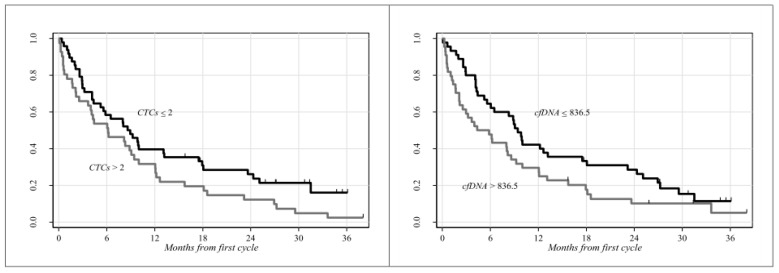
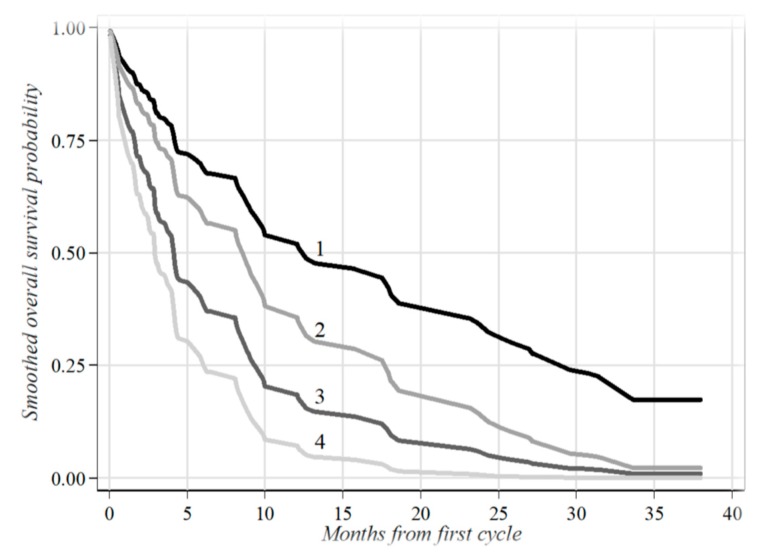
The treatment of advanced non-small cell lung cancer (NSCLC) has been revolutionized by immune checkpoint inhibitors (ICIs). The identification of prognostic and predictive factors in ICIs-treated patients is presently challenging. Circulating tumor cells (CTCs) and cell-free DNA (cfDNA) were evaluated in 89 previously treated NSCLC patients receiving nivolumab. Blood samples were collected before therapy and at the first and second radiological response assessments. CTCs were isolated by a filtration-based method. cfDNA was extracted from plasma and estimated by quantitative PCR. Patients with baseline CTC number and cfDNA below their median values (2 and 836.5 ng from 3 mL of blood and plasma, respectively) survived significantly longer than those with higher values (p = 0.05 and p = 0.04, respectively). The two biomarkers were then used separately and jointly as time-dependent covariates in a regression model confirming their prognostic role. Additionally, a four-fold risk of death for the subgroup presenting both circulating biomarkers above the median values was observed ( < 0.001). No significant differences were found between circulating biomarkers and best response. However, progressing patients with concomitant lower CTCs and cfDNA performed clinically well ( = 0.007), suggesting that jointed CTCs and cfDNA might help discriminate a low-risk population which might benefit from continuing ICIs beyond progression.
免疫检查点抑制剂(ICI)彻底改变了晚期非小细胞肺癌(NSCLC)的治疗方式。目前,在接受ICI治疗的患者中识别预后和预测因素具有挑战性。对89例先前接受过治疗且正在接受纳武单抗治疗的NSCLC患者的循环肿瘤细胞(CTC)和游离DNA(cfDNA)进行了评估。在治疗前以及首次和第二次影像学反应评估时采集血样。通过基于过滤的方法分离CTC。从血浆中提取cfDNA并通过定量PCR进行估算。基线CTC数量和cfDNA低于其各自中位数(分别为每3 mL血液和血浆中2个和836.5 ng)的患者的生存期明显长于数值较高的患者(p值分别为0.05和0.04)。然后,在回归模型中分别并联合使用这两种生物标志物作为时间依赖性协变量,证实了它们的预后作用。此外,观察到两种循环生物标志物均高于中位数的亚组的死亡风险增加了四倍(<0.001)。循环生物标志物与最佳反应之间未发现显著差异。然而,CTC和cfDNA水平均较低的进展期患者临床情况良好(=0.007),这表明联合CTC和cfDNA可能有助于鉴别出可能从疾病进展后继续使用ICI中获益的低风险人群。