Hanning Sara M, Hua Changji, Baroutian Saeid, Burrell Rob, Taylor Matthew, Wright L James, Svirskis Darren
School of Pharmacy, Faculty of Medical and Health Sciences, University of Auckland, 85 Park Road, Grafton, Auckland, 1023 New Zealand.
Department of Chemical and Materials Engineering, Faculty of Engineering, University of Auckland, Auckland, New Zealand.
J Mater Cycles Waste Manag. 2022;24(4):1603-1611. doi: 10.1007/s10163-022-01410-z. Epub 2022 May 10.
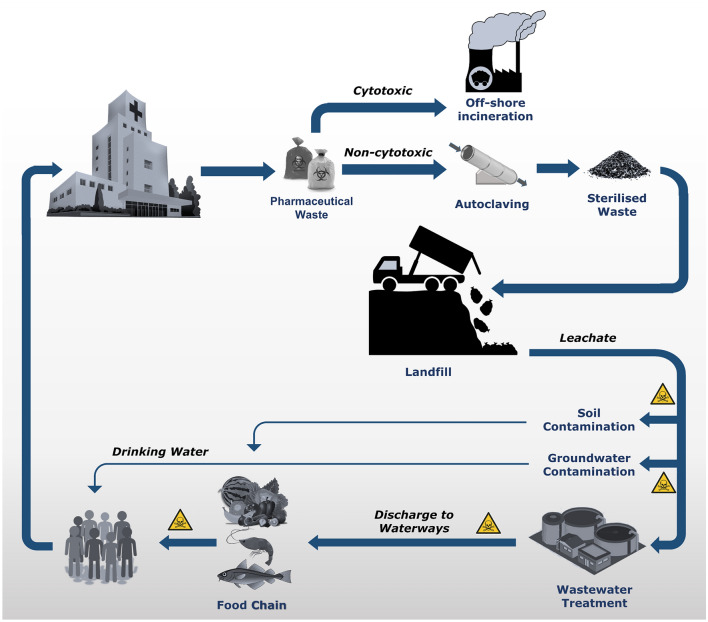
This study aimed to quantify the amount of pharmaceutical waste produced in New Zealand, and determine the composition of pharmaceutical waste from community pharmacies in Auckland, New Zealand. Pharmaceutical waste collected in New Zealand is increasing, peaking at 542 tonne in 2019. Pharmaceutical waste collected from hospitals and pharmacies in Auckland increased by more than fourfold from 2016 to 2020. An audit of the types of pharmaceutical waste collected from community pharmacies revealed that the most common classes of drugs identified in this waste stream belonged to the nervous system, cardiovascular system and alimentary tract, and metabolism. Following examination of the contents of 12 pharmaceutical waste bins, 475 different pharmaceutical products were identified, highlighting the breadth of drugs in this waste stream. A range of dosage forms and hence materials were identified, which could present challenges for future waste treatment approaches. Hazardous drugs were identified including cytotoxic compounds, which should go into a separate waste stream for incineration. There is a need for similar data to be collected from multiple sites to fully appreciate the magnitude and composition of pharmaceutical waste. This will allow for the suitability of current practices for managing this hazardous waste stream to be evaluated.
本研究旨在量化新西兰产生的医药废弃物数量,并确定新西兰奥克兰社区药房的医药废弃物成分。新西兰收集的医药废弃物正在增加,2019年达到峰值542吨。2016年至2020年期间,奥克兰医院和药房收集的医药废弃物增加了四倍多。对从社区药房收集的医药废弃物类型进行的审计显示,该废物流中最常见的药物类别属于神经系统、心血管系统、消化道和新陈代谢类。在检查了12个医药废弃物箱的内容物后,识别出了475种不同的药品,凸显了该废物流中药物的广泛性。识别出了一系列剂型以及相应的材料,这可能给未来的废弃物处理方法带来挑战。识别出了包括细胞毒性化合物在内的危险药物,这些药物应进入单独的废物流进行焚烧。需要从多个地点收集类似数据,以全面了解医药废弃物的规模和成分。这将有助于评估当前管理这一危险废物流的做法是否合适。