Nadeau-Fredette Annie-Claire, Sukul Nidhi, Lambie Mark, Perl Jeffrey, Davies Simon, Johnson David W, Robinson Bruce, Van Biesen Wim, Kramer Anneke, Jager Kitty J, Saran Rajiv, Pisoni Ronald, Chan Christopher T
Centre de Recherche Hôpital Maisonneuve-Rosemont, Montreal, Quebec, Canada.
Department of Medecine, Université de Montréal, Montreal, Quebec, Canada.
Kidney Int Rep. 2022 Mar 4;7(5):1062-1073. doi: 10.1016/j.ekir.2022.02.016. eCollection 2022 May.
Transition to hemodialysis (HD) is a common outcome in peritoneal dialysis (PD), but the associated mortality risk is poorly understood. This study sought to identify rates of and risk factors for mortality after transitioning from PD to HD.
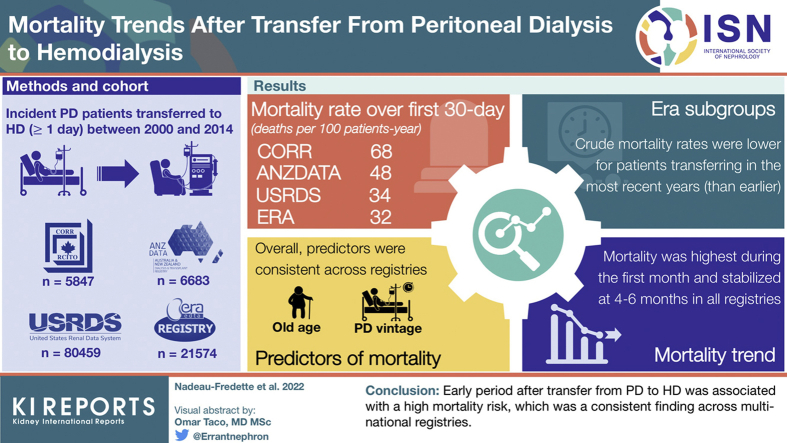
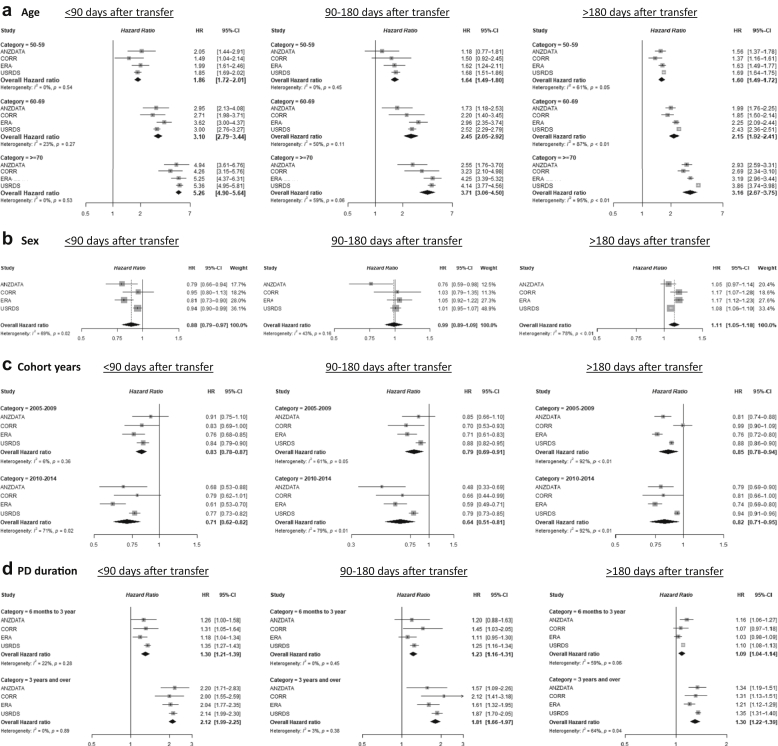
Patients with incident PD (between 2000 and 2014) who transferred to HD for ≥1 day were identified, using data from Australia and New Zealand Dialysis and Transplantation registry (ANZDATA), Canadian Organ Replacement Register (CORR), Europe Renal Association (ERA) Registry, and the United States Renal Dialysis System (USRDS). Crude mortality rates were calculated for the first 180 days after transfer. Separate multivariable Cox models were built for early (<90 days), medium (90-180 days), and late (>180 days) periods after transfer.
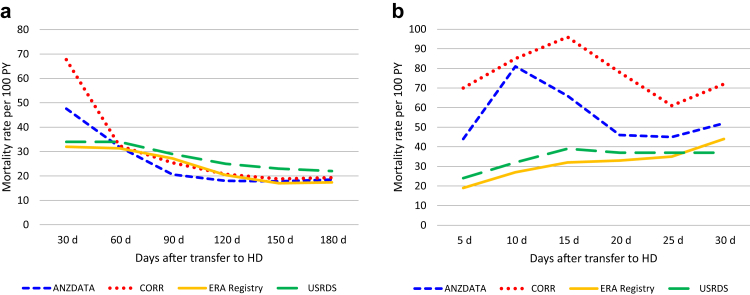
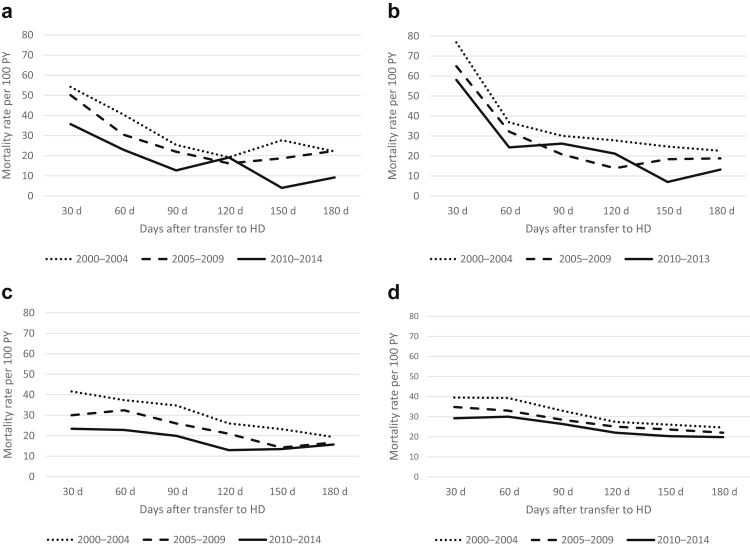
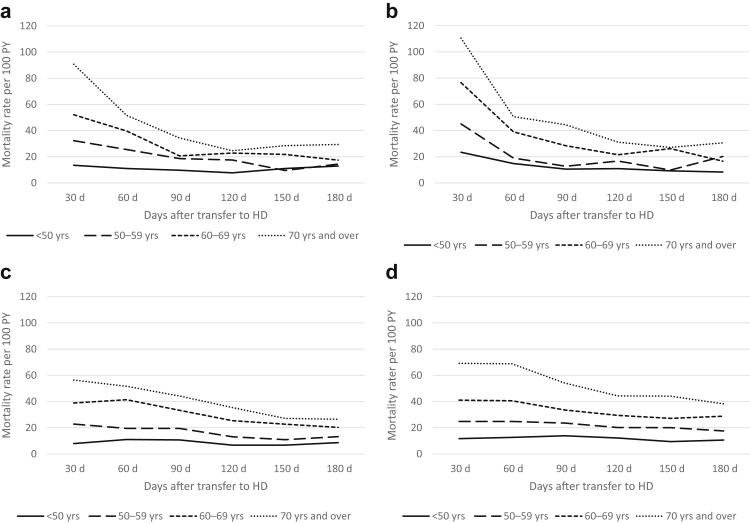
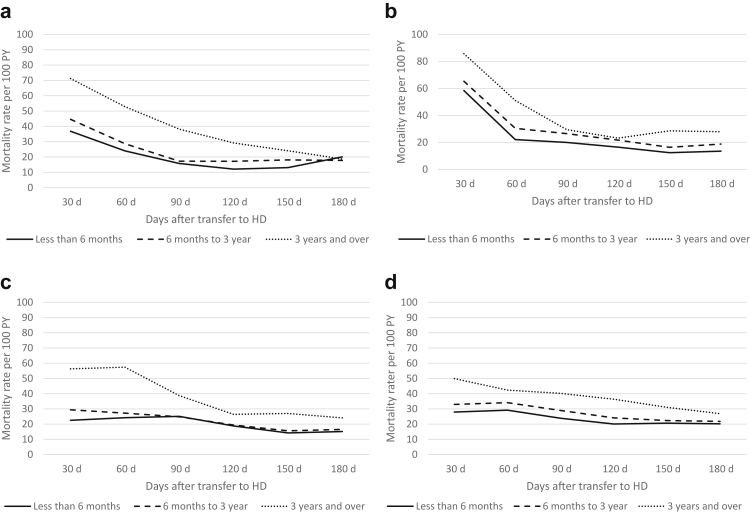
Overall, 6683, 5847, 21,574, and 80,459 patients were included from ANZDATA, CORR, ERA Registry, and USRDS, respectively. In all registries, crude mortality rate was highest during the first 30 days after a transfer to HD declining thereafter to nadir at 4 to 6 months. Crude mortality rates were lower for patients transferring in the most recent years (than earlier). Older age, PD initiation in earlier cohorts, and longer PD vintage were associated with increased risk of death, with the strongest associations during the first 90 days after transfer and attenuating thereafter. Mortality risk was lower for men than women <90 days after transfer, but higher after 180 days.
In this multinational study, mortality was highest in the first month after a transfer from PD to HD and risk factors varied by time period after transfer. This study highlights the vulnerability of patients at the time of modality transfer and the need to improve transitions.
向血液透析(HD)过渡是腹膜透析(PD)的常见结局,但与之相关的死亡风险却知之甚少。本研究旨在确定从PD转为HD后的死亡率及危险因素。
利用澳大利亚和新西兰透析与移植登记处(ANZDATA)、加拿大器官替代登记处(CORR)、欧洲肾脏协会(ERA)登记处以及美国肾脏透析系统(USRDS)的数据,确定2000年至2014年间开始接受PD治疗且转为HD治疗≥1天的患者。计算转移后前180天的粗死亡率。针对转移后的早期(<90天)、中期(90 - 180天)和晚期(>180天)分别构建多变量Cox模型。
总体而言,分别从ANZDATA、CORR、ERA登记处和USRDS纳入了6683例、5847例、21574例和80459例患者。在所有登记处中,转为HD后的前30天粗死亡率最高,此后下降至4至6个月时的最低点。近年来转移的患者粗死亡率较低(与早期相比)。年龄较大、在较早队列中开始PD治疗以及较长的PD治疗时间与死亡风险增加相关,在转移后的前90天关联最强,此后逐渐减弱。转移后<90天男性的死亡风险低于女性,但180天后则较高。
在这项跨国研究中,从PD转为HD后的第一个月死亡率最高,且危险因素因转移后的时间段而异。本研究突出了患者在透析方式转换时的脆弱性以及改善转换过程的必要性。