Yang Xiaozhou, Yin Huimin, Xiao Congshu, Li Rongkuan, Liu Yu
Department of Infectious Diseases, The Second Affiliated Hospital of Dalian Medical University, Dalian, China.
Front Med (Lausanne). 2022 Apr 29;9:879982. doi: 10.3389/fmed.2022.879982. eCollection 2022.
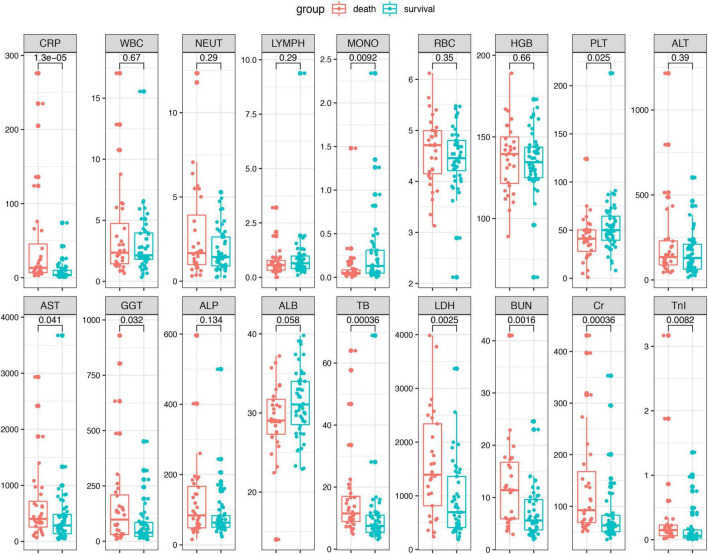
Severe fever with thrombocytopenia syndrome (SFTS) is an emerging infectious disease with the high case-fatality rate, lacking effective therapies and vaccines. Inflammation-based indexes have been widely used to predict the prognosis of patients with cancers and some inflammatory diseases. In our study, we aim to explore the predictive value of the inflammation-based indexes in SFTS patients.
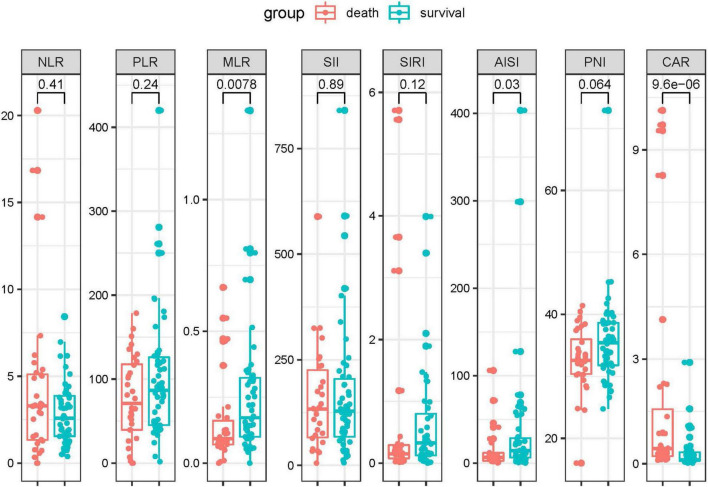
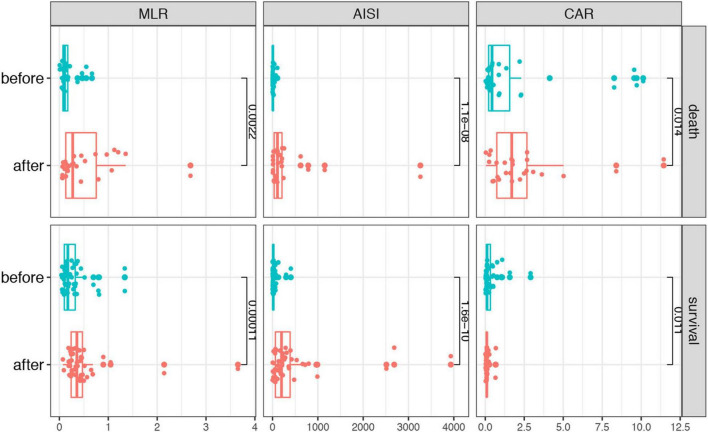
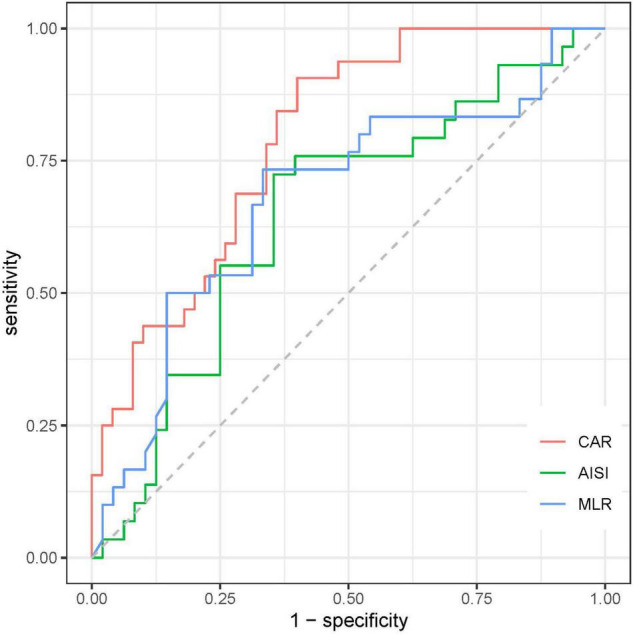
We retrospectively analyzed 82 patients diagnosed with SFTS. The inflammation-based indexes, including neutrophil-to-lymphocyte ratio (NLR), monocyte-to-lymphocyte ratio (MLR), platelet-to-lymphocyte ratio (PLR), systemic immune-inflammation index (SII), systemic inflammation response index (SIRI), aggregate index of systemic inflammation (AISI) and C-reactive protein to albumin ratio (CAR), were compared between the survival and death patients. Receiver operating characteristic (ROC) curves were used to compare the predictive ability of MLR, AISI, and CAR. The survival analysis was based on the Kaplan-Meier (KM) method. Multivariate logistic regression analysis was used to analyze the independent risk factors of poor prognosis in patients with SFTS.
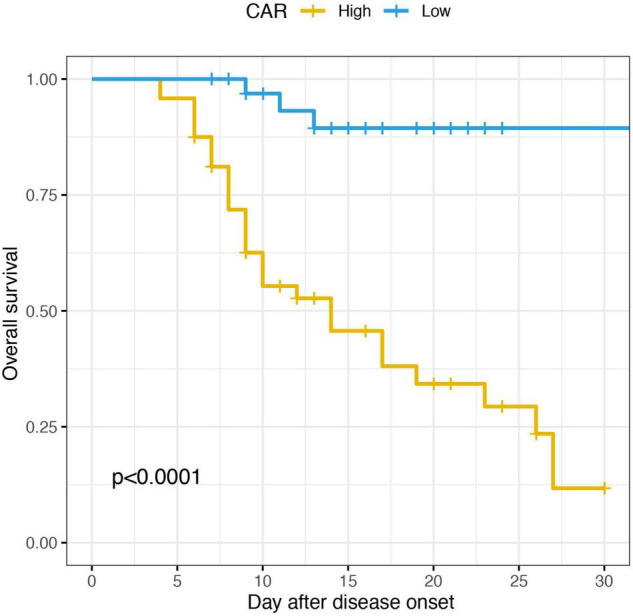
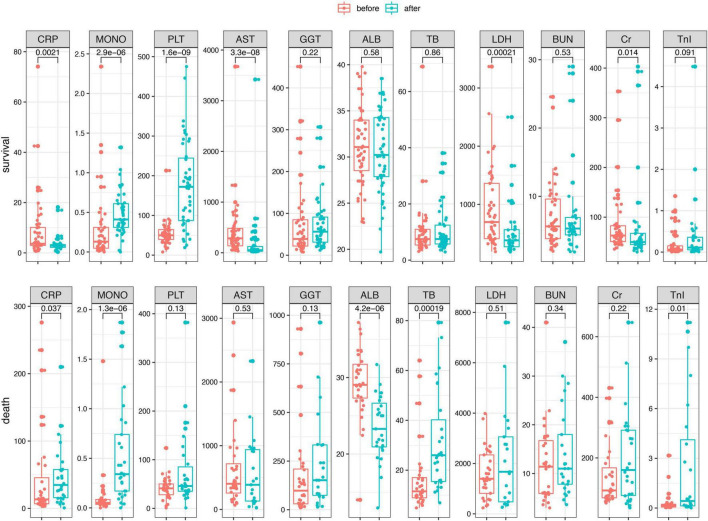
The CAR is higher in the death group while MLR and AISI were higher in the survival group. The ROC curve analysis indicated CAR exhibited more predictive value than the other indexes and the optimal cut-off value of CAR was equal to or greater than 0.14. KM survival curve showed that higher CAR was significantly correlated to the lower overall survival in SFTS patients. Multivariate logistic regression analysis indicated that CAR was an independent risk factor for poor prognosis in patients with SFTS.
The CAR is an independent risk factor for death in patients with SFTS and could predict the poor prognosis of SFTS patients. It could be used as a biomarker to help physicians to monitor and treat patients more aggressively to improve clinical prognosis.
发热伴血小板减少综合征(SFTS)是一种新出现的传染病,病死率高,缺乏有效的治疗方法和疫苗。基于炎症的指标已广泛用于预测癌症患者和一些炎症性疾病患者的预后。在我们的研究中,我们旨在探讨基于炎症的指标对SFTS患者的预测价值。
我们回顾性分析了82例确诊为SFTS的患者。比较了生存组和死亡组患者基于炎症的指标,包括中性粒细胞与淋巴细胞比值(NLR)、单核细胞与淋巴细胞比值(MLR)、血小板与淋巴细胞比值(PLR)、全身免疫炎症指数(SII)、全身炎症反应指数(SIRI)、全身炎症聚集指数(AISI)和C反应蛋白与白蛋白比值(CAR)。采用受试者工作特征(ROC)曲线比较MLR、AISI和CAR的预测能力。生存分析基于Kaplan-Meier(KM)方法。采用多因素logistic回归分析SFTS患者预后不良的独立危险因素。
死亡组的CAR较高,而生存组的MLR和AISI较高。ROC曲线分析表明,CAR比其他指标具有更高的预测价值,CAR的最佳截断值等于或大于0.14。KM生存曲线显示,较高的CAR与SFTS患者较低的总生存率显著相关。多因素logistic回归分析表明,CAR是SFTS患者预后不良的独立危险因素。
CAR是SFTS患者死亡的独立危险因素,可预测SFTS患者的不良预后。它可作为一种生物标志物,帮助医生更积极地监测和治疗患者,以改善临床预后。