Wang Jia-Ni, Tang Li-Rong, Li Wei-Hua, Zhang Xin-Yu, Shao Xiao, Wu Ping-Ping, Yang Ze-Mei, Wu Guo-Wei, Chen Qian, Wang Zheng, Zhang Peng, Li Zhan-Jiang, Wang Zhenchang
Department of Radiology, Beijing Friendship Hospital, Capital Medical University, Beijing, China.
Beijing Anding Hospital, Capital Medical University, Beijing, China.
Front Neurosci. 2022 Apr 26;16:858717. doi: 10.3389/fnins.2022.858717. eCollection 2022.
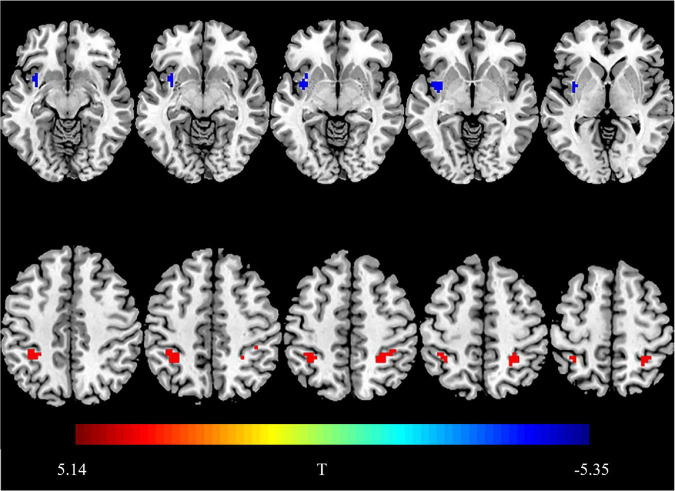
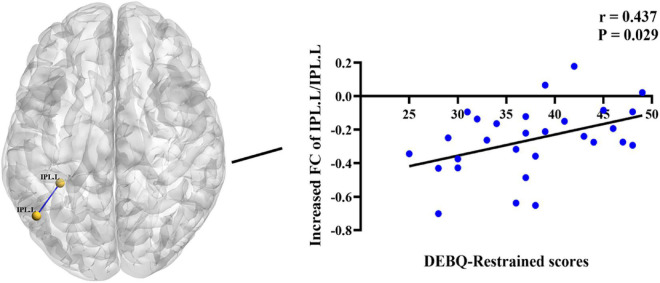
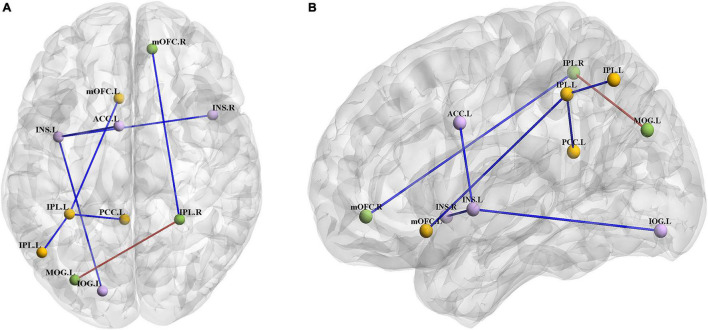
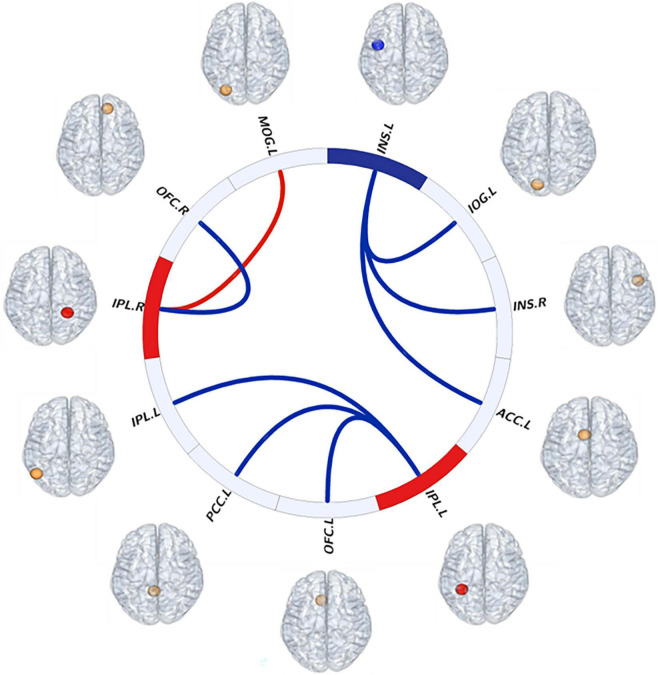
The management of eating behavior in bulimia nervosa (BN) patients is a complex process, and BN involves activity in multiple brain regions that integrate internal and external functional information. This functional information integration occurs in brain regions involved in reward, cognition, attention, memory, emotion, smell, taste, vision and so on. Although it has been reported that resting-state brain activity in BN patients is different from that of healthy controls, the neural mechanisms remain unclear and need to be further explored. The fractional amplitude of low-frequency fluctuation (fALFF) analyses are an important data-driven method that can measure the relative contribution of low-frequency fluctuations within a specific frequency band to the whole detectable frequency range. The fALFF is well suited to reveal the strength of interregional cooperation at the single-voxel level to investigate local neuronal activity power. FC is a brain network analysis method based on the level of correlated dynamics between time series, which establishes the connection between two spatial regions of interest (ROIs) with the assistance of linear temporal correlation. Based on the psychological characteristics of patients with BN and the abnormal brain functional activities revealed by previous neuroimaging studies, in this study, we investigated alterations in regional neural activity by applying fALFF analysis and whole-brain functional connectivity (FC) in patients with BN in the resting state and to explore correlations between brain activities and eating behavior. We found that the left insula and bilateral inferior parietal lobule (IPL), as key nodes in the reorganized resting-state neural network, had altered FC with other brain regions associated with reward, emotion, cognition, memory, smell/taste, and vision-related functional processing, which may have influenced restrained eating behavior. These results could provide a further theoretical basis and potential effective targets for neuropsychological treatment in patients with BN.
神经性贪食症(BN)患者饮食行为的管理是一个复杂的过程,并且BN涉及多个整合内部和外部功能信息的脑区的活动。这种功能信息整合发生在参与奖赏、认知、注意力、记忆、情感、嗅觉、味觉、视觉等的脑区。尽管已有报道称BN患者的静息态脑活动与健康对照者不同,但其神经机制仍不清楚,需要进一步探索。低频振幅分数(fALFF)分析是一种重要的数据驱动方法,可测量特定频段内低频波动对整个可检测频率范围的相对贡献。fALFF非常适合在单像素水平揭示区域间合作的强度,以研究局部神经元活动功率。功能连接(FC)是一种基于时间序列之间相关动力学水平的脑网络分析方法,它借助线性时间相关性建立两个感兴趣空间区域(ROI)之间的连接。基于BN患者的心理特征以及先前神经影像学研究揭示的脑功能活动异常,在本研究中,我们通过应用fALFF分析和静息态BN患者的全脑功能连接(FC)来研究区域神经活动的改变,并探索脑活动与饮食行为之间的相关性。我们发现,作为重组后的静息态神经网络中的关键节点,左侧岛叶和双侧顶下小叶(IPL)与其他与奖赏、情感、认知、记忆、嗅觉/味觉以及视觉相关功能处理相关的脑区的FC发生了改变,这可能影响了节制饮食行为。这些结果可为BN患者的神经心理治疗提供进一步的理论基础和潜在的有效靶点。