Bristol Veterinary School, University of Bristol, Bristol, UK.
Independent Consultant, Bournemouth, UK.
Equine Vet J. 2023 Mar;55(2):295-305. doi: 10.1111/evj.13598. Epub 2022 Jun 19.
Limited information exists regarding changes in the size of respiratory and locomotor muscles in response to exercise training in the Thoroughbred racehorse.
To describe and compare the responses of the respiratory and locomotor muscles to conventional exercise training and inspiratory muscle training (IMT).
Prospective randomised controlled trial.
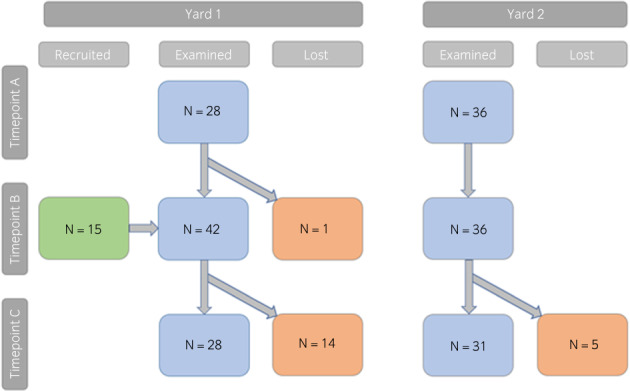
Thoroughbred racehorses, in training for competition in National Hunt races, were recruited from two training establishments. Ultrasonographic images were obtained for selected muscles of the upper airway, diaphragm, accessory respiratory, and locomotor systems and their sizes measured. Examinations were performed at three timepoints: (A) when unfit, (B) following 12 weeks of conventional exercise training and (C) following 10-12 weeks continued training at race fitness. In addition, horses at yard 1 performed IMT, between timepoint B and C, and were randomly assigned into high-load (treatment) or low-load (control) group. Repeated measures models were constructed to compare the change in muscle measurements over time, and to investigate the effects of yard, previous airway surgery and IMT on the change in ultrasonographic size measurements obtained.
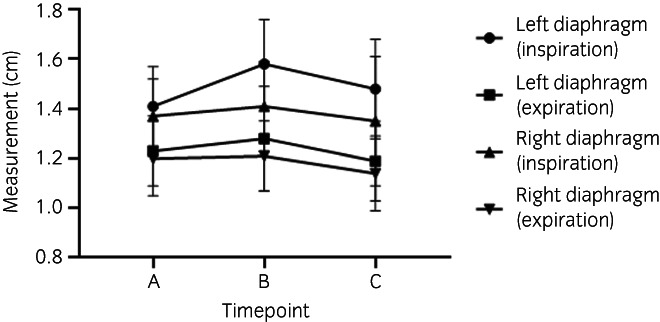
Upper airway muscle size increased in response to conventional race training between timepoints A-C, and B-C. Diaphragm size increased in response to conventional exercise training between timepoints A and B. The diaphragm size of horses that undertook high-load IMT was either maintained or increased, whereas diaphragm size decreased in horses that undertook low-load IMT or no IMT between timepoints B and C. A significant interaction between gluteal muscle size and airway surgery status was observed, with greater gluteal muscle thicknesses measured in horses that had not previously undergone airway surgery (left gluteal 3.9%, p < 0.001; right 4.5%, p = 0.04).
Low number of horses underwent IMT.
Respiratory and locomotor muscles increase in size in response to conventional exercise training, with a further change in diaphragm size in response to inspiratory muscle training.
关于运动训练对纯种赛马呼吸和运动肌肉大小的影响,相关信息有限。
描述和比较常规运动训练和吸气肌训练(IMT)对呼吸和运动肌肉的反应。
前瞻性随机对照试验。
从两个训练机构招募参加国家狩猎比赛的训练有素的纯种赛马。为上呼吸道、膈肌、辅助呼吸和运动系统的选定肌肉获取超声图像,并测量其大小。检查在三个时间点进行:(A)未适应时,(B)经过 12 周常规运动训练后,(C)达到比赛状态后的 10-12 周继续训练后。此外,马厩 1 的马在 B 和 C 之间进行 IMT,并随机分为高负荷(治疗)或低负荷(对照)组。构建重复测量模型以比较肌肉测量值随时间的变化,并研究马厩、先前的气道手术和 IMT 对超声大小测量变化的影响。
上呼吸道肌肉大小在 A-C 和 B-C 之间常规赛马训练中增加,膈肌大小在 A-B 之间常规运动训练中增加。进行高负荷 IMT 的马的膈肌大小保持或增加,而进行低负荷 IMT 或没有 IMT 的马的膈肌大小在 B-C 之间减少。观察到臀肌大小和气道手术状态之间存在显著的相互作用,未进行过气道手术的马的臀肌厚度更大(左侧臀肌 3.9%,p<0.001;右侧 4.5%,p=0.04)。
进行 IMT 的马数量较少。
呼吸和运动肌肉在常规运动训练中会增大,而在吸气肌训练中会进一步改变膈肌大小。