Department of Medicine, Johns Hopkins University, Baltimore, Maryland, USA.
Department of Surgery, Johns Hopkins University, Baltimore, Maryland, USA.
Am J Transplant. 2022 Aug;22(8):2041-2051. doi: 10.1111/ajt.17093. Epub 2022 May 31.
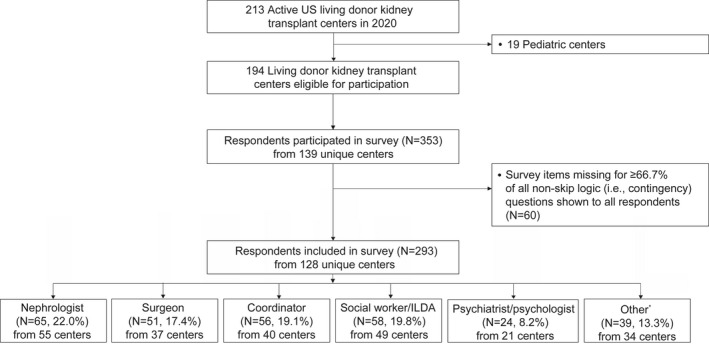
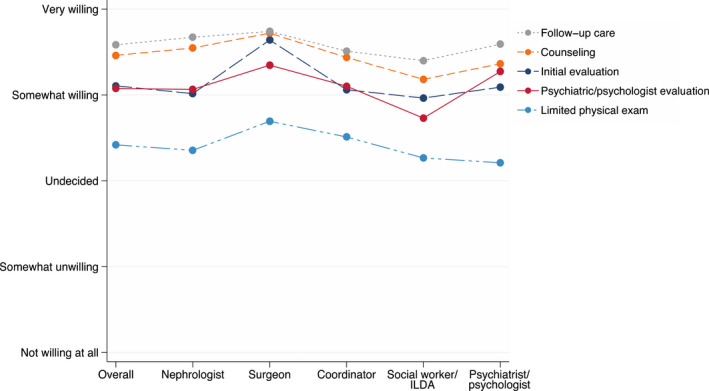
Individuals considering living kidney donation face geographic, financial, and logistical challenges. Telemedicine can facilitate healthcare access/care coordination. Yet difficulties exist in telemedicine implementation and sustainability. We sought to examine centers' practices and providers' attitudes toward telemedicine to improve services for donors. We surveyed multidisciplinary providers from 194 active adult US living donor kidney transplant centers; 293 providers from 128 unique centers responded to the survey (center representation rate = 66.0%), reflecting 83.9% of practice by donor volume and 91.5% of US states/territories. Most centers (70.3%) plan to continue using telemedicine beyond the pandemic for donor evaluation/follow-up. Video was mostly used by nephrologists, surgeons, and psychiatrists/psychologists. Telephone and video were mostly used by social workers, while video or telephone was equally used by coordinators. Half of respondent nephrologists and surgeons were willing to accept a remote completion of physical exam; 68.3% of respondent psychiatrists/psychologists and social workers were willing to accept a remote completion of mental status exam. Providers strongly agreed that telemedicine was convenient for donors and would improve the likelihood of completing donor evaluation. However, providers (65.5%) perceived out-of-state licensing as a key policy/regulatory barrier. These findings help inform practice and underscore the instigation of policies to remove barriers using telemedicine to increase living kidney donation.
个人在考虑活体肾脏捐赠时会面临地理、财务和后勤方面的挑战。远程医疗可以促进获得医疗保健和协调护理。然而,远程医疗的实施和可持续性仍然存在困难。我们旨在研究中心的实践和提供者对远程医疗的态度,以改善供者服务。我们调查了来自 194 家活跃的美国成人活体供肾移植中心的多学科提供者;来自 128 个独特中心的 293 名提供者对调查做出了回应(中心代表率为 66.0%),反映了供者数量的 83.9%和美国 91.5%的州/领地的实践。大多数中心(70.3%)计划在大流行后继续使用远程医疗进行供者评估/随访。视频主要由肾病学家、外科医生和精神科医生/心理学家使用。电话和视频主要由社会工作者使用,而协调员则平等地使用视频或电话。一半的答复肾病学家和外科医生愿意接受远程完成体检;68.3%的答复精神科医生/心理学家和社会工作者愿意接受远程完成精神状态检查。提供者强烈认为远程医疗对供者来说很方便,并将提高完成供者评估的可能性。然而,提供者(65.5%)认为州外许可制度是一个关键的政策/监管障碍。这些发现有助于为实践提供信息,并强调了为利用远程医疗消除障碍以增加活体肾脏捐赠而制定政策。