Leibniz-Institute of Photonic Technology (Leibniz-IPHT), Jena, Germany.
InfectoGnostics Research Campus, Centre for Applied Research, Jena, Germany.
Sci Rep. 2022 May 16;12(1):8067. doi: 10.1038/s41598-022-10823-7.
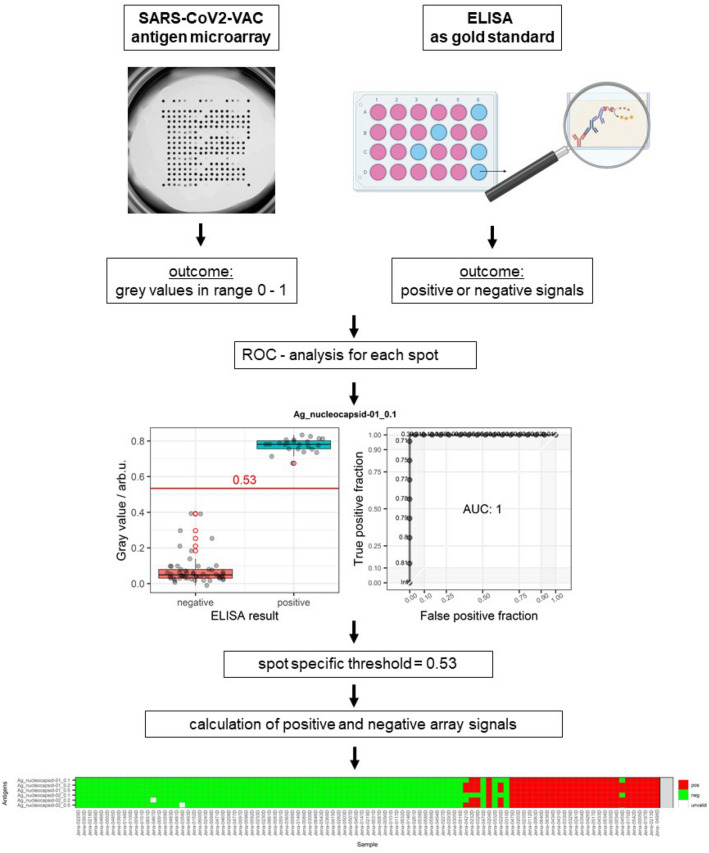
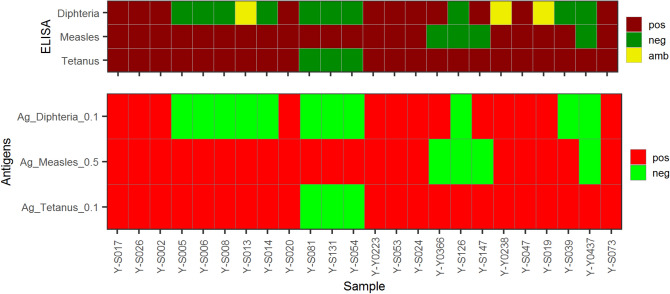
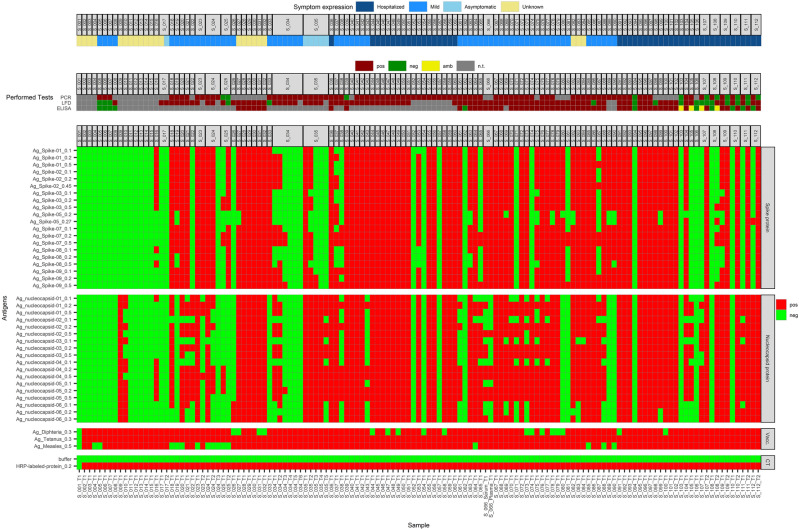
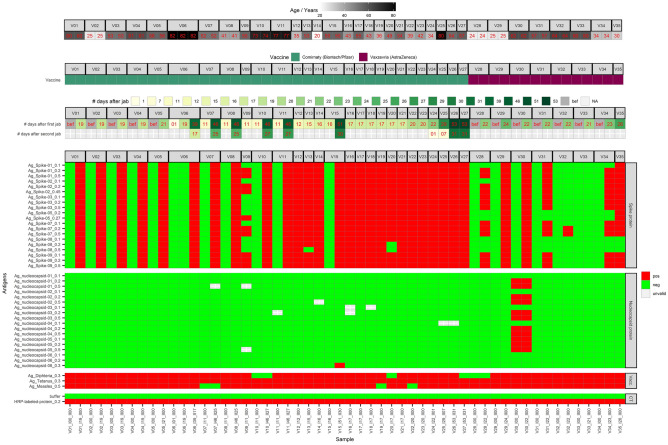
Strategies to contain the current SARS-CoV-2 pandemic rely, beside vaccinations, also on molecular and serological testing. For any kind of assay development, screening for the optimal antigen is essential. Here we describe the verification of a new protein microarray with different commercially available preparations significant antigens of SARS-CoV-2 that can be used for the evaluation of the performance of these antigens in serological assays and for antibody screening in serum samples. Antigens of other pathogens that are addressed by widely used vaccinations were also included. To evaluate the accuracy of 21 different antigens or antigen preparations on the microarray, receiver operating characteristics (ROC) curve analysis using ELISA results as reference were performed. Except for a single concentration, a diagnostic sensitivity of 1 was determined for all antigen preparations. A diagnostic specificity, as well as an area under the curve (AUC) of 1 was obtained for 16 of 21 antigen preparations. For the remaining five, the diagnostic specificity ranged from 0.942 to 0.981 and AUC from 0.974 to 0.999. The optimized assay was subsequently also applied to determine the immune status of previously tested individuals and/or to detect the immunization status after COVID-19 vaccination. Microarray evaluation of the antibody profiles of COVID-19 convalescent and post vaccination sera showed that the IgG response differed between these groups, and that the choice of the test antigen is crucial for the assay performance. Furthermore, the results showed that the immune response is highly individualized, depended on several factors (e.g., age or sex), and was not directly related to the severity of disease. The new protein microarray provides an ideal method for the parallel screening of many different antigens of vaccine-preventable diseases in a single sample and for reliable and meaningful diagnostic tests, as well as for the development of safe and specific vaccines.
控制当前 SARS-CoV-2 大流行的策略除了接种疫苗外,还依赖于分子和血清学检测。对于任何类型的检测方法开发,筛选最佳抗原都是必不可少的。在这里,我们描述了一种新的蛋白质微阵列的验证,该微阵列使用了不同的市售 SARS-CoV-2 显著抗原制备物,可以用于评估这些抗原在血清学检测中的性能,并用于血清样本中的抗体筛选。还包括了其他广泛使用疫苗针对的病原体的抗原。为了评估 21 种不同抗原或抗原制剂在微阵列上的准确性,使用 ELISA 结果作为参考进行了接收者操作特征 (ROC) 曲线分析。除了单个浓度外,所有抗原制剂的诊断灵敏度均为 1。16 种抗原制剂的诊断特异性和曲线下面积 (AUC) 均为 1。对于其余五种,诊断特异性范围为 0.942 至 0.981,AUC 范围为 0.974 至 0.999。随后,优化后的检测方法还应用于确定先前测试个体的免疫状态和/或检测 COVID-19 接种后的免疫状态。对 COVID-19 恢复期和接种后血清的抗体谱进行微阵列评估表明,这些组之间的 IgG 反应不同,并且测试抗原的选择对于检测性能至关重要。此外,结果表明免疫反应具有高度个体性,取决于几个因素(例如年龄或性别),并且与疾病的严重程度没有直接关系。新的蛋白质微阵列为在单个样本中平行筛选可预防疫苗疾病的许多不同抗原提供了一种理想的方法,可用于可靠且有意义的诊断测试以及安全和特异性疫苗的开发。