Cancer Control and Population Sciences, Huntsman Cancer Institute at The University of Utah, South 4729, 2000 Circle of Hope Dr., Salt Lake City, UT, 84112, USA.
Cancer Biostatistics Shared Resource, Huntsman Cancer Institute, Salt Lake City, UT, USA.
J Cancer Surviv. 2023 Dec;17(6):1571-1582. doi: 10.1007/s11764-022-01214-y. Epub 2022 May 17.
We examined whether financial burdens occurring during the COVID-19 pandemic impacted healthcare utilization among survivors of adolescent and young adult cancers.
We surveyed survivors enrolled in a patient navigation program to obtain self-reports of delayed/skipped cancer care or other care, changes to medication obtainment, and changes to medication use since the COVID-19 pandemic began. Reported financial burdens were defined as financial toxicity in the past 4 weeks (COmprehensive Score for financial Toxicity [COST] ≤ median 21) and material hardships (range = 4-11) since March 2020. Adjusted logistic regression models calculated associations and effect modification by gender.
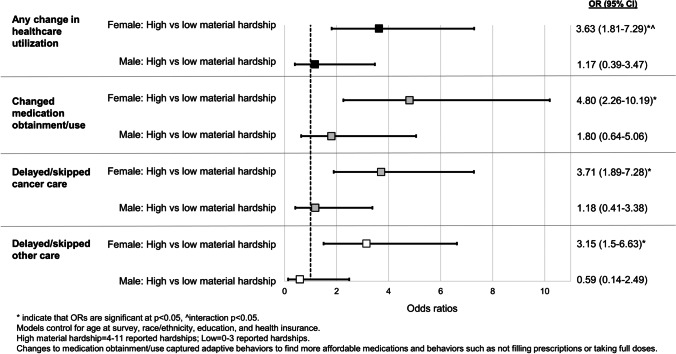
Survivors (n = 341) were mostly female (61.3%) and non-Hispanic White (83.3%). Nearly 20% delayed/skipped cancer care, 35.2% delayed/skipped other care, 19.1% changed medication obtainment, and 12.6% changed medication use. Greater material hardships were associated with delayed/skipped cancer care (odds ratio (OR) = 3.13, 95% CI = 1.44-6.81) and other care (OR = 2.17, 95% CI = 1.18-3.98), and changed medication obtainment (OR = 2.72, 95% CI = 1.43-5.18) or use (OR = 4.49, 95% CI = 2.05-9.80). Financial toxicity was associated with delayed/skipped other care (OR = 2.53, 95% CI = 1.31-4.89) and changed medication obtainment (OR = 1.96, 95% CI = 1.01-3.83) and medication use (OR = 3.73, 95% CI = 1.59-8.73). The association of material hardships and any changes in healthcare utilization was greater among female compared to male survivors.
Financial burdens experienced during the pandemic impeded survivors' ability to utilize necessary healthcare, with worse impacts among female survivors.
Delayed or skipped healthcare may lead to an increased cancer mortality or severity of therapy-related conditions. Providing resources that enable survivors experiencing financial burdens to continue critical cancer and preventive care during the COVID-19 pandemic is a priority.
我们研究了 COVID-19 大流行期间发生的经济负担是否会影响青少年和年轻成人癌症幸存者的医疗保健利用情况。
我们调查了参加患者导航计划的幸存者,以获得自我报告的癌症护理或其他护理延迟/跳过、获取药物的改变以及自 COVID-19 大流行开始以来药物使用的改变。报告的经济负担定义为过去 4 周内的财务毒性(综合财务毒性评分[COST]≤中位数 21)和自 2020 年 3 月以来的物质困难(范围为 4-11)。调整后的逻辑回归模型通过性别计算关联和效应修饰。
幸存者(n=341)主要为女性(61.3%)和非西班牙裔白人(83.3%)。近 20%的人延迟/跳过癌症护理,35.2%的人延迟/跳过其他护理,19.1%的人改变了药物获取,12.6%的人改变了药物使用。更大的物质困难与癌症护理(优势比(OR)=3.13,95%置信区间[CI]=1.44-6.81)和其他护理(OR=2.17,95%CI=1.18-3.98)有关,以及药物获取(OR=2.72,95%CI=1.43-5.18)或使用(OR=4.49,95%CI=2.05-9.80)。财务毒性与其他护理的延迟/跳过(OR=2.53,95%CI=1.31-4.89)和药物获取(OR=1.96,95%CI=1.01-3.83)和药物使用(OR=3.73,95%CI=1.59-8.73)有关。与男性幸存者相比,女性幸存者的物质困难和任何医疗保健利用变化的相关性更大。
大流行期间经历的经济负担阻碍了幸存者获得必要医疗保健的能力,女性幸存者的影响更严重。
延迟或跳过医疗保健可能会导致癌症死亡率增加或与治疗相关的疾病严重程度增加。为在 COVID-19 大流行期间经历经济负担的幸存者提供继续接受关键癌症和预防保健的资源是当务之急。