Hsieh Szu-Min, Chang Shan-Chwen, Cheng Hao-Yuan, Shih Shin-Ru, Lien Chia En
Department of Internal Medicine, Division of Infectious Diseases, National Taiwan University Hospital and College of Medicine, National Taiwan University, Taipei, Taiwan.
Medigen Vaccine Biologics Corporation, Taipei, Taiwan.
Infect Dis Ther. 2022 Aug;11(4):1493-1504. doi: 10.1007/s40121-022-00652-6. Epub 2022 May 17.
MVC-COV1901 is a protein subunit COVID-19 vaccine based on the stable prefusion spike protein S-2P adjuvanted with CpG 1018 and aluminum hydroxide. Interim results of a phase 2 clinical trial demonstrated favorable safety profile and immunogenicity and the vaccine has been authorized for use in Taiwan. However, waning antibody levels after immunization and variants of concern (VoC) could negatively impact vaccine-induced neutralization of virus. In this extension to the phase 1 clinical study we investigated a three-dose regimen of MVC-COV1901 for durability of antibody levels and virus neutralization capacity, including neutralization of the Omicron variant.
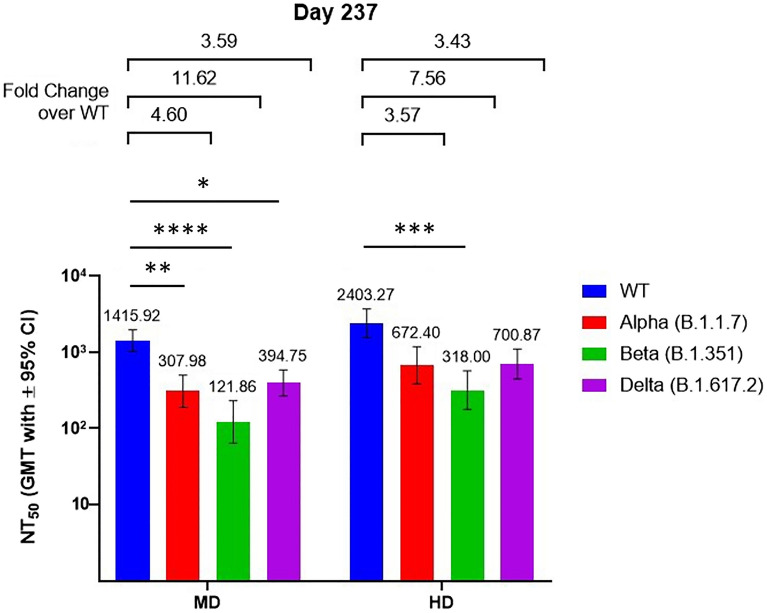
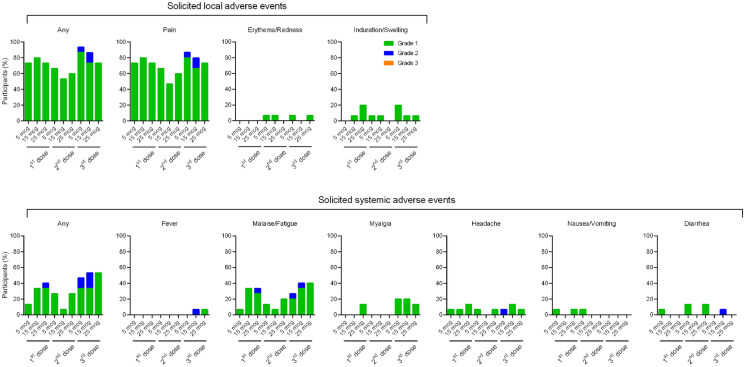
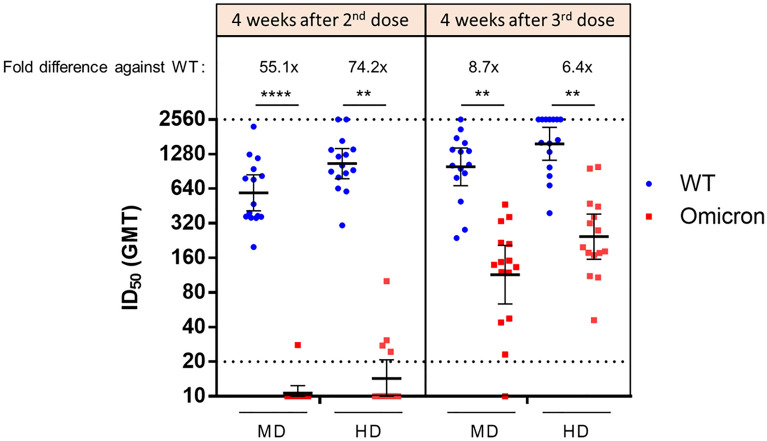
Forty-five healthy adults from 20 to 49 years of age were divided into three groups of 15 participants receiving two doses of either low dose (LD), medium dose (MD), or high dose (HD) of MVC-COV1901. Six months after the second dose (day 209), a third MD dose of MVC-COV1901 was administered to the LD and MD groups and a HD dose was given to the HD group. Safety was followed for up to 28 days after the booster dose by monitoring incidences of adverse events (AE). Immunogenicity and antibody persistence for up to 6 months after the booster dose were assessed by neutralizing assay with the wild-type (Wuhan) SARS-CoV-2 virus. To examine the immunogenicity of booster dose against variants, neutralizing assays were carried out with the Alpha, Beta, and Delta variant viruses and the Omicron variant pseudovirus using samples from 4 weeks after the booster dose.
Adverse reactions after the booster dose were mostly mild and comparable to that of the first two doses. Compared to day 209, neutralizing antibodies were increased by 10.3-28.9 times at 4 weeks after the booster. During the 6-month follow-up after the booster, the rate of decline of neutralizing antibody level was much less than that after the second dose. Three doses of MVC-COV1901 also improved antibody-mediated neutralization of Alpha, Beta, and Delta variants as well as the Omicron variant pseudovirus.
Our data showed increased persistence of neutralizing antibodies and enhancement of immunogenicity against VoCs offered after a third dose of MVC-COV1901.
ClinicalTrials.gov identifier NCT04487210.
MVC-COV1901是一种基于稳定的预融合刺突蛋白S-2P的蛋白质亚基新冠疫苗,佐剂为CpG 1018和氢氧化铝。一项2期临床试验的中期结果显示其安全性和免疫原性良好,该疫苗已在台湾获得使用授权。然而,免疫后抗体水平下降以及关注变异株(VoC)可能会对疫苗诱导的病毒中和作用产生负面影响。在这项1期临床研究的扩展试验中,我们研究了MVC-COV1901三剂方案对抗体水平持久性和病毒中和能力的影响,包括对奥密克戎变异株的中和作用。
45名年龄在20至49岁之间的健康成年人被分为三组,每组15名参与者,分别接受两剂低剂量(LD)、中剂量(MD)或高剂量(HD)的MVC-COV1901。在第二剂接种后6个月(第209天),LD组和MD组接种第三剂MD剂量的MVC-COV1901,HD组接种HD剂量。通过监测不良事件(AE)的发生率,在加强剂量后长达28天内跟踪安全性。通过用野生型(武汉)SARS-CoV-2病毒进行中和试验,评估加强剂量后长达6个月的免疫原性和抗体持久性。为了检测加强剂量对变异株的免疫原性,在加强剂量后4周采集样本,用阿尔法、贝塔和德尔塔变异株病毒以及奥密克戎变异株假病毒进行中和试验。
加强剂量后的不良反应大多为轻度,与前两剂相当。与第209天相比,加强剂量后4周中和抗体增加了10.3至28.9倍。在加强剂量后的6个月随访期间,中和抗体水平的下降速度远低于第二剂接种后。三剂MVC-COV1901还改善了抗体介导的对阿尔法、贝塔和德尔塔变异株以及奥密克戎变异株假病毒的中和作用。
我们的数据显示,第三剂MVC-COV1901接种后,中和抗体的持久性增加,对关注变异株的免疫原性增强。
ClinicalTrials.gov标识符NCT04487210。