• 文献检索
  • 文档翻译
  • 深度研究
  • 学术资讯
  • Suppr Zotero 插件Zotero 插件
  • 邀请有礼
  • 套餐&价格
  • 历史记录
应用&插件
Suppr Zotero 插件Zotero 插件浏览器插件Mac 客户端Windows 客户端微信小程序
定价
高级版会员购买积分包购买API积分包
服务
文献检索文档翻译深度研究API 文档MCP 服务
关于我们
关于 Suppr公司介绍联系我们用户协议隐私条款
关注我们

Suppr 超能文献

核心技术专利:CN118964589B侵权必究
粤ICP备2023148730 号-1Suppr @ 2026

文献检索

告别复杂PubMed语法,用中文像聊天一样搜索,搜遍4000万医学文献。AI智能推荐,让科研检索更轻松。

立即免费搜索

文件翻译

保留排版,准确专业,支持PDF/Word/PPT等文件格式,支持 12+语言互译。

免费翻译文档

深度研究

AI帮你快速写综述,25分钟生成高质量综述,智能提取关键信息,辅助科研写作。

立即免费体验

Emergence and spread of ancestral in Late-Neolithic and Bronze-Age Eurasia, . 5,000 to 1,500 y B.P.

作者信息

Slavin Philip, Sebbane Florent

机构信息

Division of History and Politics, University of Stirling, FK9 4LA Scotland, United Kingdom.

Univ. Lille, Inserm, CNRS, CHU Lille, Institut Pasteur Lille, U1019-UMR 9017-CIIL-Center for Infection and Immunity of Lille, F-59000 Lille, France.

出版信息

Proc Natl Acad Sci U S A. 2022 May 24;119(21):e2204044119. doi: 10.1073/pnas.2204044119. Epub 2022 May 17.
DOI:10.1073/pnas.2204044119
PMID:35580179
原文链接:https://pmc.ncbi.nlm.nih.gov/articles/PMC9172127/
Abstract
摘要
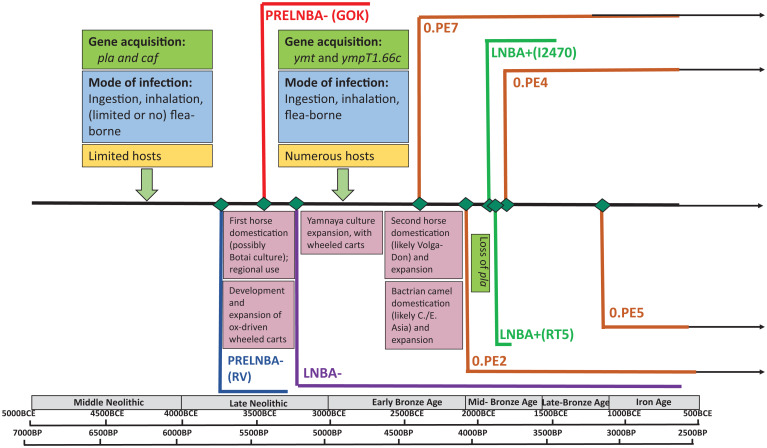
https://cdn.ncbi.nlm.nih.gov/pmc/blobs/1e9a/9172127/e61cded5c4c6/pnas.2204044119fig01.jpg

相似文献

1
Emergence and spread of ancestral in Late-Neolithic and Bronze-Age Eurasia, . 5,000 to 1,500 y B.P.新石器时代晚期和青铜时代欧亚大陆祖先的出现与传播,公元前5000年至1500年
Proc Natl Acad Sci U S A. 2022 May 24;119(21):e2204044119. doi: 10.1073/pnas.2204044119. Epub 2022 May 17.
2
The Stone Age Plague and Its Persistence in Eurasia.石器时代的瘟疫及其在欧亚大陆的持续存在。
Curr Biol. 2017 Dec 4;27(23):3683-3691.e8. doi: 10.1016/j.cub.2017.10.025. Epub 2017 Nov 22.
3
Stone Age genomes shed light on the early evolution, diversity, and ecology of plague.石器时代的基因组揭示了瘟疫的早期进化、多样性和生态。
Proc Natl Acad Sci U S A. 2022 Apr 26;119(17):e2116722119. doi: 10.1073/pnas.2116722119. Epub 2022 Apr 11.
4
[Establishment and evaluation of identification method for Yersinia pestis and Yersinia pseudotuberculosis].[鼠疫耶尔森菌和假结核耶尔森菌鉴定方法的建立与评价]
Zhonghua Liu Xing Bing Xue Za Zhi. 2015 May;36(5):496-500.
5
Yersinia pestis genomes reveal plague in Britain 4000 years ago.鼠疫耶尔森氏菌基因组揭示了 4000 年前英国的鼠疫疫情。
Nat Commun. 2023 May 30;14(1):2930. doi: 10.1038/s41467-023-38393-w.
6
Analysis of 3800-year-old Yersinia pestis genomes suggests Bronze Age origin for bubonic plague.对 3800 年前鼠疫耶尔森氏菌基因组的分析表明,腺鼠疫起源于青铜时代。
Nat Commun. 2018 Jun 8;9(1):2234. doi: 10.1038/s41467-018-04550-9.
7
[Ecological interactions among Yersinia in their common reservoir, the rodent].[耶尔森菌在其共同宿主——啮齿动物中的生态相互作用]
Bull Soc Pathol Exot. 1999 Dec;92(5 Pt 2):414-7.
8
Investigation of Yersinia pestis and Yersinia pseudotuberculosis strains from Georgia and neighboring countries in the Caucasus by high-density SNP microarray.利用高密度单核苷酸多态性(SNP)微阵列对来自格鲁吉亚及高加索地区邻国的鼠疫耶尔森菌和假结核耶尔森菌菌株进行调查。
Arch Microbiol. 2018 Nov;200(9):1345-1355. doi: 10.1007/s00203-018-1545-8. Epub 2018 Jul 4.
9
Emergence and Spread of Basal Lineages of Yersinia pestis during the Neolithic Decline.新石器时代衰落期间鼠疫耶尔森菌基础谱系的出现和传播。
Cell. 2019 Jan 10;176(1-2):295-305.e10. doi: 10.1016/j.cell.2018.11.005. Epub 2018 Dec 6.
10
Analysis of the three Yersinia pestis CRISPR loci provides new tools for phylogenetic studies and possibly for the investigation of ancient DNA.对三种鼠疫耶尔森氏菌CRISPR基因座的分析为系统发育研究以及可能的古DNA研究提供了新工具。
Adv Exp Med Biol. 2007;603:327-38. doi: 10.1007/978-0-387-72124-8_30.

引用本文的文献

1
Neolithic Yersinia pestis infections in humans and a dog.新石器时代人类和狗体中的鼠疫耶尔森菌感染。
Commun Biol. 2024 Aug 18;7(1):1013. doi: 10.1038/s42003-024-06676-7.

本文引用的文献

1
Stone Age genomes shed light on the early evolution, diversity, and ecology of plague.石器时代的基因组揭示了瘟疫的早期进化、多样性和生态。
Proc Natl Acad Sci U S A. 2022 Apr 26;119(17):e2116722119. doi: 10.1073/pnas.2116722119. Epub 2022 Apr 11.
2
The origins and spread of domestic horses from the Western Eurasian steppes.家马起源于并扩散自欧亚大陆西部的草原。
Nature. 2021 Oct;598(7882):634-640. doi: 10.1038/s41586-021-04018-9. Epub 2021 Oct 20.
3
Acquisition of yersinia murine toxin enabled Yersinia pestis to expand the range of mammalian hosts that sustain flea-borne plague.
鼠疫耶尔森氏菌获得鼠类耶尔森氏菌毒素,使其能够扩大维持跳蚤传播鼠疫的哺乳动物宿主范围。
PLoS Pathog. 2021 Oct 14;17(10):e1009995. doi: 10.1371/journal.ppat.1009995. eCollection 2021 Oct.
4
A 5,000-year-old hunter-gatherer already plagued by Yersinia pestis.5000 年前的狩猎采集者已被鼠疫耶尔森菌困扰。
Cell Rep. 2021 Jun 29;35(13):109278. doi: 10.1016/j.celrep.2021.109278.
5
Plague reservoir species throughout the world.世界各地的鼠疫储存宿主。
Integr Zool. 2021 Nov;16(6):820-833. doi: 10.1111/1749-4877.12511. Epub 2020 Dec 24.
6
Paleolithic to Bronze Age Siberians Reveal Connections with First Americans and across Eurasia.旧石器时代至青铜时代的西伯利亚人揭示了与最初的美洲人和欧亚大陆的联系。
Cell. 2020 Jun 11;181(6):1232-1245.e20. doi: 10.1016/j.cell.2020.04.037. Epub 2020 May 20.
7
A refined model of how Yersinia pestis produces a transmissible infection in its flea vector.一个精制的鼠疫耶尔森菌在其跳蚤载体中产生可传播感染的模型。
PLoS Pathog. 2020 Apr 15;16(4):e1008440. doi: 10.1371/journal.ppat.1008440. eCollection 2020 Apr.
8
Whole-genome sequencing of 128 camels across Asia reveals origin and migration of domestic Bactrian camels.对亚洲 128 头骆驼进行全基因组测序揭示了家养双峰驼的起源和迁徙。
Commun Biol. 2020 Jan 7;3(1):1. doi: 10.1038/s42003-019-0734-6.
9
Phylogeography of the second plague pandemic revealed through analysis of historical Yersinia pestis genomes.通过分析历史鼠疫耶尔森氏菌基因组揭示第二次鼠疫大流行的系统地理学。
Nat Commun. 2019 Oct 2;10(1):4470. doi: 10.1038/s41467-019-12154-0.
10
Emergence and Spread of Basal Lineages of Yersinia pestis during the Neolithic Decline.新石器时代衰落期间鼠疫耶尔森菌基础谱系的出现和传播。
Cell. 2019 Jan 10;176(1-2):295-305.e10. doi: 10.1016/j.cell.2018.11.005. Epub 2018 Dec 6.