From the Turku PET Centre (O.M., M.M., M.N., E.H., E.R., M.S., L.A.), Turku University Hospital and University of Turku, Finland; Neurocenter (O.M., M.N., E.H., E.R., M.S., L.A.), Turku University Hospital, Finland; Department of Clinical Neurosciences (O.M., M.N., M.S., L.A.), University of Turku, Finland; and Faculty of Science and Engineering (M.M.), Åbo Akademi University, Turku, Finland.
Neurol Neuroimmunol Neuroinflamm. 2022 May 17;9(4). doi: 10.1212/NXI.0000000000001182. Print 2022 Jul.
Our aim was to investigate whether 18-kDa translocator protein (TSPO) radioligand binding in gray matter (GM) predicts later disability progression in multiple sclerosis (MS).
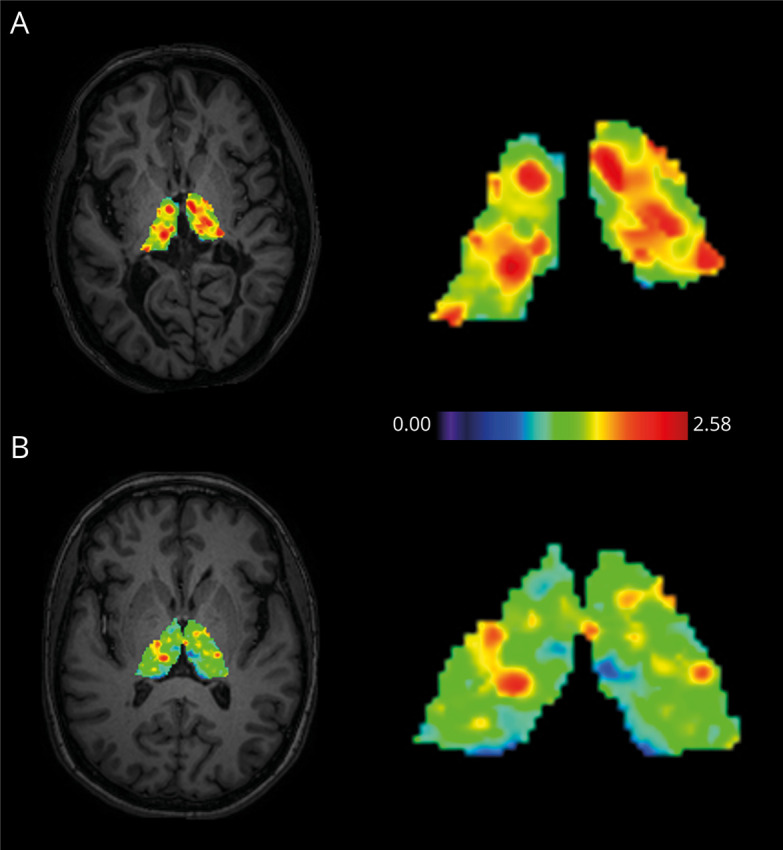
In this prospective imaging study, innate immune cells were investigated in the MS patient brain using PET imaging. The distribution volume ratio (DVR) of the TSPO-binding radioligand [C]PK11195 was determined in 5 GM regions: thalamus, caudate, putamen, pallidum, and cortical GM. Volumetric brain MRI parameters were obtained for comparison. The Expanded Disability Status Scale (EDSS) score was assessed at baseline and after follow-up of 3.0 ± 0.3 (mean ± SD) years. Disability progression was defined as an EDSS score increase of 1.0 point or 0.5 point if the baseline EDSS score was ≥6.0. A forward-type stepwise logistic regression model was constructed to compare multiple imaging and clinical variables in their ability to predict later disability progression.
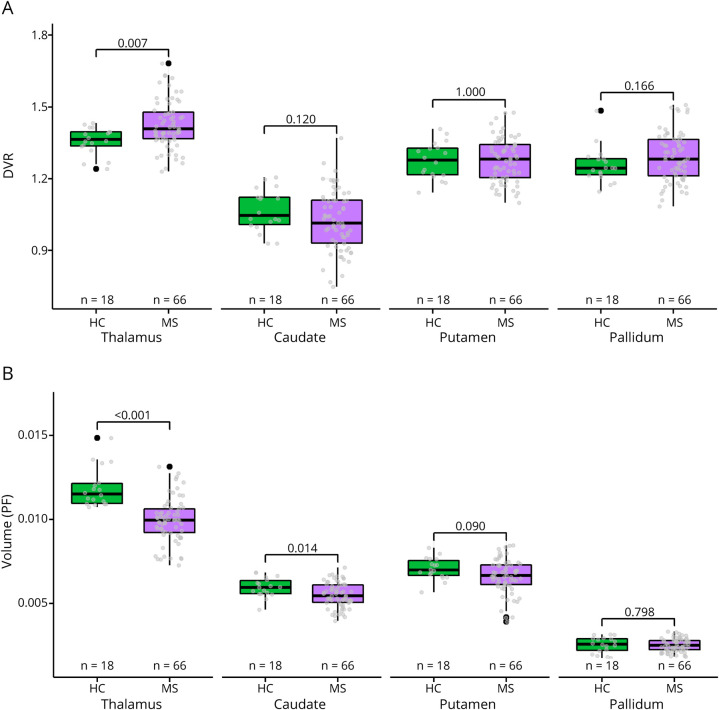
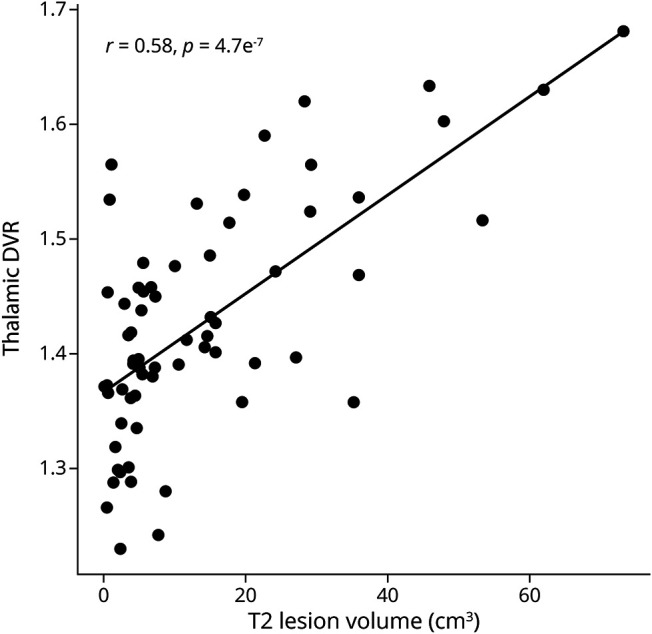
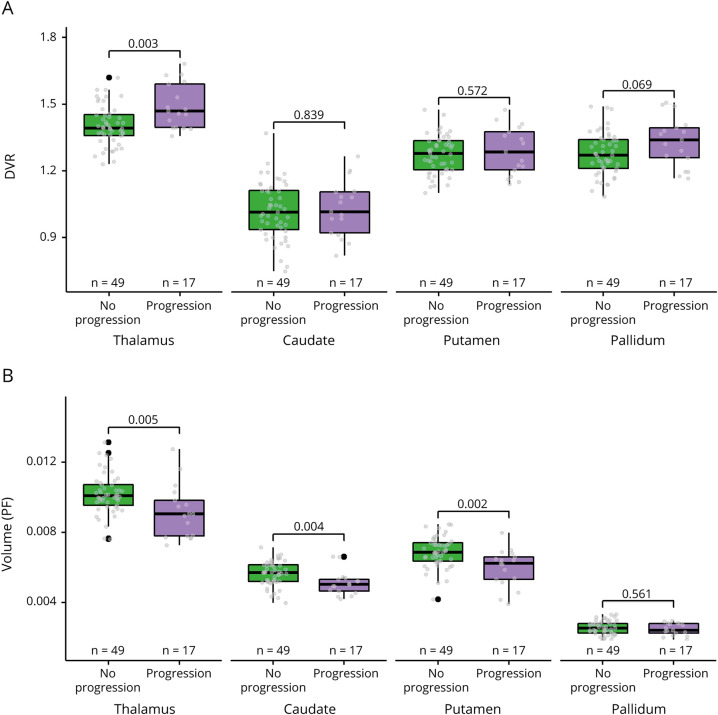
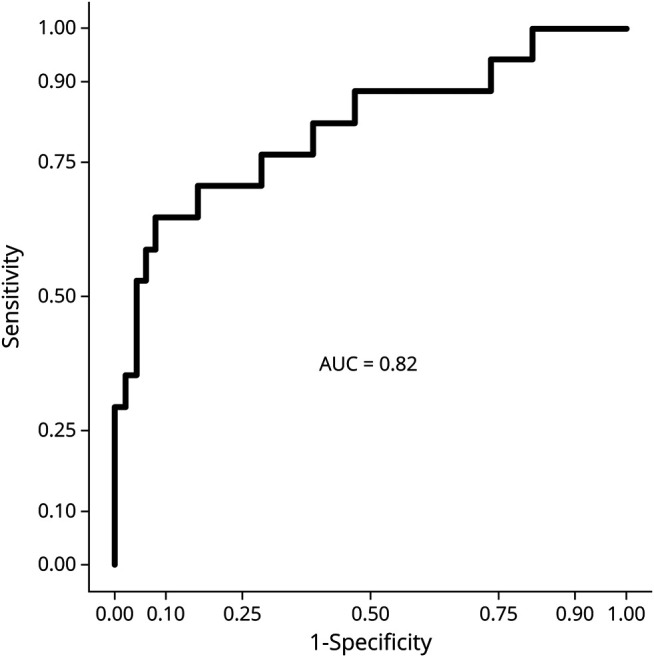
The cohort consisted of 66 patients with MS and 18 healthy controls. Patients with later disability progression (n = 17) had more advanced atrophy in the thalamus, caudate, and putamen at baseline compared with patients with no subsequent worsening. TSPO binding was significantly higher in the thalamus among the patients with later worsening. The thalamic DVR was the only measured imaging variable that remained a significant predictor of disability progression in the regression model. The final model predicted disability progression with 52.9% sensitivity and 93.9% specificity with an area under the curve value of 0.82 (receiver operating characteristic curve).
Increased TSPO radioligand binding in the thalamus has potential in predicting short-term disability progression in MS and seems to be more sensitive for this than GM atrophy measures.
本研究旨在探究灰质(GM)中 18kDa 转位蛋白(TSPO)放射性配体结合是否能预测多发性硬化症(MS)的后续残疾进展。
在这项前瞻性影像学研究中,使用 PET 成像研究了 MS 患者大脑中的固有免疫细胞。测定了 TSPO 结合放射性配体[C]PK11195 在 5 个 GM 区域(丘脑、尾状核、壳核、苍白球和皮质 GM)中的分布容积比(DVR)。为了比较,还获得了容积脑 MRI 参数。在随访 3.0±0.3(平均值±标准差)年后,评估扩展残疾状况量表(EDSS)评分。残疾进展定义为 EDSS 评分增加 1.0 分或基线 EDSS 评分≥6.0 时增加 0.5 分。构建了正向逐步逻辑回归模型,以比较多种影像学和临床变量预测后续残疾进展的能力。
该队列包括 66 例 MS 患者和 18 例健康对照者。与无进一步恶化的患者相比,随后残疾进展的患者(n=17)在基线时丘脑、尾状核和壳核的萎缩更为严重。与无进一步恶化的患者相比,进展患者的丘脑 TSPO 结合明显更高。在回归模型中,只有测量的影像学变量丘脑 DVR 仍然是残疾进展的显著预测因子。最终模型以 52.9%的敏感性和 93.9%的特异性,曲线下面积值为 0.82(接受者操作特征曲线)预测残疾进展。
丘脑 TSPO 放射性配体结合增加可能有助于预测 MS 的短期残疾进展,并且似乎比 GM 萎缩测量更敏感。