School of Life Sciences and Biotechnology, Shanghai Jiao Tong University, 200240, Shanghai, China.
Institute of Natural Sciences, Shanghai Jiao Tong University, 200240, Shanghai, China.
Nat Commun. 2022 May 17;13(1):2714. doi: 10.1038/s41467-022-30315-6.
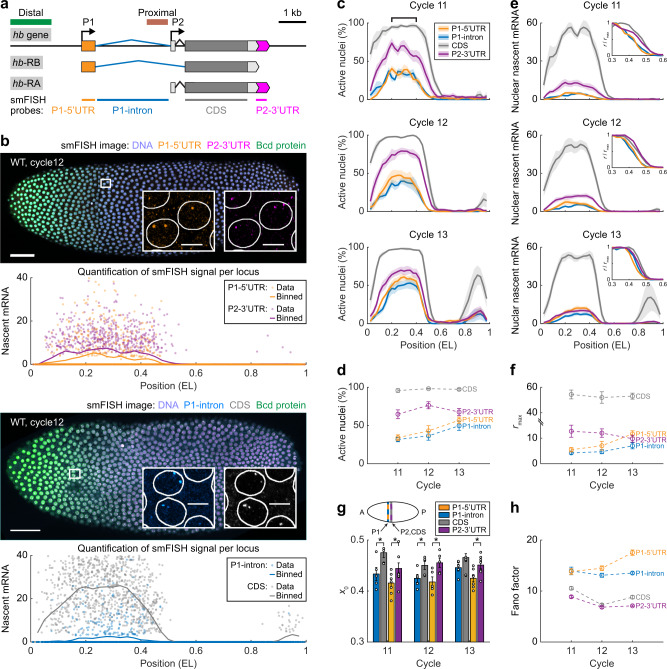
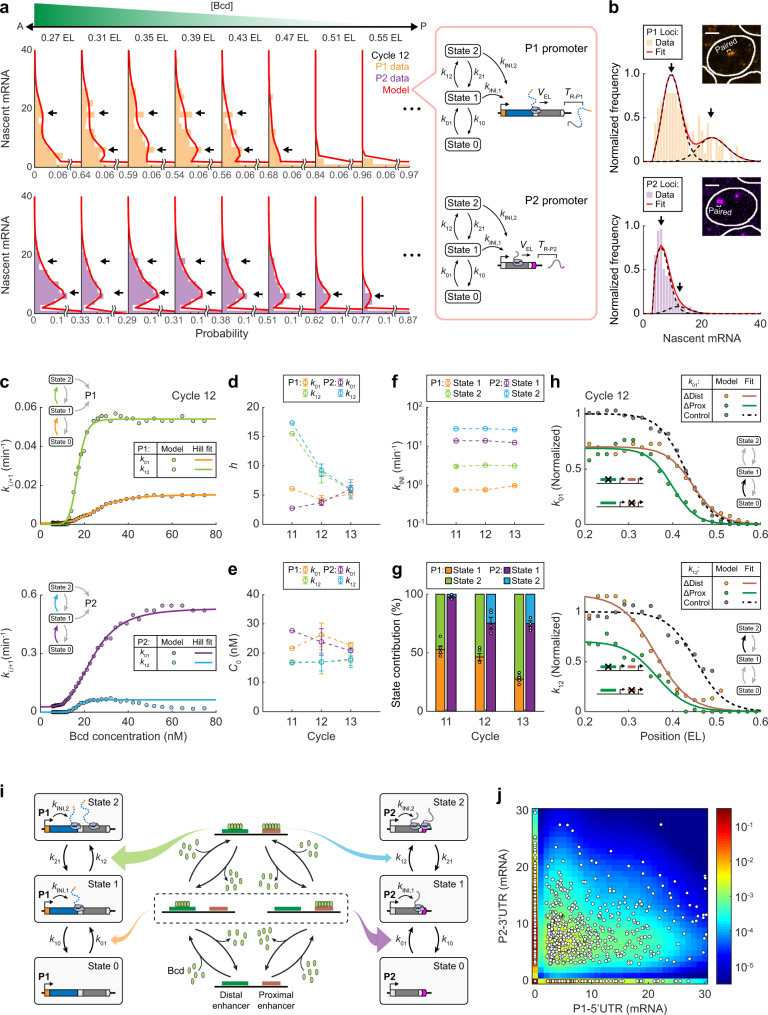
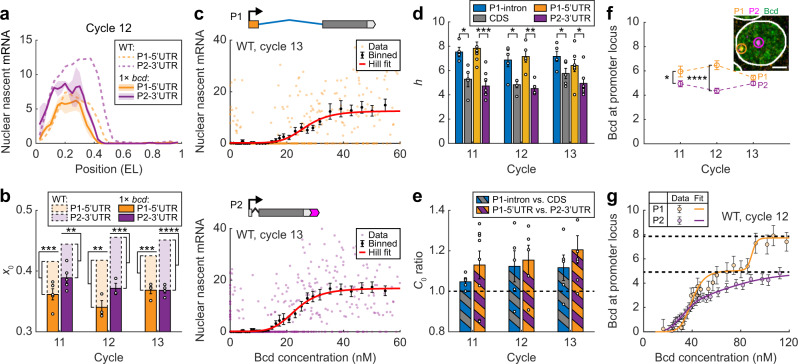
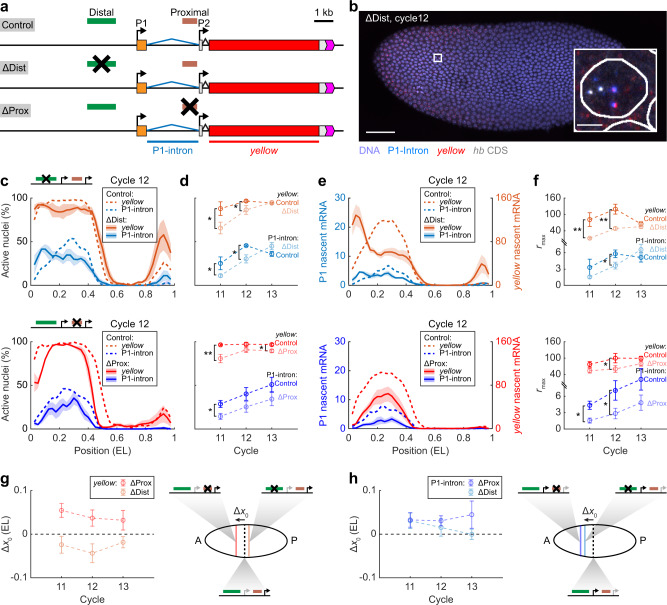
Many eukaryotic genes contain alternative promoters with distinct expression patterns. How these promoters are differentially regulated remains elusive. Here, we apply single-molecule imaging to quantify the transcriptional regulation of two alternative promoters (P1 and P2) of the Bicoid (Bcd) target gene hunchback in syncytial blastoderm Drosophila embryos. Contrary to the previous notion that Bcd only activates P2, we find that Bcd activates both promoters via the same two enhancers. P1 activation is less frequent and requires binding of more Bcd molecules than P2 activation. Using a theoretical model to relate promoter activity to enhancer states, we show that the two promoters follow common transcription kinetics driven by sequential Bcd binding at the two enhancers. Bcd binding at either enhancer primarily activates P2, while P1 activation relies more on Bcd binding at both enhancers. These results provide a quantitative framework for understanding the kinetic mechanisms of complex eukaryotic gene regulation.
许多真核基因包含具有不同表达模式的替代启动子。这些启动子如何被差异化调控仍然难以捉摸。在这里,我们应用单分子成像技术来定量分析合胞胚果蝇胚胎中 Bicoid(Bcd)靶基因 hunchback 的两个替代启动子(P1 和 P2)的转录调控。与之前认为 Bcd 仅激活 P2 的观点相反,我们发现 Bcd 通过相同的两个增强子激活两个启动子。P1 的激活频率较低,需要比 P2 激活更多的 Bcd 分子结合。我们使用一个理论模型将启动子活性与增强子状态相关联,表明这两个启动子遵循由两个增强子上 Bcd 结合的顺序驱动的共同转录动力学。两个增强子上的 Bcd 结合主要激活 P2,而 P1 的激活则更多地依赖于两个增强子上的 Bcd 结合。这些结果为理解复杂真核基因调控的动力学机制提供了一个定量框架。