Department of Preventive Medicine, Yonsei University College of Medicine, 50-1 Yonsei-ro, Seodaemun-gu, Seoul, 03722, South Korea.
Department of Public Health, Yonsei University Graduate School, Seoul, South Korea.
BMC Public Health. 2022 May 17;22(1):995. doi: 10.1186/s12889-022-13409-0.
Public isolated due to the early quarantine regarding coronavirus disease 2019 (COVID-19) increasingly used more social media platforms. Contradictory claims regarding the effect of social media use on mental health needs to be resolved. The purpose of the study was to summarise the association between the time spent on social media platform during the COVID-19 quarantine and mental health outcomes (i.e., anxiety and depression).
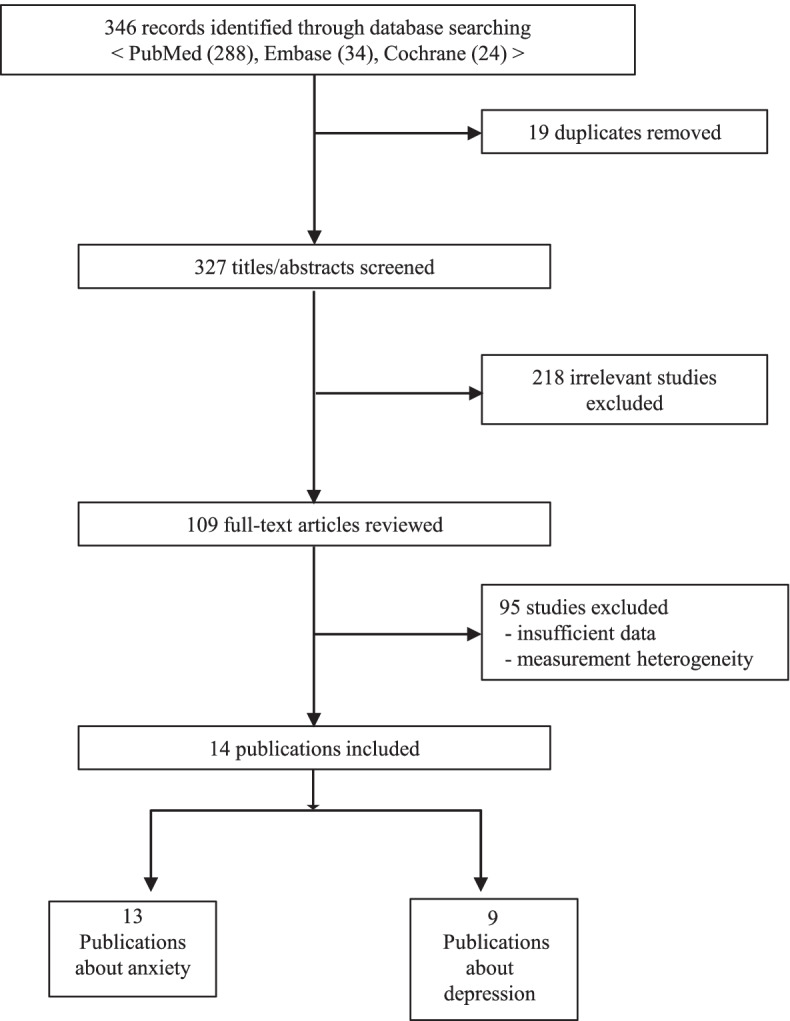
Studies were screened from the PubMed, Embase, and Cochrane Library databases. Regarding eligibility criteria, studies conducted after the declaration of the pandemic, studies that measured mental health symptoms with validated tools, and studies that presented quantitative results were eligible. The studies after retrieval evaluated the association between time spent on social media platform and mental health outcomes (i.e. anxiety and depression). The pooled estimates of retrieved studies were summarised in odds ratios (ORs). Data analyses included a random-effect model and an assessment of inter-study heterogeneity. Quality assessment was conducted by two independent researchers using the Risk of Bias Assessment Tool for Nonrandomized Studies (RoBANS). This meta-analysis review was registered in PROSPERO ( https://www.crd.york.ac.uk/PROSPERO/ , registration No CRD42021260223, 15 June 2021).
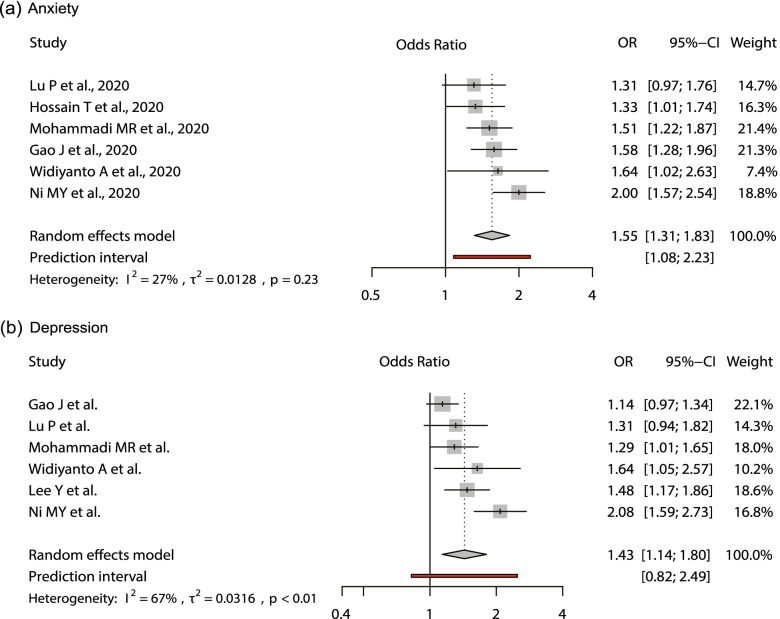
Fourteen studies were included. The increase in the time spent using social media platforms were associated with anxiety symptoms in overall studies (pooled OR = 1.55, 95% CI: 1.30-1.85), and the heterogeneity between studies was mild (I = 26.77%). Similarly, the increase in social media use time was also associated with depressive symptoms (pooled OR = 1.43, 95% CI: 1.30-1.85), and the heterogeneity between studies was moderate (I = 67.16%). For sensitivity analysis, the results of analysis including only the "High quality" studies after quality assessment were similar to those of the overall study with low heterogeneity (anxiety: pooled OR = 1.45, 95% CI: 1.21-1.96, I = 0.00%; depression: pooled OR = 1.42, 95% CI: 0.69-2.90, I = 0.00%).
The analysis demonstrated that the excessive time spent on social media platform was associated with a greater likelihood of having symptoms of anxiety and depression.
由于 2019 年冠状病毒病(COVID-19)的早期隔离,公众越来越多地使用更多的社交媒体平台。需要解决有关社交媒体使用对心理健康影响的相互矛盾的说法。本研究的目的是总结 COVID-19 隔离期间花在社交媒体平台上的时间与心理健康结果(即焦虑和抑郁)之间的关联。
从 PubMed、Embase 和 Cochrane Library 数据库中筛选研究。关于纳入标准,在大流行宣布后进行的研究、使用经过验证的工具测量心理健康症状的研究以及呈现定量结果的研究均符合条件。检索后评估了花在社交媒体平台上的时间与心理健康结果(即焦虑和抑郁)之间的关联。使用比值比(OR)总结检索研究的汇总估计值。数据分析包括随机效应模型和对研究间异质性的评估。两位独立研究人员使用非随机研究的偏倚风险评估工具(RoBANS)进行质量评估。本荟萃分析综述已在 PROSPERO(https://www.crd.york.ac.uk/PROSPERO/ ,注册号 CRD42021260223,2021 年 6 月 15 日)中注册。
纳入了 14 项研究。总体研究中,使用社交媒体平台的时间增加与焦虑症状相关(汇总 OR=1.55,95%CI:1.30-1.85),研究之间的异质性为轻度(I=26.77%)。同样,社交媒体使用时间的增加也与抑郁症状相关(汇总 OR=1.43,95%CI:1.30-1.85),研究之间的异质性为中度(I=67.16%)。对于敏感性分析,质量评估后仅包括“高质量”研究的分析结果与异质性较低的总体研究结果相似(焦虑:汇总 OR=1.45,95%CI:1.21-1.96,I=0.00%;抑郁:汇总 OR=1.42,95%CI:0.69-2.90,I=0.00%)。
分析表明,花在社交媒体平台上的时间过多与出现焦虑和抑郁症状的可能性更大有关。