Fabbrizi Maria Rita, Parsons Jason L
Cancer Research Centre, Department of Molecular and Clinical Cancer Medicine, University of Liverpool, Liverpool L3 9TA, United Kingdom.
Clatterbridge Cancer Centre NHS Foundation Trust, Clatterbridge Road, Bebington CH63 4JY, United Kingdom.
Cancer Drug Resist. 2020 Sep 17;3(4):775-790. doi: 10.20517/cdr.2020.49. eCollection 2020.
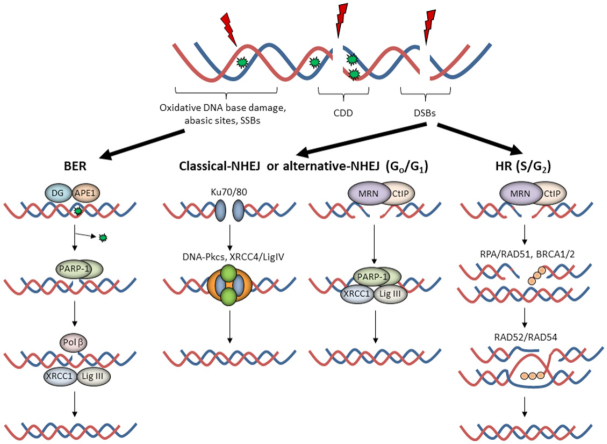
Incidences of head and neck squamous cell carcinoma (HNSCC) have been on the rise in the last few decades, with a significant risk factor being human papillomavirus (HPV) type-16/18 infection, particularly in the development of oropharyngeal cancers. Radiotherapy (RT) is an important treatment modality for HNSCC, where it promotes extensive cellular DNA damage leading to the therapeutic effect. It has been well-established that HPV-positive HNSCC display better response rates and improved survival following RT compared to HPV-negative HNSCC. The differential radiosensitivity has been largely associated with altered cellular DNA damage response mechanisms in HPV-positive HNSCC, and particularly with the signaling and repair of DNA double strand breaks. However, other factors, particularly hypoxia present within the solid cancer, have a major impact on relative radioresistance. Consequently, recent approaches aimed at enhancing the radiosensitivity of HNSCC have largely centered on targeting key proteins involved in DNA repair, DNA damage checkpoint activation, and hypoxia signaling. These studies have utilised and models of HPV-positive and HPV-negative HNSCC and examined the impact of specific inhibitors against the targets in combination with radiation in suppressing HNSCC cell growth and survival. Here, accumulating evidence has shown that targeting enzymes including poly (ADP-ribose) polymerase, ataxia telangiectasia and Rad-3 related, DNA-dependent protein kinase catalytic subunit, and checkpoint kinase 1 can radiosensitise HNSCC cells which should be taken forward in further preclinical studies, with the goal of optimizing the future effective RT treatment of HNSCC.
在过去几十年中,头颈部鳞状细胞癌(HNSCC)的发病率一直在上升,一个重要的风险因素是16/18型人乳头瘤病毒(HPV)感染,尤其是在口咽癌的发生发展中。放射治疗(RT)是HNSCC的一种重要治疗方式,它会促使细胞DNA广泛损伤从而产生治疗效果。已经明确的是,与HPV阴性的HNSCC相比,HPV阳性的HNSCC在放疗后显示出更好的反应率和更高的生存率。这种放射敏感性差异在很大程度上与HPV阳性HNSCC中细胞DNA损伤反应机制的改变有关,特别是与DNA双链断裂的信号传导和修复有关。然而,其他因素,尤其是实体癌中存在的缺氧,对相对放射抗性有重大影响。因此,最近旨在提高HNSCC放射敏感性的方法主要集中在靶向参与DNA修复、DNA损伤检查点激活和缺氧信号传导的关键蛋白上。这些研究利用了HPV阳性和HPV阴性HNSCC的模型,并研究了针对这些靶点的特异性抑制剂与辐射联合使用在抑制HNSCC细胞生长和存活方面的影响。在这里,越来越多的证据表明,靶向包括聚(ADP - 核糖)聚合酶、共济失调毛细血管扩张症和Rad - 3相关蛋白、DNA依赖性蛋白激酶催化亚基以及检查点激酶1在内的酶可以使HNSCC细胞对辐射敏感,这应该在进一步的临床前研究中推进,目标是优化未来HNSCC的有效放疗治疗。