Kekem District Hospital, Kekem, West Region, Cameroon.
Department of Biochemistry, University of Dschang, Dschang, West Region, Cameroon.
PLoS One. 2022 May 18;17(5):e0268643. doi: 10.1371/journal.pone.0268643. eCollection 2022.
Hypocalcaemia remains a prevalent laboratory finding in pregnancy, capable of inducing adverse maternofoetal outcomes. This study compares the prevalence of hypocalcaemia in apparently healthy pregnant women from the ionised, and total calcaemia viewpoints and further identifies factors associated with total crude and ionised hypocalcaemia in pregnancy.
A hospital-based cross-sectional study was conducted between November 2020 and September 2021, targeting apparently healthy pregnant women received in late pregnancy in four maternities in the Nkongsamba Health District, Cameroon. Blood samples were collected and analysed for serum ionised calcium concentrations and pH (by ion-selective electrode potentiometry), and for total calcium and albumin concentration (by atomic absorption spectrophotometry). Sociodemographic, obstetric and nutritional data were collected using an interviewer-administered questionnaire.
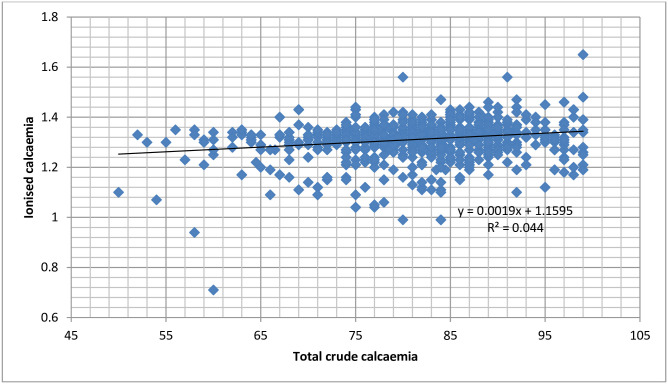
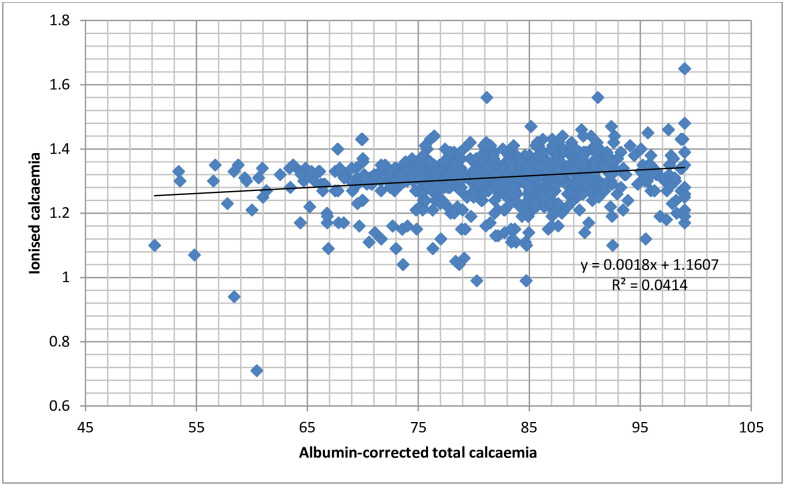
The average age of the 1074 participants included in the study was 28.20±6.08 years. The prevalence of total crude and total albumin-corrected hypocalcaemia in this study was 61.64 [58.69-64.50]% and 56.70 [53.72-59.64]%, respectively (p-value = 0.000). The prevalence of ionised hypocalcaemia was very low (2.89 [2.04-4.07]%) compared with the prevalence of total hypocalcaemia (p-value = 0.000). Monthly income below 100.000FCFA (179 USD) (AOR = 0.73, p-value = 0.024), taking more than 2 meals daily (AOR = 0.68, p-value = 0.006) and taking desserts (AOR = 0.73, p-value = 0.046) reduced the odds of total crude hypocalcaemia, while having banana/plantain and tubers as the content of their most consumed meal significantly increased the odds of total crude hypocalcaemia (AOR = 1.37, p-value = 0.012). Single women (AOR = 2.54, p-value = 0.021), with a higher education (AOR = 3.27, p-value = 0.017), who initiated antenatal care before 4 months (AOR = 2.47, p-value = 0.029), had their odds of ionised hypocalcaemia significantly increased. On the other hand, women below 30 years (AOR = 0.44, p-value = 0.039), with occupations other than housewife (AOR = 0.34, p-value = 0.027), and women who took desserts between meals (AOR = 0.45, p-value = 0.034) had their odds of ionised hypocalcaemia significantly reduced. Taking calcium supplements simultaneously with other supplements also significantly reduced the odds of total hypocalcaemia in pregnancy (OR = 0.69, p-value = 0.027).
Ionised hypocalcaemia in pregnancy is a rare finding. Only 2.89% of all apparently healthy pregnant women have ionised hypocalcaemia in late pregnancy, while 56.70% have total hypocalcaemia. Factors like the daily number of meals, taking of desserts, the content of the most consumed meal and monthly revenue significantly affect the prevalence of total hypocalcaemia in pregnancy. On the other hand, factors like age above 30 years, having a higher education, being single, having initiated antenatal care before 4 months of pregnancy, being a housewife and not taking desserts between meals have a significantly positive association with ionised hypocalcaemia.
低钙血症在妊娠中仍然是一种常见的实验室发现,能够引起母婴不良结局。本研究比较了从离子和总钙的角度来看,在妊娠中健康孕妇的低钙血症的患病率,并进一步确定了与妊娠总钙和离子钙降低相关的因素。
这是一项在 2020 年 11 月至 2021 年 9 月期间进行的基于医院的横断面研究,目标人群是喀麦隆 Nkongsamba 卫生区四家妇产科晚期妊娠的健康孕妇。采集血样,通过离子选择性电极电位法检测血清离子钙浓度和 pH 值,通过原子吸收分光光度法检测总钙和白蛋白浓度。使用访谈员管理的问卷收集社会人口学、产科和营养数据。
本研究共纳入 1074 名参与者,平均年龄为 28.20±6.08 岁。在这项研究中,总钙粗降和总白蛋白校正低钙血症的患病率分别为 61.64[58.69-64.50]%和 56.70[53.72-59.64]%(p 值=0.000)。与总低钙血症相比,离子钙降低的患病率非常低(2.89[2.04-4.07]%)(p 值=0.000)。月收入低于 100000 非洲法郎(179 美元)(AOR=0.73,p 值=0.024)、每天吃超过 2 餐(AOR=0.68,p 值=0.006)和吃甜点(AOR=0.73,p 值=0.046)降低了总钙粗降的几率,而香蕉/芭蕉和块茎作为最常食用的食物的含量显著增加了总钙粗降的几率(AOR=1.37,p 值=0.012)。单身女性(AOR=2.54,p 值=0.021)、受过高等教育(AOR=3.27,p 值=0.017)、在 4 个月前开始产前保健(AOR=2.47,p 值=0.029)的女性,其离子钙降低的几率显著增加。另一方面,年龄在 30 岁以下(AOR=0.44,p 值=0.039)、职业非家庭主妇(AOR=0.34,p 值=0.027)和两餐之间吃甜点的女性(AOR=0.45,p 值=0.034),其离子钙降低的几率显著降低。同时服用钙补充剂和其他补充剂也显著降低了妊娠总钙降低的几率(OR=0.69,p 值=0.027)。
妊娠中的离子钙降低是一种罕见的发现。只有 2.89%的健康孕妇在妊娠晚期有离子钙降低,而 56.70%的孕妇有总钙降低。每天进餐次数、吃甜点、最常食用食物的含量和月收入等因素显著影响妊娠总钙降低的患病率。另一方面,年龄在 30 岁以上、受过高等教育、单身、在 4 个月前开始产前保健、家庭主妇和两餐之间不吃甜点等因素与离子钙降低有显著的正相关。