Lampert Thomas, Hoebel Jens, Kroll Lars Eric
Robert Koch Institute, Berlin Department of Epidemiology and Health Monitoring.
Formerly Robert Koch Institute, Berlin Department of Epidemiology and Health Monitoring.
J Health Monit. 2019 Mar 14;4(1):3-14. doi: 10.25646/5872. eCollection 2019 Mar.
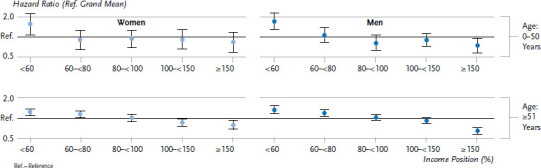
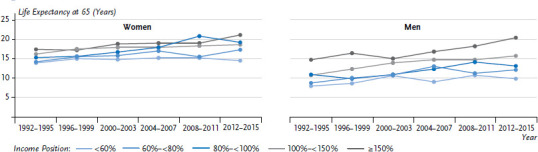
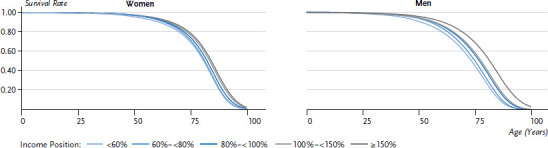
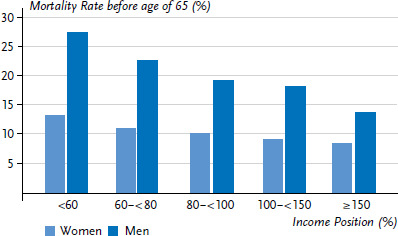
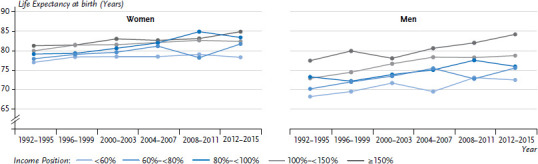
Social differences in mortality and life expectancy are a clear demonstration of the social and health-related inequalities that exist within a particular population. According to data from the Socio-Economic Panel (SOEP) for the period ranging from 1992 to 2016, 13% of women and 27% of men in the lowest income group died before the age of 65; the same can be said for just 8% of women and 14% of men in the highest income group. The difference between mean life expectancy at birth among the lowest and highest income groups is 4.4 years for women and 8.6 years for men. Substantial differences also exist between income groups regarding further life expectancy at the age of 65: women in the lowest income group have a 3.7-year shorter life expectancy than women in the highest income group. Similarly, men in the lowest income group have a 6.6-year shorter life expectancy than men in the highest income group. Finally, results from the trend analyses suggest that social differences in life expectancy have remained relatively stable over the last 25 years.
死亡率和预期寿命方面的社会差异清楚地表明了特定人群中存在的与社会和健康相关的不平等现象。根据社会经济面板(SOEP)提供的1992年至2016年期间的数据,收入最低群体中有13%的女性和27%的男性在65岁之前死亡;而在收入最高群体中,这一比例仅为8%的女性和14%的男性。最低和最高收入群体之间出生时的平均预期寿命差异,女性为4.4岁,男性为8.6岁。在65岁时的剩余预期寿命方面,收入群体之间也存在显著差异:收入最低群体的女性比收入最高群体的女性预期寿命短3.7岁。同样,收入最低群体的男性比收入最高群体的男性预期寿命短6.6岁。最后,趋势分析结果表明,在过去25年中,预期寿命的社会差异一直相对稳定。