Brønnum-Hansen Henrik
Faculty of Health Sciences, Department of Public Health, University of Copenhagen, Copenhagen, Denmark.
BMJ Open. 2017 May 17;7(5):e014489. doi: 10.1136/bmjopen-2016-014489.
Social inequality trends in life expectancy are not informative as to changes in social disparity in the age-at-death distribution. The purpose of the study was to investigate social differentials in trends and patterns of adult mortality in Denmark.
Register data on income and mortality from 1986 to 2014 were used to investigate trends in life expectancy, life disparity and the threshold age that separates 'premature' and 'late' deaths. Mortality compression was quantified and compared between income quartiles.
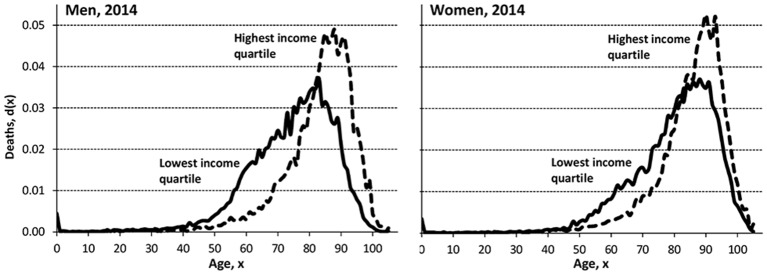
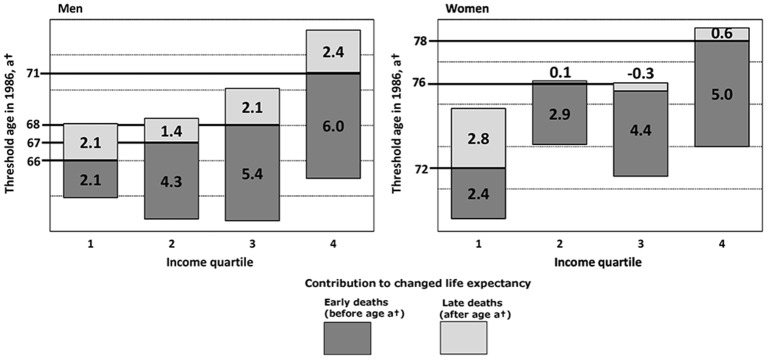
Since 1986, male life expectancy increased by 4.2 years for the lowest income quartile and by 8.4 years for the highest income quartile. The clear compression of mortality apparent in the highest income quartile did not occur for the lowest income quartile. Premature and late deaths accounted both by 2.1 years of the increase in life expectancy in the lowest income quartile and by 6.0 and 2.4 years, respectively, in the highest income quartile. Life expectancy increased by 5.2 years among women in the lowest income quartile, 2.4 years due to premature deaths and 2.8 years due to late deaths. The gain in life expectancy among women in the highest income quartile of 5.6 years was distributed by 5.0 and 0.6 years due to premature and late deaths, respectively.
The study demonstrates that the increasing social gap in mortality appears differently in the change of the age-at-death distribution. Thus, no compression of mortality was seen in the lowest income quartile. The results do not provide support for a uniformly extension of pension age for all.
预期寿命方面的社会不平等趋势并不能说明死亡年龄分布的社会差距变化情况。本研究的目的是调查丹麦成年人死亡率趋势和模式中的社会差异。
利用1986年至2014年的收入和死亡率登记数据,研究预期寿命趋势、寿命差距以及区分“过早”和“过晚”死亡的临界年龄。对收入四分位数之间的死亡率压缩情况进行量化和比较。
自1986年以来,收入最低四分位数组的男性预期寿命增加了4.2岁,收入最高四分位数组的男性预期寿命增加了8.4岁。收入最高四分位数组明显出现的死亡率压缩在收入最低四分位数组并未出现。在收入最低四分位数组中,过早死亡和过晚死亡分别占预期寿命增加的2.1岁;在收入最高四分位数组中,过早死亡和过晚死亡分别占预期寿命增加的6.0岁和2.4岁。收入最低四分位数组的女性预期寿命增加了5.2岁,其中过早死亡导致增加2.4岁,过晚死亡导致增加2.8岁。收入最高四分位数组的女性预期寿命增加了5.6岁,其中过早死亡导致增加5.0岁,过晚死亡导致增加0.6岁。
该研究表明,死亡率方面不断扩大的社会差距在死亡年龄分布变化中呈现出不同的情况。因此,在收入最低四分位数组中未观察到死亡率压缩现象。研究结果不支持对所有人统一提高退休年龄。