Zhan Jingye, Yang Kangdi, Sun Zhuoer, Bai Lingling, Lu Xiaoying, Wang Xiuhong, Liu Weizhi, Yi Chen, Wang Lina
Lab for Post-traumatic Stress Disorder, Faculty of Psychology and Mental Health, Naval Medical University, Shanghai, China.
Department of Traditional Chinese Medicine, Naval Medical University, Shanghai, China.
Front Psychiatry. 2022 May 2;13:883590. doi: 10.3389/fpsyt.2022.883590. eCollection 2022.
A number of studies have documented that coronavirus disease 2019 (COVID-19) brought more negative impact on the physical and psychological functioning of frontline healthcare workers. Especially, sleep quality was focused. This study aimed to investigate the sleep quality of frontline healthcare workers, risk factors for sleep quality, and the effect of Tai Chi training.
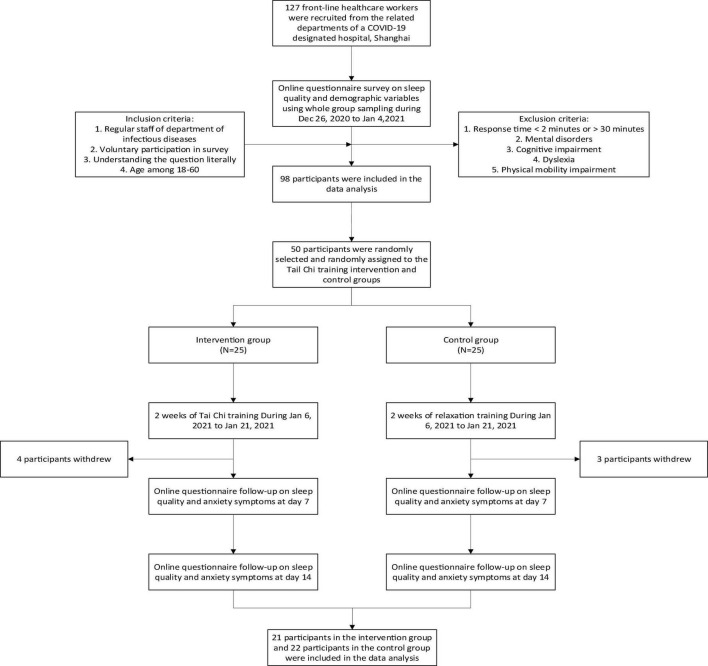
A total of 98 frontline healthcare workers were recruited, coming from the infection department, fever clinic, laboratory, and medical imaging department in a COVID-19-designated hospital in Shanghai. Of them, 50 participated in a 2-week intervention and were randomized to receive a Tai Chi training or relaxation training. Participants were assessed at baseline, 7 and 14 days after participation. Demographic information, sleep quality, and anxiety were measured by using the demographic questionnaire, Pittsburgh Sleep Quality Index (PSQI) and Beck Anxiety Inventory (BAI).
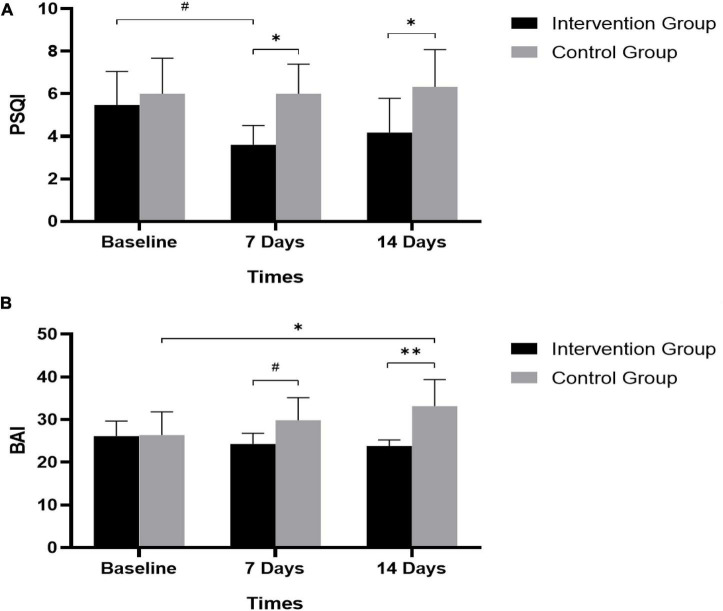
13.3% participants were above the cut-off score (>10) for the PSQI. Regression analysis showed gender, age, working years, and job category had effect on sleep quality. Compared to the control group, participants in the Tai Chi training group had lower scores on both PSQI ( < 0.05) and BAI ( < 0.01) after the 2-week intervention.
It was demonstrated that poor sleep quality existed in the frontline healthcare workers, which was related to gender, age, working years, and job category. Tai Chi training can dramatically improve their sleep quality and reduce anxiety symptoms.
多项研究表明,2019年冠状病毒病(COVID-19)对一线医护人员的身体和心理功能产生了更多负面影响。尤其是睡眠质量受到关注。本研究旨在调查一线医护人员的睡眠质量、睡眠质量的危险因素以及太极拳训练的效果。
共招募了98名一线医护人员,他们来自上海一家COVID-19定点医院的感染科、发热门诊、实验室和医学影像科。其中,50人参加了为期2周的干预,并被随机分为接受太极拳训练或放松训练。在基线、参与后7天和14天对参与者进行评估。使用人口统计学问卷、匹兹堡睡眠质量指数(PSQI)和贝克焦虑量表(BAI)测量人口统计学信息、睡眠质量和焦虑情况。
13.3%的参与者PSQI得分高于临界值(>10)。回归分析表明,性别、年龄、工作年限和工作类别对睡眠质量有影响。与对照组相比,太极拳训练组的参与者在为期2周的干预后,PSQI得分(<0.05)和BAI得分(<0.01)均较低。
结果表明,一线医护人员存在睡眠质量差的情况,这与性别、年龄、工作年限和工作类别有关。太极拳训练可以显著改善他们的睡眠质量并减轻焦虑症状。